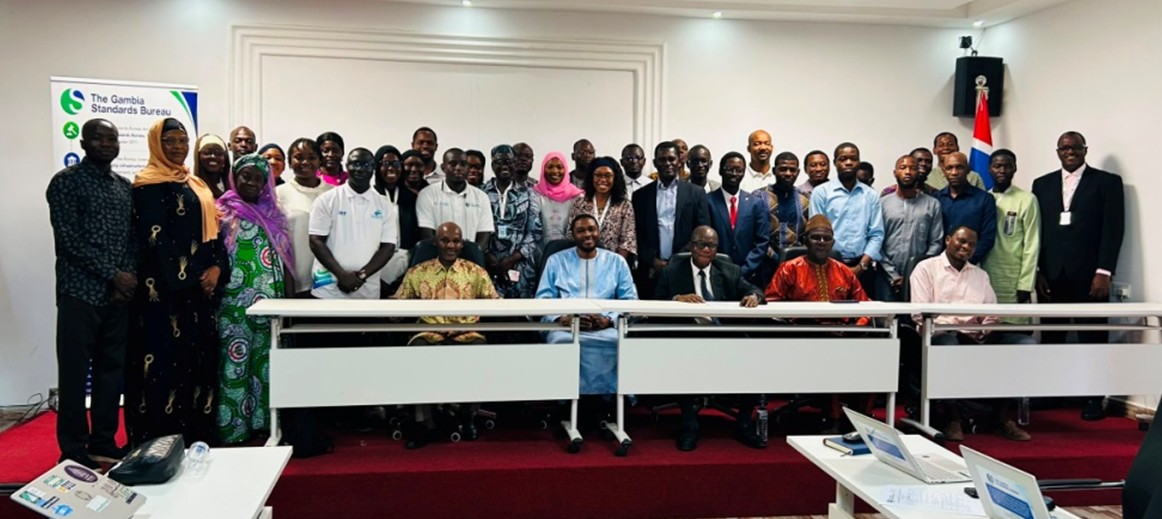
The event brought together key stakeholders from government institutions, regulatory bodies, the private sector, academia, development partners, and civil society to review and provide input on the document.
“The strategic plan will be operationalised through activities and initiatives in the implementation plan and monitoring and evaluation matrices. We commit to deploy the balanced scorecard as the tool for execution and monitoring,” Papa Secka, Director General of the Bureau, told the stakeholders.
Secka said the strategic plan is to create value for their customers, suppliers, partners and employees. He said this is aligned with their organisational culture on how the bureau achieves results.
Secka said the plan is well aligned with the African Union 2063 Agenda and the Sustainable Development Goals.
“TGSB supports the development of Gambian industries by providing standards and conformity assessment services that help businesses to improve the quality of their products and services,” he said.
For his part, Chairman of the Board of Directors of the Gambia Standards Bureau, Dr Ernest Aubee, said the plan would define the road map, not just for the Bureau, but for everything related to quality infrastructure, standard setting and conformity assessment in the country. He said that, as a result, the plan would help them contribute to the evolving economic transformation of the Gambia.
“It is therefore gratifying to note that from the first plan to date, over 500 standards have been developed in various sectors of the Gambian economy. That is an achievement, and I think you should clap for yourself,” he told the bureau staff.
DrAubee challenged the participants to look at the strategic plan with a professional lens, to make sure that it becomes the ideal document for the country. He said they cannot afford to have a substandard document.
DrAubee stressed that a substandard document would be unacceptable, and would not be accepted by the government.
“What we want to see in terms of The Gambia is to ensure that our goods and services are competitive, locally and internationally. And also, we want to safeguard the living conditions, whether it is food security, whether it is health security, whether it is environmental security. We want to safeguard the living conditions of all Gambians because Gambians deserve the best and nothing less than the best,” he said.
Meanwhile,LaminCamara, Permanent Secretary, Ministry of Trade and Regional Integration, said the strategy plan will not only guide the Bureau's work over the next five years, but will also strengthen its capacity to effectively fulfill its national mandate in standardisation, conformity assessment, methodology, and consumer protection.
Camara said standards are far more than technical specifications. He said they are strategic instruments for economic transformation, industrial development, and international trade.
“In today's increasingly integrated global economy, countries compete not only on price, but also on quality, safety, reliability, and compliance with internationally recognised standards. A country's competitiveness is therefore closely linked to the strength of its national quality infrastructure,” he said.