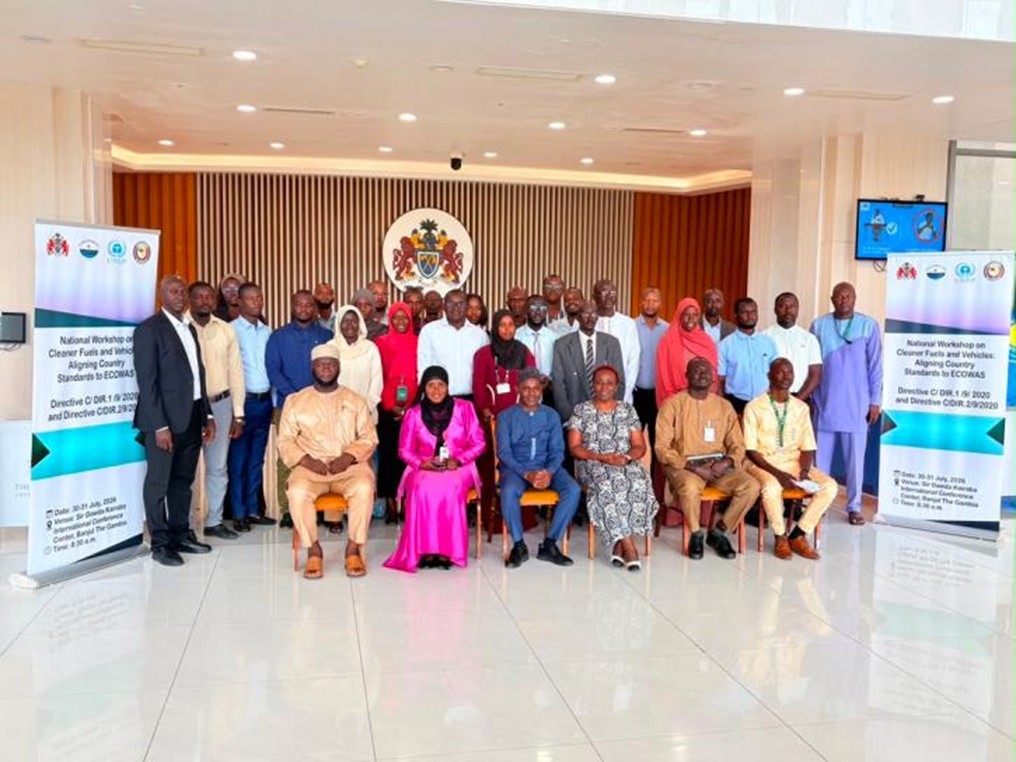
The commitment was made during a two-day national workshop held at the Sir Dawda Kairaba Jawara International Conference Centre, where government institutions, development partners, regulators and environmental experts gathered to assess The Gambia’s progress in implementing the regional directives.
Deputy Executive Director, Njagga Touray, in his remarks mentioned that air pollution has become one of the country’s most pressing environmental and public health concerns, largely driven by emissions from the transport sector.
He said the workshop provides an opportunity for stakeholders to review progress made, identify implementation challenges and agree on a practical roadmap with clear responsibilities and timelines.
“The transport sector remains a significant source of harmful pollutants, including particulate matter, nitrogen oxides and greenhouse gases, which contribute to respiratory and cardiovascular diseases, environmental degradation and climate change,” he said.
Touray further noted that cleaner fuels and improved vehicle emission standards would reduce pollution, lower healthcare costs, improve fuel efficiency and help The Gambia fulfil its obligations under the Paris Agreement, the Sustainable Development Goals and other international environmental commitments.
Touray also disclosed that the NEA is strengthening environmental monitoring by installing air quality monitoring equipment to generate reliable data that will guide policy decisions and measure progress toward cleaner air.
He stressed that successful implementation of the ECOWAS directives would require strong collaboration among government institutions, fuel importers, vehicle dealers, standards authorities, customs officials, academia, development partners and the transport sector.
“The roadmap that emerges from this workshop should be realistic, inclusive and action-oriented,” he said.
United Nations Environment Programme (UNEP) representative, Jane Akumu, urged The Gambia to move beyond policy adoption and begin implementing the clean fuel standards without further delay.
She recalled that discussions on cleaner fuels in Africa began more than two decades ago with the successful elimination of leaded petrol, but said high sulphur fuel remains a major threat to public health.
Akumu cited recent research indicating that vehicle emissions contribute to one premature death every 45 minutes globally and about 250,000 new cases of childhood asthma each year.
She noted that several African countries have already adopted cleaner fuel standards, with East African countries implementing 10 parts per million sulphur fuel, and Morocco advancing to Euro 6 vehicle emission standards.
“The standards being proposed for ECOWAS are not overly ambitious. They are standards that Europe implemented in 2005, and they offer significant health benefits,” she said.
Director General of the Gambia Standards Bureau, Papa Secka, in his keynote address acknowledged that while The Gambia updated its fuel quality standards following the adoption of the ECOWAS directives in 2020, implementation has remained slow due to several bottlenecks.
He revealed that the country completed and published national vehicle emission standards in 2022 but admitted that compliance with fuel quality requirements, particularly sulphur limits, remains inconsistent.
“The level of sulphur in our fuel still remains extremely high and must be addressed if we are to achieve the objectives of the ECOWAS directives,” Secka said.
He also called for stronger regulation of imported second-hand vehicles, warning that ageing vehicles contribute not only to air pollution but also to road traffic accidents.
Secka encouraged the NEA and other regulators to begin enforcing existing standards where possible, even before new regulations are finalised, while intensifying public awareness campaigns.