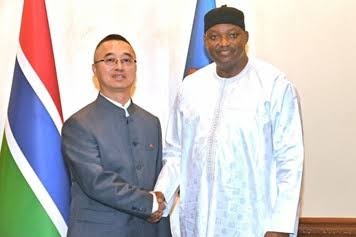
As the newly appointed Ambassador Extraordinary and Plenipotentiary of the People's Republic of China to the Republic of The Gambia, I arrived on 7November at Africa's Smiling Coast. The gentle sea breeze and warm welcome immediately made me feel at home. President Adama Barrow received my Letters of Credence at the earliest date, and I am greatly encouraged by his strong commitment to furthering China-Gambia relations. I have brought with me sincere greetings and best wishes of the people of China to the people of The Gambia, and have already had the pleasure of meeting many Gambian friends. Along with their warm welcome, many friends raised some thought-provoking questions: How has the Communist Party of China (CPC) managed to achieve the twin miracles of long-term social stability and rapid economic development? How does it translate its commitment to “serving the people” into concrete action? And what does the CPC’s self-revolution mean for the world? I would like to share some of my thoughts on these questions.
Shortly before my arrival in The Gambia, the CPC convened the Fifth Plenary Session of its 20th Central Committee. The meeting deliberated and adopted the Resolution of the CPC Central Committee on Persevering with Full and Rigorous Party Self-Governance. To put it in the words of ordinary Chinese people, the central message of the meeting is that “to forge good steel, one must first be a good blacksmith.” At its heart lies a question n that matters to every political party: How can those entrusted with power remain true to their original ideals and avoid corruption and degeneration? How can a government ensure that its attention and resources are always directed towards the dining tables, school desks, and hospital beds of ordinary people?
Self-Revolution Is Not a Slogan, but a Daily Commitment
The CPC has a concept known as “self-revolution”. In reviewing the Party's 105-year history since its founding, the recent plenary session identified “letting the people oversee the government” and “the Party’s self-revolution” as the two answers the CPC has found to the question of how to escape the historical cycle of rise and fall.
What, then, does self-revolution mean? It means having the courage to turn the blade inward, exercising full and rigorous Party self-governance, preserving the Party's advanced nature and purity, and continuously strengthening its capacity to purify, improve, renew, and excel itself.
The CPC’s ability to pursue self-revolution rests on a robust institutional framework that operates on a regular and sustained basis. This includes rigorously conducting political activities within the Party, making persistent efforts to improve Party conduct and enforce Party discipline, taking coordinated steps to ensure that officials do not have the audacity, opportunity, or desire to commit corruption, and continuously improving the oversight system.
The “Last Mile” of Governance Lies at the Grassroots
Even the best policies are nothing more than words on paper if they cannot be implemented in the most remote villages and at the grassroots level. The Resolution places particular emphasis on strengthening grassroots governance under the leadership of Party building. This means that Party community officials are right there among the people, responding to people's concerns at the community level. Another example is China’s government service hot-line 12345, which provides an efficient channel for all citizens to seek assistance whenever they encounter difficulties, discover loopholes of the job of the government, or misconduct of government agencies and officials.Such institutional arrangements ensure that people's immediate needs and concerns can receive timely responses.
At the end of the day, the governance capacity of a government or political party is not measured by how many meetings it holds in the capital, but by whether it is willing and able to hear the voices of people in the most remote villages.
Policies Can Only Be Delivered Through People
No matter how extensive the grassroots governance network may be, it is ultimately individual officials who knock on people's doors and help them resolve their problems.
The plenary session attaches great importance to “building a high-caliber contingent of officials capable of shouldering the mission of national rejuvenation”. It also makes clear that “the key to exercising full and rigorous Party self-governance lies in exercising strict management over officials”.
No towering tree can grow in a greenhouse. CPC officials must go among the people and work on the front lines where problems arise if they are to truly understand the people. During China's fight against poverty, CPC dispatched more than three million first secretaries and resident village officials across the country, working alongside local officials on the front lines of poverty alleviation. They learned how to engage with local people not in conference rooms, but on muddy roads and along the ridges of fields.
The Ultimate Purpose of Self-Revolution Is to Improve People’s Lives
China’s experience demonstrates that exercising full and rigorous Party self-governance can unleash tremendous governance capacity.
When an organizational system is well coordinated from top to bottom and ensures effective implementation, and when officials possess both firm convictions and the competence to deliver, policies and decisions can be translated from top-level design into concrete action in the fields and villages. This, in turn, advances Chinese modernization as a whole.
At the end of the day, exercising strict discipline within the Party and building a capable contingent of officials are not ends in themselves. The real purpose is to better develop the country and serve the people.
How relevant is the CPC’s Self-Revolution to the World?
The CPC’s self-revolution is the key fitting to China’s condition in the first place. By combining the Party's own oversight with oversight by the people, the CPC has expanded the theory and practice of political party’s building. Its experience offers a public good for global governance and provides valuable insights for the international community in addressing challengesof self-governance faced by each and every country.
Full and rigorous Party self-governance is not only an important guarantee for China’s development, but also a source of vitality that has enabled the CPC to remain dynamic after more than a century. Through its continued pursuit of self-revolution, China is more capable of advancing high-quality development and further expanding its opening up, thereby creating greater opportunities for cooperation with partners around the world, including The Gambia.
Conclusion
Africa is a continent brimming with hope and holds a pivotal place in the future of global development. Although I have been in The Gambia for only a short time, I have already witnessed first-hand the remarkable development achievements that the Gambian people have made through unity and hard work in recent years.
My arrival coincides with the 10th anniversary of the resumption of diplomatic relations between China and The Gambia. Under the strategic guidance of President Xi Jinping and President Adama Barrow, our bilateral relations have been elevated to a strategic partnership. China and The Gambia are sincere partners on the path towards development and national rejuvenation. Both countries face the important tasks of developing their economies, improving people’s livelihoods and strengthening governance.
China stands ready to not only continue promoting practical cooperation that delivers tangible benefits to the peoples of both countries, but also share with each other experiences in state governance and capacity building.
Political parties in The Gambia are committed to the country’s development and the well-being of its people. During exchanges with their Chinese counterparts on governance and administration, Gambian participants expressed a deep sense of resonance about the people-centered governing philosophy. It’s my conviction that the governance experiences of China and The Gambia can transcend geographical distance, inspire one another, and offer mutual insights.
After all, no country can claim to have graduated with full marks when it comes to serving the people. In this regard, we are all forever on the way.