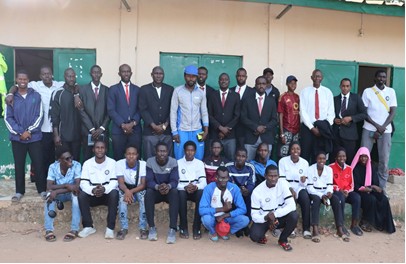
The two-in-one training programme, held at the Old Yundum High School Hall, brought together participants from various affiliated karate clubs.
The training focused on referee theory and coaching techniques ahead of the upcoming national and international competitions.
The referee session was led by the Federation’s Technical Director, Pateh Jobe, with support from Eliman Njie, a national referee under the federation.
Technical Director Jobe broke down the rigorous requirements of modern karate competition, emphasising that success on the mat begins with a deep understanding of the World Karate Federation (WKF) regulatory framework.
"To maintain the integrity of the sport, officials must be vigilant," Jobe noted during his presentation.
"The flow and discipline of a contest depend entirely on the referee’s ability to manage match procedures and timing with absolute precision," he stated.
Njie shifted the focus towards the high-stakes environment of live officiating, providing a masterclass on the application of the WKF scoring system and the enforcement of match discipline.
"Consistency is the backbone of any fair contest," Njie remarked while addressing the assembly of officials.
"Our role is to ensure that every point awarded and every penalty issued aligns strictly with international standards, leaving no room for ambiguity," he said.
Coaching Module
The second phase of the seminar focused on coaching theory and athlete management, led by National Team Coaches Mbaye Nyang (Kumite) and Alieu Nyang (Kata).
The duo framed coaching as a discipline equal in rigour to the sport itself.
"A coach’s impact extends far beyond technical instruction," Mbaye Nyang asserted.
"From professional dress codes to managing an athlete’s headspace before a match, leadership is defined by discipline and the professional conduct we maintain within the venue."
Complementing this, Alieu Nyang described the training as a "critical technical step" for Gambian karate. His session focused on the psychological and strategic demands placed on those sitting in the coach’s chair.
"Effective coaching is a balance of strategy and support," Alieu explained.
"On the tatami, you are the strategist; off it, you are the mentor. Our goal is to provide the psychological guidance that allows an athlete to execute under pressure," he stated.
The Federation concluded the session by noting these reforms are important preparations for the 2026 competitive season, ensuring local clubs are ready for the international stage.