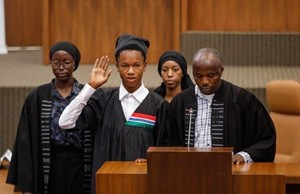
Born and raised in Farafenni town in The Gambia’s North Bank Region, Babacarr Sowe’s journey is one defined by service, resilience, and an unwavering commitment to amplifying the voices of children.
Babacarr began his early education at Farafenni Barracks Nursery School before moving on to Farafenni Proper Lower Basic School and later Farafenni Upper Basic School, where he obtained his GABECE certificate. Even at a young age, leadership came naturally to him, as he actively participated in student leadership roles throughout his basic education.
Driven by a growing ambition to learn and serve on a wider scale, he enrolled at Masroor Senior Secondary School, where he served as Assembly Prefect for one year. He later transferred to Nusrat Senior Secondary School, where he completed his secondary education and earned his WASSCE certificate. Today, Babacarr aspires to study Psychology at the University of The Gambia, inspired by a deep passion to support vulnerable individuals particularly children living with trauma, abuse, neglect, and unseen emotional scars.
“Mental well-being is still underrated in The Gambia,” he says, noting that many children suffer in silence because they feel unsafe speaking about their experiences.
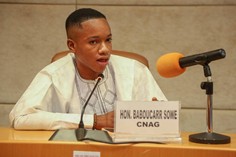 Babacarr’s advocacy journey began in Class 8 after he was exposed to child protection and empowerment initiatives through an Italian-supported project implemented by COOPI. The experience awakened his passion for children’s rights and advocacy. By Class 9, he was already participating in weekly radio programs and child-rights-themed competitions, gaining confidence to speak publicly on issues affecting children.
Inspired to do more, Babacarr joined the Children’s National Assembly Congress in 2021, determined to fight injustice, challenge harmful social norms, and restore hope to young lives. This commitment later motivated him to contest for and secure the position of National Speaker of the Children’s National Assembly.
His motivation, he explains, stemmed from a desire to transform ideas into tangible impact, ensure children’s voices are not only heard but reflected in policies, and build meaningful initiatives that genuinely improve children’s lives across The Gambia.
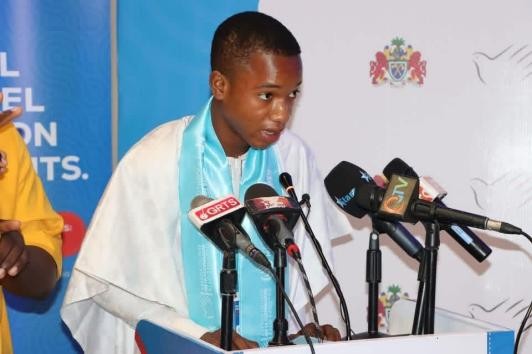 As National Speaker, Babacarr represents children nationwide, chairs Assembly sittings, monitors progress on calls to action, and promotes inclusivity ensuring child-led initiatives are impactful and inclusive. Balancing leadership with academics has not been easy, but through discipline, time management, and careful planning, he continues to excel in both.
“Discipline, honesty, and humility are the foundations of young leadership,” he believes. “No matter your abilities, humility shapes how people trust you, support you, and share knowledge with you.”
The Children’s National Assembly, he explains, provides a structured platform for children to express their concerns at regional, national, and even international levels. Through consultations, school outreaches, and community dialogues, the Assembly gathers children’s experiences and presents them to relevant stakeholders, advocating for child-friendly policies and inclusive decision-making.
Among the most pressing challenges facing Gambian children, Babacarr identifies child marriage, child abuse, child labour, limited access to quality education and healthcare, and widespread neglect. To address these issues, the Assembly engages directly with children, conducts awareness campaigns, develops calls to action, and collaborates with partners such as UNICEF and government ministries to influence national policies.
Recent resolutions passed by the Assembly have focused on promoting inclusivity for children with disabilities and those from marginalized communities, calling for accessible education, child-friendly services, and an end to discrimination. These efforts, he notes, are already yielding results, with schools beginning to adapt their environments and inclusive programs steadily expanding.
While acknowledging progress in The Gambia’s education sector particularly improved access in rural areas, Babacarr stresses that challenges remain in teaching quality, learning resources, STEM inclusion, and student retention, especially for girls. He calls for continued investment in teacher training, disability-friendly infrastructure, assistive learning materials, and safe transportation for students in rural communities.
To young people who feel unheard, Babacarr offers a powerful message: “Your voice matters. Speak up, stay engaged, join advocacy groups, and use media for positive change. Every small action adds up.”
Reflecting on his proudest moments, he highlights representing children at regional and national platforms and amplifying their voices on education, protection, and climate change. His vision is to leave behind a legacy of courage, inclusivity, and purposeful leadership one that reminds young people that leadership does not require privilege, only boldness and commitment.
Looking ahead, Babacarr envisions the Children’s National Assembly becoming a stronger, more influential policy-shaping institution, fully integrated into national decision-making processes and committed to achieving 100 percent protection and empowerment for every child.
“Parents, teachers, and policymakers must trust and empower children,” he urges. “Their voices are valuable. Development cannot be sustained without including those most affected.”
For Babacarr Sowe, leadership begins exactly where you are with your voice, your ideas, and the courage to stand for others.