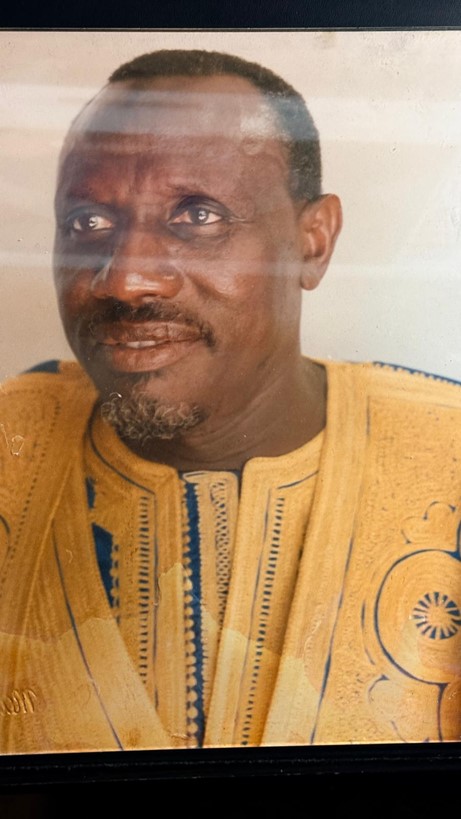
“Inna lillahi wa inna ilayhi raji’un — To Allah we belong, and to Him we shall return.”
The Harmattan is still. The River Gambia flows low today, Saturday the 2nd of May 2026, as if in reverence.
For a baobab has fallen.
And when a baobab falls in The Gambia, the whole savannah mourns.
The late Honourable Alhaji Yaya Ceesay — Alhaji Yaya, Uncle Yaya, Cabinet Minister, Son of the Soil — has returned to the mercy of Allah Subhanahu wa Ta’ala, who lent him to us for a season, and has now reclaimed him in glory.
And so we do not say goodbye. We say Alhamdulillah — for the gift of him.
- The Custodian Of A Republic
He belonged to the First Republic, but he was not confined by it.
From 1965 to 1994, under the late President Sir Dawda Kairaba Jawara, he served in the Cabinet when Cabinets were schools of statecraft, not casinos of personal aggrandisement or self-interest.
He was a Minister when the word still meant servant. When a portfolio was a trust, not a trophy.
He did not shout. He stewarded.
He did not posture. He performed.
He did not defect. He devoted.
In the People’s Progressive Party, (PPP), he was not a guest. He was a cornerstone.
National President. Longest-serving member. Not because he clung, but because the Party clung to him.
In an era when loyalty is seasonal and ideology is rented by the term, Alhaji Yaya was a fixed star.
The PPP was his political “Qibla”,
and he never turned his face from it — not in victory, not in defeat, not in the long winter of 1994 when the barracks spoke and the ballot was silenced.
The Arithmetic Of Integrity
We live now in the age of political hyenas — men who mourned Jammeh in 2017 and dined with his jailers in 2023.
Men who prefix their names with “Honourable” though honour has never visited their house.
Alhaji Yaya was the antidote.
He was of the generation that understood “ngorr”, “fulla”,
“jomm” and “faiidaa” — dignity, honour, self-respect, and shame — not as words for campaign posters, but as weights for the soul.
He walked with “jomm” when it was unfashionable. He practiced “fulla” when it was unprofitable.
His CREDIBILITY was not announced. It was accrued.
In every village, he visited without a camera.
In every farmer, he listened to the soul without a deadline.
In every Cabinet meeting, he always endeavoured to tell not what was convenient, but what was right.
He has therefore left behind something rarer in our Republic: an unmortgaged legacy.
III. The Bridge Between Banjul And The Nation
A typical “Jarranka”, he was also born of “Bangjulo”, that very
fiber that binds. And he indeed bound us.
He remembered when Banjul was Bathurst, and he helped rename it without hating the past.
He understood that to own your name is not to erase history, but to author it.
He knew the rains that turned Independence Drive into brown mirrors.
He knew the Harmattan that reminded us we are not above the earth.
He knew that Albert Market asks no tribe before it sells you rice, coos, findi or nyeleng and he governed with that same blindness — the holy blindness of justice.
He was a pious Muslim who frequently quoted the Qur’an, but never used it as a cudgel.
He knew that the “adhan” prayer call from King Fahad Mosque and the bell from St. Mary’s Cathedral were not rivals, but refrains in the same national anthem.
The Silence After the Statesmen
The First Republic was not perfect.
But it produced men.
Men who could be exiled without being embittered. Men who could lose power without losing themselves.
Alhaji Yaya Ceesay was such a man.
After 1994, he did not howl. He did not hawk himself to the new order. He returned to his people, to his Party, to his prayers.
As such, he became an elder not by age, but by example.
He taught us that defeat is not disgrace when you believe in the Almighty God’s will.
That opposition is not enmity when your heart is true.
In the Third Republic, when charlatans auction their loyalty and apologists circle like vultures, his life therefore served both as an indictment and an instruction.
Conclusion: The Final Cabinet Meeting
Most Befitting and Memorable Conclusion — "The Minutes Of A Life Well Lived"
So the Cabinet of the Almighty has called its meeting, and Alhaji Yaya Ceesay has answered Present, as he always did.
To his family: May Allah SWT grant you Sabr Jameel. He was yours by blood, but he was ours by service.
We return him to you wrapped not in flags, but in duas.
To the PPP: Your baobab has fallen, but its roots run deep. Tend them. In a forest of grass, be trees again.
To The Gambia: We are poorer in men, but richer in example. The First Republic is now fully in the hands of history. Let history record that it gave us giants.
To the political hyenas: Look upon this grave. This is what “Honourable” looks like. This is what it costs. This is what you cannot buy.
And to Alhaji Yaya Ceesay:
You were a Minister when Ministers were measured by boreholes, not Benzes.
You were a Partyman when Parties were movements, not matrimonies of convenience.
You were a Believer when belief was not broadcast, but practiced.
The marble has dropped for you today, Alhaji. But it does not sound like an end.
It sounds like Allahu Akbar — God is Greatest — because you were His gift to us.
Go in peace, Ya Sheik.
The River Gambia will carry your Janazah to the sea.
The Harmattan will attend, and for once, it will not be dry.
For all of Bangjulo weeps.
And when the history of this land is written — not by the victors, but by the truth — your name will not be in the footnotes.
It will be in the title:
“The Men Who Made Us A Nation.”
Allahummaghfir lahu warhamhu, wa ‘aafihi wa’fu ‘anhu.
May Allah forgive him, have mercy on him, grant him ease, and pardon him.
Ameen, thumma Ameen.
By Hassan Gibril
Opinion
Mali in flames, and the world looks away in a familiar double standard
By Retired Lt. Colonel Samsudeen Sarr
Former Commander, The Gambia National Army; Former Diplomat at the United Nations
While global attention remains fixated on the war in the Middle East, a crisis of equal gravity, arguably of greater relevance to us in West Africa, has been unfolding in Mali with alarming intensity. The deterioration of Mali’s security landscape in late April 2026, following coordinated attacks by Jama'at Nusrat al-Islam wal-Muslimin and allied separatist elements such as the Azawad Liberation Front, demands urgent continental and international attention.
Among the most shocking developments was the reported killing of Mali’s Defence Minister, Sadio Camara, in a suicide car bomb attack at Kati, the country’s strategic military hub near Bamako. This was not an isolated incident, but part of a broader, highly coordinated offensive targeting military installations, critical infrastructure, and administrative centers, including the governor’s palace in Kidal. These were not random acts of insurgency but calculated operations designed to destabilize the Malian state.
Yet, what is equally disturbing is the manner in which this crisis is being framed in certain international media circles. Listening to mainstream media reports such as those from Al Jazeera correspondents, one cannot help but detect a subtle but dangerous narrative shift, where armed groups, long classified as terrorists, are now portrayed in quasi-romantic terms as “nationalists” or “liberation forces.”
This careful manipulation of language reflects a deeper geopolitical bias that has historically determined who is labeled a terrorist and who is celebrated as a freedom fighter.
The alliance between jihadist groups like JNIM and separatist movements, for the first time, has significantly enhanced their operational capacity. Reports of fuel blockades and economic strangulation tactics in Bamako underscore the severity of the threat.
Yet to be frank, the sophistication of these attacks raises legitimate questions about external involvement. Mali’s decision to sever ties with traditional Western allies, withdraw from ECOWAS, and align itself with Burkina Faso and Niger under the Alliance of Sahel States was a bold attempt to reclaim sovereignty. But it has also placed the country at odds with powerful geopolitical interests.
And herein lies the hypocrisy.
Under previous civilian administrations hailed by the West as democratic, these same jihadist groups were unequivocally condemned as existential threats to regional and global security. Today, because Mali has chosen a different political and military path, those very groups are being subtly rebranded, their actions contextualized, if not outrightly rationalized.
This is not new to me. During my officer cadet-entrance exam in 1986 under the British Army Training Team, we were tasked with debating a provocative question of "why South Africa’s African National Congress (ANC) was labeled a terrorist organization, while the Afghan Mujahideen were hailed as freedom fighters?" The answer, even then, was clear; labels are not determined by objective morality, but by geopolitical alignment.
History has since rendered its verdict. The African National Congress now governs a democratic South Africa, while the Mujahideen’s legacy evolved into the Taliban, whose rule remains contentious on the global stage. The lesson is simple; it means today’s “terrorist” may be tomorrow’s statesman, and vice versa, depending on who controls the narrative.
But in Mali’s case, we must not allow narrative manipulation to obscure reality. These are terrorist groups. Their methods, suicide bombings, coordinated assaults on government personnel, military targets, and economic sabotage are the very definition of terrorists. That they now serve the strategic discomfort of certain global actors does not transform their nature.
What is perhaps most disappointing is the muted response from African institutions. The African Union, ECOWAS, and even individual states have failed to mount a unified and forceful condemnation of these attacks. This silence is not neutrality but complicity born of fear, hesitation, or worse, political calculation.
Contrast this with the swift mobilization threats against Niger following the ousting of President Mohamed Bazoum. Then, the sanctity of constitutional order was invoked with urgency. Today, as a sovereign African state faces a full-scale terrorist assault, that urgency has evaporated.
This inconsistency is embarrassing and very dangerous.
Africa cannot afford selective outrage. If we are to assert true sovereignty and collective security, then we must apply principles consistently. Terrorism must be condemned irrespective of who it inconveniences geopolitically. Mali must be supported, not isolated, for choosing a path that seeks to redefine its sovereignty.
I therefore call on the United Nations, the African Union, and ECOWAS to openly condemn these attacks and to extend tangible support to Mali. I also urge President Adama Barrow to lend The Gambia’s voice in clear and principled condemnation of this cowardice.
Silence, in moments like this, is abdication, and history will judge it as such.