Funded by the World Food Programme (WFP) through the Adaptation Fund (AF), RICAR is a five‑year project executed by the Ministry of Environment, Climate Change and Natural Resources (MECCNAR). It is currently being implemented in the Upper River (URR) and Central River Regions (CRR) North and South.
The project’s overall goal is to enhance the adaptive capacity of rural populations by supporting climate‑resilient and diversified livelihoods. To achieve this, RICAR partners with the National Nutrition Agency (NaNA) to deliver Social and Behavioural Change Communication (SBCC) activities through Multidisciplinary Facilitation Teams (MDFTs) and trained Community Change Agents.
These Change Agents are equipped to promote climate change mitigation and adaptation measures in their communities. They also receive grants to establish climate‑smart businesses in agriculture and related sectors, boosting both resilience and income generation.
Part of NaNA’s role is to document “Most Significant Change Stories” that highlight the human impact of RICAR’s interventions. Interviews with beneficiaries reveal the project’s transformative effect on rural youth.
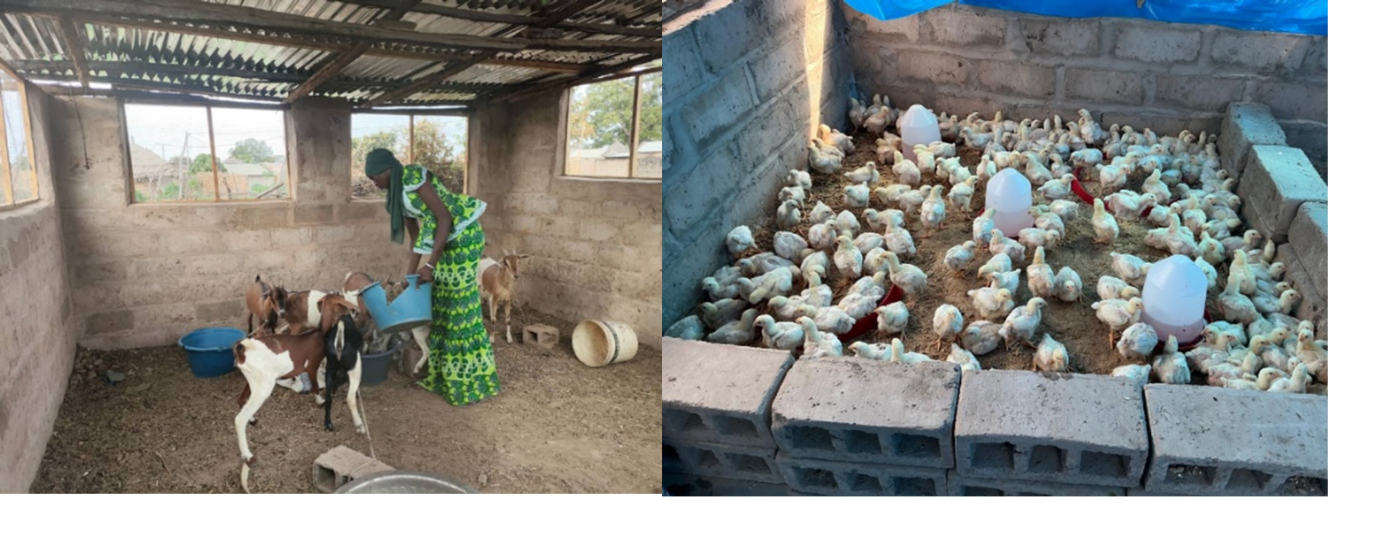
Fatim Sallah, a Change Agent from Njoben Tuklorr in CRR North, was previously unemployed after completing senior school. She received a grant of D115,000, which she used to buy 15 goats and build a shelter for them. She explained that beyond animal husbandry, the goats’ waste will serve as fertiliser to improve crop production. “I hope to be a role model for other unemployed youths to benefit from RICAR in the future,” she said.
Bintou Jatta, from Bakadaji Nianija in CRR North, received D207,000 and invested in poultry farming. She built a poultry house and stocked it with 200 chicks and feed. “Before this initiative, residents had to travel to other villages to buy chickens. Now customers can buy directly from my farm,” she noted.
Fama Njie, from Hosnan Angalais village in Upper Saloum, CRR North, also established a poultry farm with 200 chicks using a grant of D200,000. She emphasised that the training she received was as valuable as the financial support, describing RICAR as “a great tool for tackling climate change.”
Through these interventions, RICAR is not only creating jobs for young Gambians but also embedding climate‑smart practices into rural economies. By combining training, grants, and community‑driven communication, the project is helping to build resilience, strengthen food security, and empower the next generation of entrepreneurs.