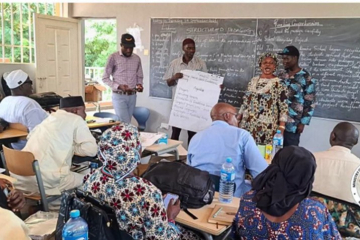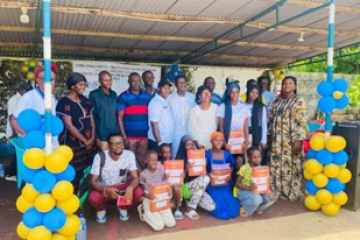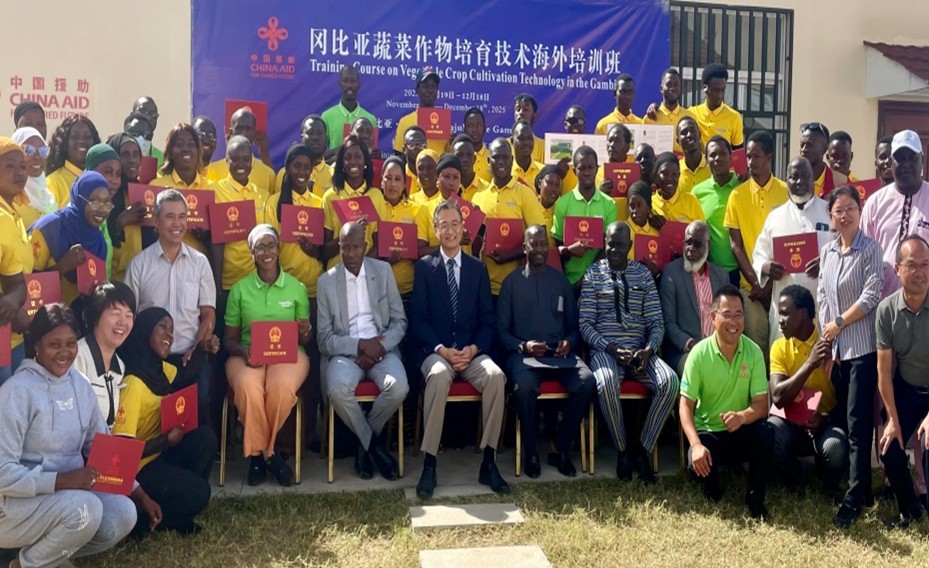
The training combined classroom instruction with practical field demonstrations, enabling participants to follow the full production cycle from planting to harvest at the project site.
It focused on crops such as peppers, cucumbers and eggplants, with participants completing the full production cycle from sowing to harvest at the Jambanjelly centre. Officials said the programme’s emphasis on water-saving irrigation, integrated pest management and efficient fertiliser use aligns with The Gambia’s push for climate-smart agriculture and improved food self-sufficiency.
China’s Ambassador to The Gambia, Liu Jin, said the programme reflects China’s long-standing commitment to human resource development in developing countries, noting that more than 500,000 professionals from over 180 countries have benefited from Chinese training initiatives over the past decades.
He described agriculture as a cornerstone of China-Gambia relations and said the overseas, field-based training model delivers practical, demand-driven and lasting impact.
Ambassador Liu outlined four pillars of agricultural cooperation between the two countries: technology cooperation, input support, capacity building and trilateral partnerships, underscoring agriculture as a priority area in bilateral relations.
He explained that under the technology cooperation pillar, Chinese expert teams have worked closely with Gambian farmers on rice, vegetables and maize through the China-Gambia Agricultural Technical Cooperation Project, which has completed its second phase and is preparing to launch a third.
On input support, he said China has donated agricultural machinery, high-quality rice, vegetable seeds, and fertilisers to help ease production constraints, while capacity building efforts have enabled hundreds of Gambians many from the agriculture sector to benefit from training programmes both in China and locally.
He added that China and The Gambia are also strengthening trilateral cooperation with partners such as the Food and Agriculture Organization (FAO) and the World Food Programme (WFP) to enhance sustainability in agricultural development.
Speaking at the ceremony, Chen Xiaoliang, Manager of Longping Hi-Tech Agriculture Co. Ltd., congratulated the participants on the successful completion of the training and thanked the Embassy of the People’s Republic of China in The Gambia, the Ministry of Agriculture and other stakeholders for their support.
He said the programme focused on the full vegetable industry chain, covering greenhouse construction, seed breeding and production, high-yield cultivation and integrated water and fertiliser management, using a “theory plus practice” approach.
Chen noted that the training enabled close exchanges between Gambian agricultural technicians, farmers and Chinese experts, with participants completing the entire production process from sowing to harvest at the Jambanjelly centre.
He described the programme as a practical demonstration of technology sharing and win-win development, adding that water-saving irrigation and integrated pest and disease management techniques introduced during the training have the potential to significantly improve vegetable yields and quality in The Gambia.
He said Longping Hi-Tech remains committed to deepening cooperation with the Ministry of Agriculture through the establishment of demonstration fields and the promotion of improved crop varieties, expressing hope that future training under the Belt and Road agricultural cooperation framework would benefit more Gambian farmers.
Alhagie Nyangado, Permanent Secretary at the Ministry of Agriculture, described the training as timely and impactful, urging participants to apply the skills acquired to improve productivity, household incomes and national food security.
He emphasised that agriculture remains central to economic transformation and said bringing such training to The Gambia allows more farmers and extension workers to benefit than overseas programmes alone.
“This is about empowering farmers with knowledge and confidence to be self-reliant,” Nyangado said, encouraging participants to cascade the skills learned to others in their communities and to work closely with extension services to scale up best practices across the country.
Speaking on behalf of the participants, Bintou Ann thanked the Chinese government, the Ministry of Agriculture and Yuan Longping Hi-Tech for the hands-on approach adopted throughout the course.
She said the combination of theory and practice particularly in greenhouse management, pest control and crop scheduling has strengthened participants’ capacity to adopt modern and sustainable vegetable production systems.
“This training has improved our understanding of modern vegetable production and increased our confidence to apply new methods on our farms,” she stated, describing the programme as timely and beneficial to farmers.