Sowe, widely regarded as one of West Africa’s most respected emerging literary voices, has written across all three genres of literature—prose, poetry, and drama. His previous works include Don’t Judge the Book by Its Cover, The Throne of the Ghost, The Memories of Reflection, and AfriKa, Not AfriCa.
He has also been featured in the continental anthology Twaweza. His new novel continues his mission to establish literature as a tool for social reflection, education, and cultural continuity.
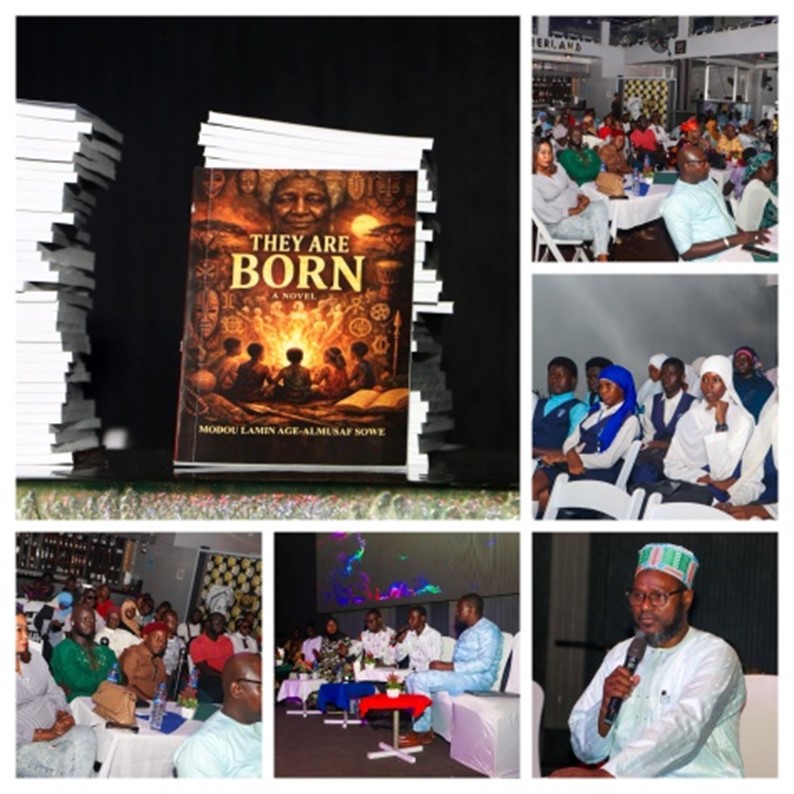
The launch drew government officials, dignitaries, scholars, thought leaders, students, and members of the wider public. Speaking at the event, Saikou Sanyang, Principal Education Officer deputising for the Minister for Basic and Secondary Education, described the novel as “a reflection of the transformative power of education and youth empowerment.” He emphasised that the book’s unveiling was more than a literary milestone—it was “opening new doors for learners, teachers, and communities.”
“Books carry the wisdom of generations, the dreams of authors, and the aspirations of nations,” Sanyang acknowledged. “This particular work will undoubtedly contribute to the growth of knowledge, the promotion of literacy, and the empowerment of readers across our country and beyond.”
Other speakers included Mayor Rohey Malick Lowe of Banjul, historian Hassoum Ceesay, and retired curriculum development official Michael Hamady Secka, all of whom praised the novel’s cultural and intellectual significance.
In his review, Professor Cherno Omar Barry, President of The Writers’ Association of The Gambia, described They Are Born as “a slow-burning, deeply reflective narrative that mirrors the realities of our societies today.” At its core, the novel explores the fate of Hamani, an ancient language fading under the pressures of modernity.
Barry noted that Sowe’s work resonates with themes explored by African literary giants such as Chinua Achebe, Ngugi wa Thiong’o, Leopold Sedar Senghor, and Wole Soyinka.
“What makes this novel devastating is its honesty,” Barry explained, “is the way it shows us the community’s own complicity. Hamani was the same language teachers discouraged, parents apologised for, and children were punished for speaking. This is not a distant colonial tragedy, it is a domestic one, unfolding in our societies today.”
Barry concluded that the novel is ultimately about responsibility: “Each generation is born into a choice, to inherit blindly, or to inherit consciously. This novel urges us to choose the latter.”
As the event closed, Sowe expressed gratitude to his family, partners, sponsors, and the broader literary community. His words underscored the spirit of the day: a reaffirmation of literature as a pillar of national progress and cultural preservation.