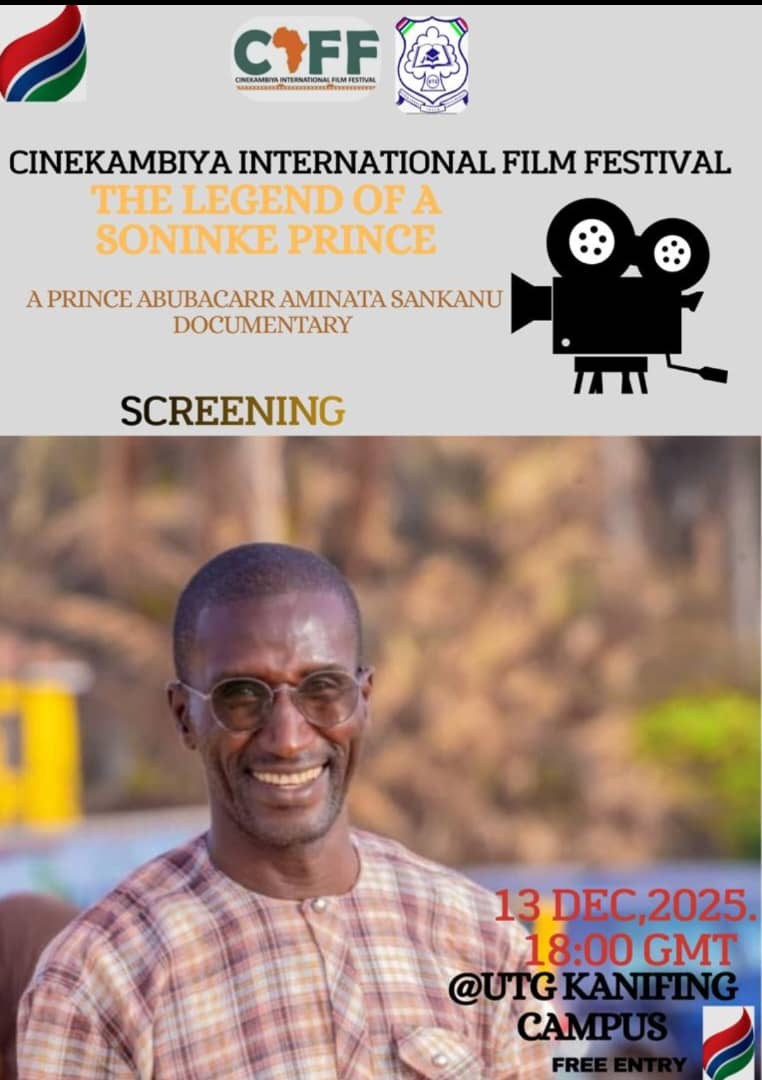
The session also accords officials the opportunity to critically examine the growth and future of The Gambia’s creative and film industry. Founded in 2015 by Gambian filmmaker and academic Prince Bubacarr Aminata Sankanu, the CineKambiya International Film Festival was established to promote Gambian and African cinema, with a strong focus on indigenous-language films, cultural storytelling, and capacity building.
Over the years, the initiative has evolved into a key cultural and academic platform linking film practice with education and contributing significantly to the growth of The Gambia’s creative industry.
Moreover, this sixth edition marked a major milestone, featuring the screening of over five documentary films produced by final-year students of the School of Journalism and Digital Media.
The films were presented for academic critique and feedback, while reinforcing CineKambiya’s role as a learning and mentorship platform for emerging filmmakers.
At the event, filmmaker, founder, and lecturer, Prince Abubacarr Sankanu highlighted the importance of structured learning, capacity building, and institutional support in building a sustainable national film sector.
Representing the Vice Chancellor of the University of The Gambia, Dr. Williams Jabang, the Deputy Vice Chancellor for Administration at UTG, described the academic screening as a crucial platform for nurturing emerging creative talent.
He commended the Dean of SJDM and the organising team for their dedication, noting that the initiative provides a strong foundation for long-term industry development.
“There is enormous untapped potential in The Gambia’s creative and performing arts industry,” Dr. Jabang affirmed, citing Nigeria’s film and music industries as examples of how cultural content can grow into a global force.
To this end, he challenged Gambian creatives to produce authentic stories that reflect national identity, culture, and lived realities.
The sixth edition also featured the screening of ‘It’s Organic’, a film by Prince Abubacarr Sankanu, which explores the dynamic relationship between music, culture, and storytelling.
The screening, he added, formed part of an academic exercise aimed at intellectual analysis, critique, and creative learning rather than entertainment alone.
Emphasising CineKambiya’s growing reach, Sankanu noted that the initiative continues to attract increasing local and international film submissions, demonstrating rising interest in Gambian creative content.
While acknowledging that the country may not yet produce enough films to sustain a full annual festival, he argued that the current focus remains on building strong structures that stimulate creativity and support skills development.
In his remarks, the Dean of the School of Journalism and Digital Media, Prof. Melchizedek Onobe, described The Gambia as a cultural intersection where African creativity thrives.
He encouraged students to stand tall in their identities, embrace originality, and understand that artistic excellence is achieved through learning, apprenticeship, and continuous engagement with real-life experiences.
“Despite ongoing examinations, students turned out in large numbers, a development described as a testament to their dedication and passion for the creative arts. Prof. Onobe expressed confidence that initiatives such as CineKambiya’s academic screenings would nurture future filmmakers, producers, and creative professionals capable of contributing meaningfully to national development,” he added.