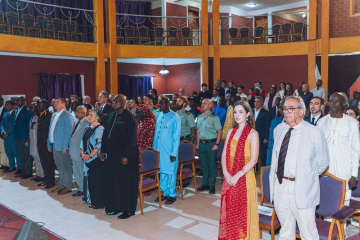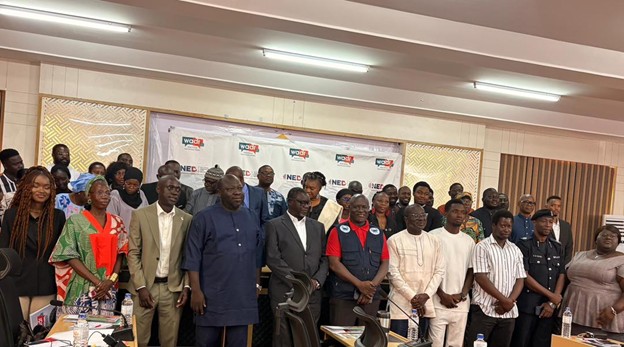
The dialogue brought together government officials, civil society, media, security experts and legal practitioners to reflect on democratic governance and generate recommendations to strengthen institutions.
Agnes E. John-Thomasi, Managing Director of WADR, said the project responds to growing pressure on democratic resilience across the region, including shrinking civic space, attacks on freedom of expression, disinformation, and weaknesses in accountability.
“A central objective of the project is to provide citizens with credible information that enables them to participate meaningfully in democratic processes, while creating opportunities for communities to share their perspectives,” she said.
She noted that while The Gambia is a secondary target country, it is critical as the country prepares for presidential elections later this year.
“It could be said that The Gambia has made significant progress in its democratic journey, but democracy cannot be taken for granted,” John-Thomasi said. “It requires institutions that function, citizens who are informed and engaged, respect for the rule of law, credible elections, accountability from those in positions of authority, and the ability of people to participate freely.”
She urged media practitioners to remain professional, impartial and focused on public interest, adding that independent media can help scrutinize institutions and challenge disinformation.
Gambia Press Union President Isatou Keita said democracy is ultimately about trust. Citing recent Afrobarometer data, she noted that nearly nine in ten Gambians reject dictatorship and one-party rule, yet confidence in the presidency, parliament and courts has been declining since 2018.
“Gambians have already decided they want democracy. What remains is for our institutions to earn the trust that decision represents,” Keita said.
She highlighted achievements including the Anti-Corruption Commission, Access to Information law, and the Truth, Reconciliation and Reparations Commission. However, she said many reforms remain incomplete, including constitutional reform after failed attempts in 2020 and 2024.
Keita pointed to gaps in judicial confidence and pending security sector legislation.
“Good reforms on paper are a start. The real work is making those reforms meaningful in the lives of ordinary Gambians,” she said.
She also calls for greater inclusion of women, youth and persons with disabilities, noting a Constitution Amendment Bill proposing 14 reserved seats for women and 2 for persons with disabilities awaits debate in the National Assembly.
Hannah Forster, Executive Director of the African Centre for Democracy and Human Rights Studies, said democracy must be measured by how it protects human dignity and rights in everyday life.
“Democratic consolidation is not achieved by changing governments alone. It requires the continuous strengthening of institutions and the development of a political culture in which power is exercised responsibly,” she said.
Forster stressed that security and human rights should not be seen as opposing goals. She urged reforms that promote professionalism, civilian oversight and accountability in security institutions. She also emphasised the need for inclusive participation and evidence-based advocacy.
“We need to move from simply speaking about inclusion to establishing practical mechanisms that make participation possible,” she said, calling for accessible polling, support for women and youth candidates, and better documentation of discrimination.
Forster proposed nine priorities, including strengthening judicial independence, protecting civic space, enhancing civic education, and countering disinformation while safeguarding free expression.
Abdulmalick Bello, Legal Officer at the Institute for Human Rights and Development in Africa, said democracy and human rights cannot be separated.
“Democracy is also about what happens between elections. It is about how public power is exercised, how institutions treat citizens, whether courts are able to operate independently,” he said.
Bello warned of a gap between legal commitments and implementation. “Accountability should not be understood as something that destabilises society. Properly understood, accountability strengthens democracy,” he said
He said civic space, media freedom, and freedom of assembly are not privileges but fundamental rights. He also called for genuine inclusion of marginalized groups in decision-making.
Speakers agreed that The Gambia has made important democratic gains since 2016, but sustaining them requires turning legal reforms into tangible improvements for citizens.
The forum concluded with a call for inclusive, transparent and rights-based reforms, stronger oversight of public institutions, and collective responsibility among government, civil society, media and citizens to consolidate democracy.