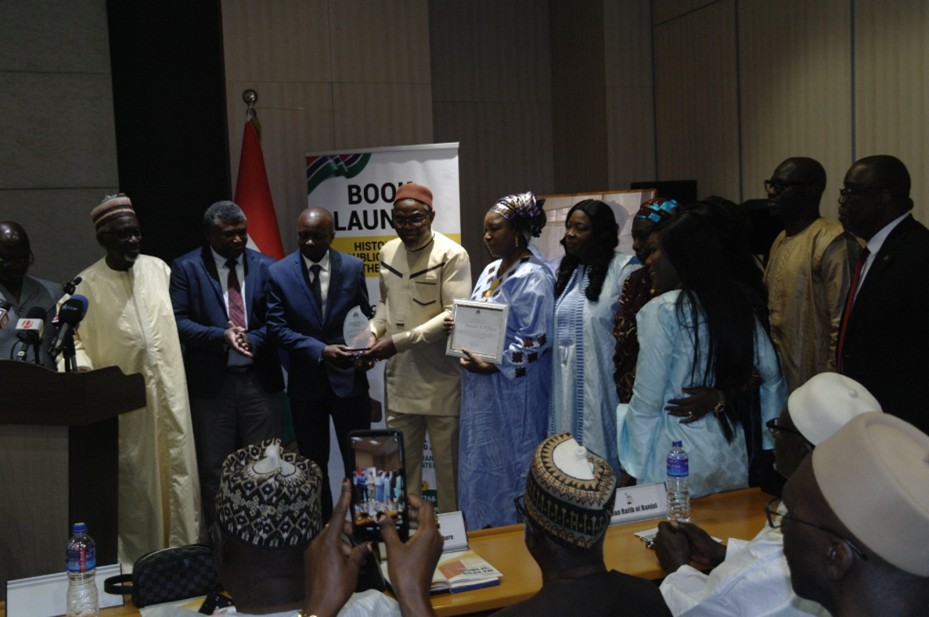
At the event, speaker after speaker described the late Dr. Jagne as a man who contributed to reshaping the country’s public health system while serving as a mentee to countless other youth health professionals.
Welcoming the gathering, Momodou Jagne, son of the author, described the event as not merely ceremonial, but rather, a powerful affirmation of the value of knowledge, service and national memory.
‘We thank you sincerely for standing with us as a family and with the public health community on this significant occasion. Today is a moment filled with mixed emotions. It is a moment of pride because a lifetime of work has found its permanent place in our national record. It is also a moment of reflection, because the author of this work is not physically present with us today. Yet in many ways, his presence is strongly felt in the ideas captured in the book and in the institutions, he served.”
This book, he went on, was not conceived as a personal achievement and that through his lifelong character, their father approached his work with a sense of duty.
He revealed that their late father began documenting the history of public health in the Gambia years before his passing driven by a clear belief that understanding “our past” is essential to building resilient, informed and effective public health systems for the future.
Phillip Saine, MSC Environmental Health Specialist and a family friend, recalled the times and commitment of the deceased, recalling that he had interacted with the late Alh. Dawooda M.B Jagne at least three levels.
“First, as a student, he taught me, moulded me and second, as a colleague, a lecturer, as he was one-time Principal at the School of Public Health, then the Gambia College, there I interacted with him on a daily basis and thirdly, I interacted with him in many research works that he led here with international organizations.”
He spoke about the deceased wealth of knowledge especially in public health from United Kingdom, United States as well as his career progression since he left studies to come home and serve his country.
Senator Edwin Snow, a family friend and an in-law to the Jagne family, also spoke good about the deceased based on testimonies of people he had interacted with.
Over the last few years since he joined the family and with numerous conversations with his wife and other family members, he said he had come to learn so much about this great legend, adding that it is quite unfortunate that he didn’t had the time to meet him.
Dr. Ahmadou Lamin Samateh, minister of Health, described the deceased as a man whose life was a testament to the highest-level commitment to the health of “our nation”.
“Today is as a moment of celebration and that today we celebrate a man who lived a good life.”
Minister Samateh spoke highly of the commitment and dedication of the late author, saying Dr. Jagne was more than just a public health servant, but a founding architect of public health system in the Gambia.
In his launch statement, Muhammed B.S Jallow, vice president of The Gambia, described the launch as an event that transcends the formal launch of a book but rather one that represents a moment of reflection on the country’s journey in public health; a reaffirmation of commitment to wellbeing of people.
He described it as also a tribute to a distinguish Gambian, whose life’s work was devoted to knowledge, service and national development.
“The late Dawooda MB Jagne has rendered an invaluable service to the nation by systematically documenting the historical evolution of public health in The Gambia. This work captures the foundation of our health of our health system, the policy choices made over time, challenges, encountered and the resilience demonstrated by successive generations of health professionals and institutions.”
VP Jallow maintained that public health remains a central pillar of national development and that it is inseparably linked to productivity, education outcomes, poverty reduction and social cohesion.
“A nation’s progress is ultimately measured by the health and dignity of its people.”
To this end, VP Jallow noted government of the Gambia continues to pursue comprehensive health sector reforms guided by national development frameworks, noting that these includes National Health Development Plan, which priorities universal health coverage; strengthened primary health care; improve maternal; newborn; child and adolescent health as well as enhanced disease prevention and surveillance.
He pointed out that the country’s health agenda is further reinforced by investment in health workforce development, infrastructure expansion, digital health system and health financing reforms to name a few.
These efforts, he added, are aligned under the country Recovery Focused National Development Plan, African Union agenda 2063 and the Sustainable Development Goals.