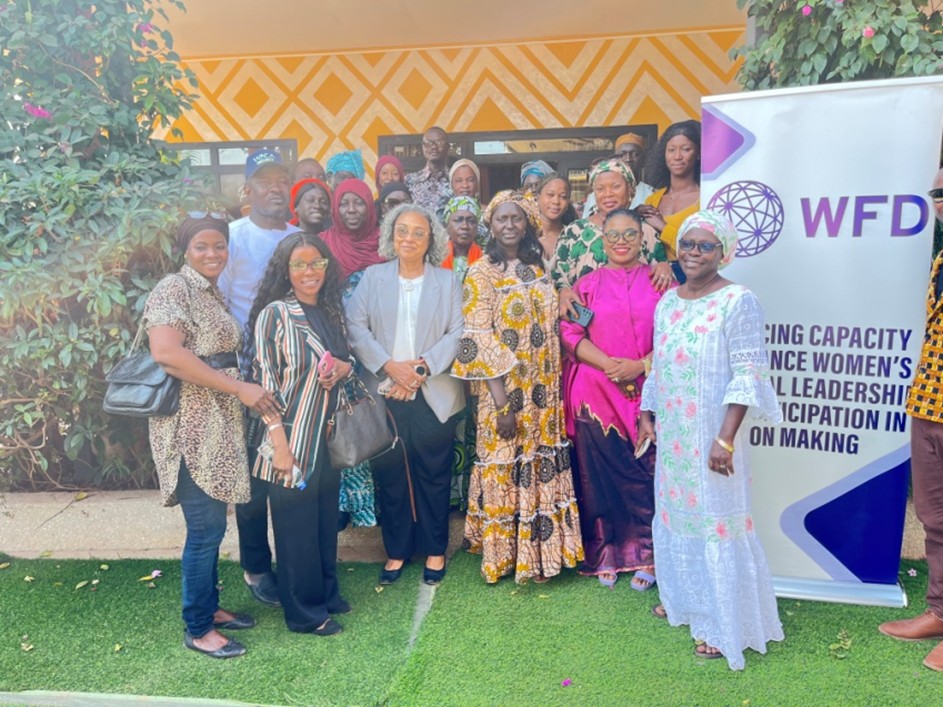
The validation exercise, held at the Bakadaji Hotel, brought together policymakers, National Assembly members, political party representatives, civil society organisations, and development partners to review and validate the findings of the study, which is expected to be officially launched in January 2026.
WFD opened its country office in The Gambia in 2018 with the aim of supporting the consolidation of democracy, with the National Assembly serving as its main partner and host institution. Globally, WFD works to promote political systems that are inclusive and accountable, ensuring that all citizens regardless of gender, origin, disability, ethnicity, or religion are able to participate meaningfully in political processes and hold leaders to account.
The Violence Against Women in Politics study is being implemented under WFD’s Women in Political Leadership (WPL) project, supported by the Foreign, Commonwealth and Development Office (FCDO) through the Gambia Inclusive and Accountable (GIA) Programme for 2025–2026.
Opening the workshop, the Country Director of WFD in The Gambia, Ms. Tobaski Njie Sarr, described the validation as a critical milestone in advancing democratic inclusion. She explained that independent consultants were contracted to carry out the research in order to ensure credibility and objectivity, drawing comparisons with WFD’s earlier study on the cost of politics in The Gambia.
Ms. Sarr said the validation process was designed to strengthen the accuracy, credibility, and ownership of the findings among stakeholders before the report’s public launch. She emphasised that the research is not merely academic, but a practical and policy-oriented tool aimed at generating evidence-based solutions to address the challenges facing women in politics.
According to her, the study seeks to support policymakers, political parties, civil society organisations, and development partners in tackling the structural, cultural, and institutional barriers that hinder women’s effective participation and leadership in political life. She stressed that addressing violence against women in politics is essential to creating a safe and enabling political environment free from intimidation, harassment, and discrimination.
Presenting the report, co-consultant Mr. Gheran Senghore described the findings as “an eye-opener,” noting that some testimonies were so sensitive that he had to rely on his female colleague to conduct certain interviews. He said this underscored both the depth of the problem and the fear experienced by women in political spaces.
Mr. Senghore introduced the three-member consultancy team, led by Mrs. Adelaide Sosseh, a gender and education specialist with extensive national, regional, and international experience; Mrs. Yadicon Njie Eribo, a women’s affairs and advocacy practitioner with strong community-level engagement; and himself, a systems management and organisational development professional.
He explained that Violence Against Women in Politics remains one of the most entrenched barriers to women’s political leadership, functioning as a form of political violence aimed at silencing, delegitimising, and excluding women from positions of power. Despite The Gambia’s legal commitments to gender equality, he said structural inequalities, entrenched party hierarchies, and prevailing socio-political norms continue to expose women in politics to physical, psychological, economic, sexual, digital, and structural violence.
Mr. Senghore noted that the study addressed a critical national gap by examining how VAWP operates as a systemic political mechanism, identifying perpetrators, and assessing institutional responses, while centering the lived experiences of affected women. He added that the research was framed within internationally recognised democratic and gender frameworks and is intended to inform policy reforms and strengthen institutional accountability.
He further highlighted that women’s representation in political institutions remains alarmingly low, particularly in elected offices. Women currently occupy only 8.6 percent of seats in the National Assembly five members far below the internationally accepted benchmark of 30 percent. He said this underrepresentation is driven by systemic barriers, including unequal access to campaign financing, biased party selection processes, disinformation, sexual harassment, and institutional impunity.
According to the findings, gendered attacks against women politicians often question their legitimacy and confine them to the private sphere, with such abuse increasingly amplified through digital platforms. This hostile environment, Mr. Senghore said, forces many women to withdraw from politics, limit their public engagement or endure abuse as the cost of leadership.
The study also revealed significant gender gaps across leadership positions in the National Assembly, Cabinet, and local councils. Among political parties, only the United Democratic Party (UDP) was found to have met the 30 percent quota for women’s representation in party structures. The research further revealed that there are no recorded cases of prosecution related to violence against women in politics, a situation attributed to the absence of specific legislation addressing the offence.
Meanwhile, co-consultant Mrs. Yadicon Njie Eribo highlighted the severe emotional and psychological trauma experienced by women in politics, noting that such violence affects not only individual women but also their families and society at large. She pointed to online bullying and public harassment as major deterrents to women’s political participation.
Mrs. Eribo also lamented the absence of psychosocial support systems for affected women, adding that even when cases are reported to the police, often little or no action is taken. She explained that the research adopted a trauma-informed approach, with interviews conducted in private and safe environments, based on informed consent, and with sensitivity to emotional distress.
She noted that many participants avoided explicit descriptions of violence but spoke extensively about fear, reputational anxiety, political retaliation, and the emotional toll of political engagement. According to her, these experiences provided critical insight into how violence against women in politics operates and undermines democracy in The Gambia.
The validation workshop concluded with discussions and stakeholder input aimed at strengthening the report’s recommendations ahead of its official launch in January 2026.