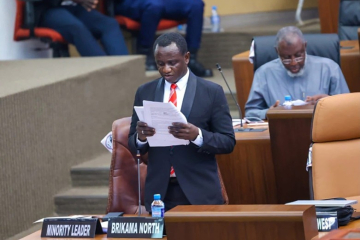
On the state of unemployment, the Trade Minister cited Gambia Bureau of Statistics (GBoS) data which places the country’s unemployment rate at 4.5 percent, adding that government is conducting a mid-term assessment that will soon present empirical data on President Adama Barrow’s pledge to create 150,000 jobs by 2026.
However, the unemployment migration link drew sharp counter-arguments from the Minister of Information, Dr. Ismaila Ceesay, who dismissed unemployment as the primary trigger for irregular migration.
According to Dr. Ceesay, many young Gambians embark on the ‘backway’ journey despite being employed or skilled, arguing that job provision alone does not guarantee youth retention in the country.
“Some people abandon their skills and employment to undertake irregular migration. Jobs alone do not necessarily keep people at home,” he stated.
The Information Minister further asserted that jobs are available in the country, but admitted that empirical data to substantiate the claim is still being compiled by GBoS.
Clarifying the government’s much-touted 150,000 jobs policy, Dr. Ceesay explained that the promise does not mean the state will directly employ that number of people, but rather create an enabling environment for both public and private sector investments capable of generating employment opportunities.
The exchange exposed lingering questions around data credibility, youth migration drivers, and accountability, as the government continues to defend its employment narrative amid persistent concerns over irregular migration and youth livelihoods.