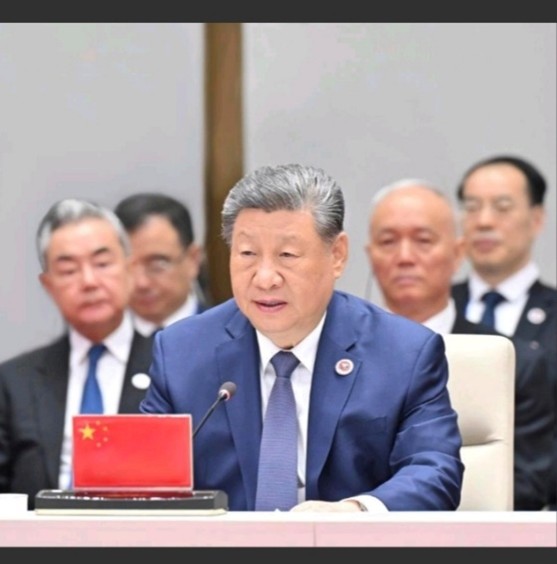
According to Chinadaily, Xi underlined the need for the SCO to remain committed to dialogue and consultation for more equitable and orderly governance while he hailed the extraordinary journey of the regional organization over the past 25 years, saying that it has grown into a new type of regional cooperation grouping with the largest land area and population and enormous development potential.
Founded in 2001 by China, Russia, Kazakhstan, Kyrgyzstan, Tajikistan and Uzbekistan, the SCO now comprises 10 member states, two observer states and 15 dialogue partners.
Xi said the most valuable spiritual asset of the regional grouping is that it pioneered, and has since invariably followed, the Shanghai Spirit featuring mutual trust, mutual benefit, equality, consultation, respect for the diversity of civilizations and pursuit of common development.
Its most important cooperation experience is that it has found the right way of coexistence, featuring non-alliance, nonconfrontation and not targeting any third party, enabling countries in the region to build a common home together, he added.
As the world is undergoing accelerated changes unseen in a century, with the intensifying rivalry between dialogue and confrontation, win-win and zero-sum, and multilateralism and unilateralism, Xi urged the SCO to step forward to shoulder its historical responsibility and proactively steer the course for the future.
He further urged the SCO to advocate universally beneficial and inclusive economic globalization, solidify cooperation in traditional fields such as trade, investment, mutual connectivity, energy and resources, and expand cooperation in emerging fields like artificial intelligence, digital economy, green industry and green mining in order to deepen and upgrade regional cooperation.
China sees the SCO as a priority area for promoting high-quality Belt and Road cooperation and implementing the Global Development Initiative, he said.
In 2025, China's trade with other SCO members reached $523.5 billion and accounted for 8 per cent of the country's total foreign trade, up from $12.1 billion in 2001, according to statistics from the Ministry of Commerce.
Xi also urged the SCO countries to take coordinated measures to tackle traditional and nontraditional security threats, and he called for efforts to prevent external forces from interfering in their internal affairs, endangering their political security and undermining regional stability.
He added that China is willing to work with all parties to practise a common, comprehensive, cooperative and sustainable security concept and make the SCO an important platform for implementing the Global Security Initiative.
Xi also emphasised the need for the SCO countries to uphold a people-centred approach and cement the foundation for everlasting friendship. China stands ready to work with all parties to implement the Global Civilization Initiative.
The summit was chaired by President Sadyr Japarov of Kyrgyzstan, which holds the current rotating presidency of the SCO.
The leaders of the SCO member states fully affirmed the development achievements of the SCO over the past 25 years, recognising that the SCO provides significant guarantees for regional security and prosperity and has become one of the cornerstones of global stability and economic development.
They praised China's significant contributions as a founding member state in promoting the organization's development and agreed to actively implement the strategic blueprint from the SCO Tianjin Summit in 2025.
In the face of a complex international situation, SCO member states should work together to enhance the organization's influence, promote the building of a more just and reasonable global governance system, and play a greater role in safeguarding the peace, stability and prosperity of the region and the world, they said.
Leaders of the SCO member states signed and issued the Bishkek Declaration on the 25th Anniversary of the Shanghai Cooperation Organization, approved the Protocol on Amending and Supplementing the Charter of the Shanghai Cooperation Organization, the Regulations on the SCO Universal Center for Countering Security Challenges and Threats, and the Regulations on the SCO Anti-Drug Center, and adopted 28 outcome documents covering security, economic, people-to-people and cultural cooperation, as well as organizational development.
It was decided at the summit that Pakistan will assume the rotating presidency of the SCO for 2026-27.
Li Ziguo, director and research fellow in the Department for European-Central Asian Studies at the China Institute of International Studies, said the summit could give fresh impetus to implementing the outcomes of last year's summit and help move the SCO into a stage of pursuing development in tandem.
Sun Zhuangzhi, director of the Institute of Russian, Eastern European and Central Asian Studies at the Chinese Academy of Social Sciences, described China's efforts in practising the Shanghai Spirit as an important driving force behind the SCO.