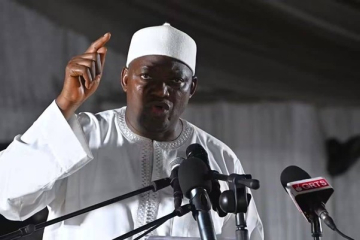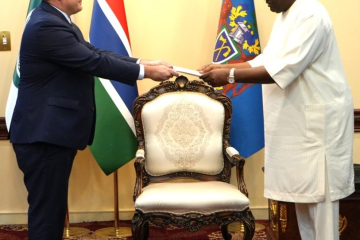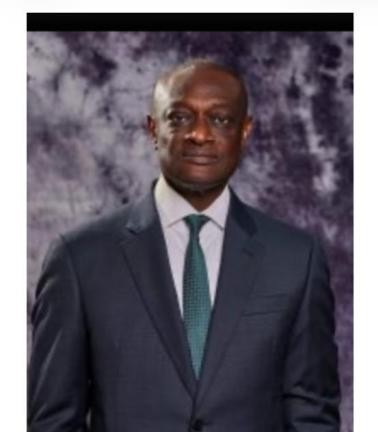
Dr. Ismaila Ceesay, Minister for Information, Media and Broadcasting Services, reportedly confirmed to West Coast Radio that Faal had been appointed as the new Chief Justice, maintaining that the veteran legal practitioner is eligible for the position.
However, the reported appointment has drawn criticism from The Gambia Bar Association (GBA), which earlier expressed the unanimous view that Faal does not meet the qualifications prescribed under Section 139(2) of the 1997 Constitution.
The Bar Association reached its position during an Emergency General Meeting held on July 6, where members examined the constitutional eligibility of Faal for the office. The association subsequently communicated its concerns to President Barrow, the Judicial Service Commission and the Attorney General and Minister for Justice.
The GBA stressed that its position was not an attack on Faal’s character, professional competence or distinguished legal career, but was strictly based on its interpretation of the constitutional requirements governing appointments to the Supreme Court.
Section 139(2) provides that a person may qualify for appointment as a judge of the Supreme Court if they have served for at least five years as a judge of the Court of Appeal or a court of similar jurisdiction in a common-law country, or have practised for at least 12 years as a legal practitioner before a court with unlimited jurisdiction in civil and criminal matters in a common-law country.
While the Bar Association maintains that Faal does not satisfy the constitutional threshold, other legal commentators have argued that his more than four decades of legal practice in common-law jurisdictions meet the requirements of the Constitution.
Faal brings an extensive legal background to the position. He has practised law since 1982 and is an Attorney and Counsellor of the Supreme Court of the United States, a member of the Bar of England and Wales, and a Barrister and Solicitor of the Supreme Court of The Gambia.
He was admitted to practise in California and Indiana in 1982 and later gained admission before several United States federal courts. In 1992, he was called to the Bar of England and Wales and was admitted as a Barrister and Solicitor of the Supreme Court of The Gambia in 1993.
His career has covered civil, criminal, constitutional, commercial and international law. He has also served as counsel in major criminal trials in the United States and represented The Gambia in high-value international arbitration proceedings.
Since 2021, Faal has served on the Panel of Arbitrators of the International Centre for Settlement of Investment Disputes (ICSID), a World Bank institution that handles investment disputes between states and foreign investors.
His academic credentials include a Master of Laws degree from the University of London, a Juris Doctor degree from Western State College of Law and a Bachelor of Science degree from Florida International University. He is also a Fellow of the Chartered Institute of Arbitrators.
Faal has maintained professional links with The Gambia’s legal system for decades, providing legal advice and support to institutions, delivering lectures at the Gambia Law School and mentoring young lawyers. Records also indicate that the Judicial Service Commission invited him in 1998 to accept appointment as a Justice of the newly established Supreme Court.
His reported appointment comes as Chief Justice Jallow concludes nearly a decade at the helm of the Judiciary. Jallow announced that he would retire voluntarily with effect from August 1, bringing to an end a long career in public service and international justice.
As the transition approaches, attention is now focused on whether the constitutional concerns raised by the Bar Association will be formally addressed and how Faal’s appointment will shape public confidence in the independence, credibility and future direction of The Gambia’s Judiciary.