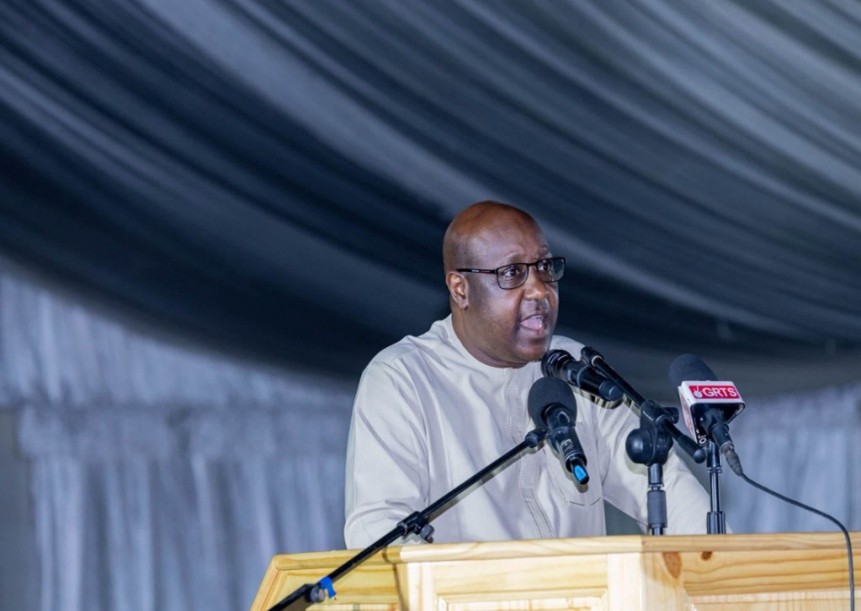
Agriculture, Livestock and Food Safety Minister Dr. Demba Sabally has announced a target to boost The Gambia’s annual rice production to 200,000 metric tonnes by 2030 as part of government’s drive to strengthen food security and reduce dependence on imported rice.
Speaking at the Mansa Kunda Ministerial Town Hall Meeting held on Friday, 13 November 2026, at the Sir Dawda Kairaba Jawara International Conference Centre, Sabally said the country currently produces about 47,000 metric tonnes of rice now, emphasising the need for greater investment in farmland development, mechanisation, irrigation infrastructure and improved seed production.
To accelerate growth in the sector, he said government plans to develop 20,000 hectares of land for rice cultivation through ongoing programmes such as the Regional Rice Value Chain Development Project, the ROOTS Project and other partner-supported initiatives.
According to the minister, these interventions are helping to expand rice-growing areas, including the reclamation of salt-affected lands, while improving farmers’ productivity and resilience.
Sabally also highlighted significant gains in seed production, noting that national rice seed output has increased from fewer than 400 metric tonnes in 2022 to more than 1,000 metric tonnes. Government, he added, is targeting the production of 2,000 metric tonnes of quality climate-smart rice seeds next year.
To strengthen local processing capacity, more than 100 rice mills were supplied across the country between 2025 and 2026 to support the development of the domestic rice value chain, he disclosed.
The minister expressed gratitude to development partners, particularly the Chinese Embassy and the Republic of Korea, for their continued support to the agriculture sector. He also acknowledged the contributions of other partners supporting the country’s agricultural development agenda.
Sabally further highlighted government investments in agricultural mechanisation, including the acquisition and deployment of tractors, combine harvesters and rice transplanters to improve land preparation, planting and harvesting.
He said government has also invested in post-harvest infrastructure through the provision of rice mills, drying floors and other facilities aimed at reducing losses, improving processing and increasing farmers’ earnings.
In addition, farmers have benefited from the distribution of improved rice and maize seeds, fertilisers and herbicides through free and subsidised support schemes designed to reduce production costs and encourage increased cultivation.
Turning to the livestock sector, Sabally underscored government’s efforts to improve animal health, strengthen veterinary services and increase livestock productivity. He outlined interventions aimed at preventing and controlling animal diseases, including the strengthening of laboratory capacity to enhance disease diagnosis, surveillance and response. He also highlighted government interventions to improve access to drinking water for livestock, recognising the importance of reliable water sources in maintaining animal health and productivity.
Livestock mortality declined from 40 per cent in 2022 to 32 per cent, though Sabally acknowledged that the rate remains high despite ongoing interventions.
He further disclosed that the country's cattle population stood at approximately 276,000 in 2025, while the sheep population increased from 179,000 to 182,000.
The livestock sector also recorded improvements in output, with milk production rising from 11.3 million litres to 13.8 million litres during the review period. Egg production increased from 89,000 to 144,000, while chicken meat production rose from 425,000 kilogrammes in 2022 to 512,000 kilogrammes in 2026.
Sabally said the various interventions form part of government’s broader strategy to expand domestic agricultural production, enhance productivity, strengthen food security and advance The Gambia’s quest for greater self-sufficiency. (Advertorial)