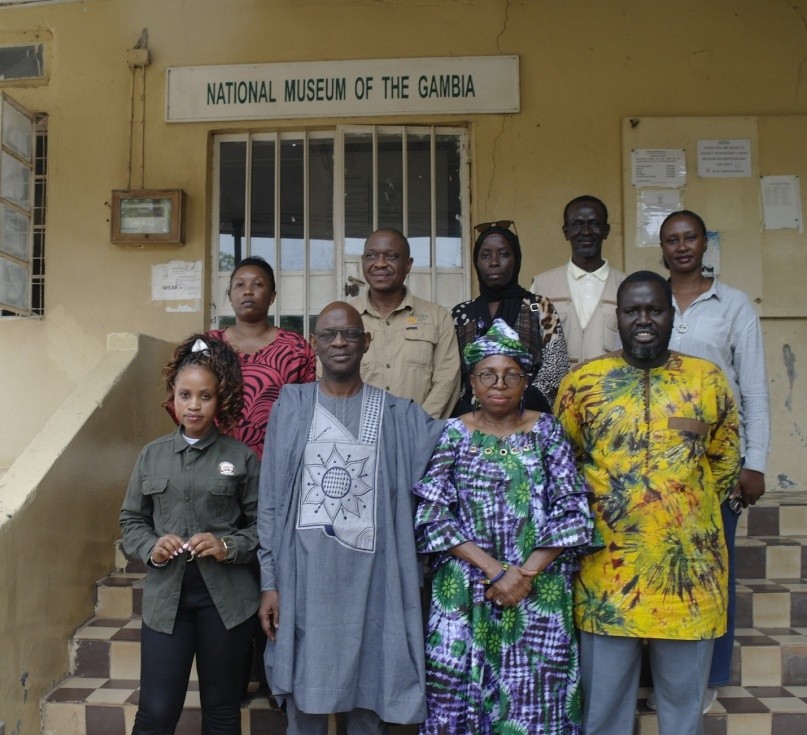
The five-member team, led by Ambassador Dr. Noella Myonga, Senior Assistant Conservation Commissioner of the Tanzania National Parks, was in The Gambia on a nine-day study tour hosted by the National Centre for Arts and Culture (NCAC). Other members included Miriam Mkonya, Erick Jordan, Emeltha Prudence, and Zuhura Mohamed.
In an interview, Ambassador Dr. Myonga said the purpose of the visit was to learn best practices in conservation, branding, and tourism development of cultural heritage sites.
“We came as a delegation working with World Heritage Sites under Tanzania National Parks,” she explained. “While we have long been champions in wildlife conservation and tourism management since 1959, about eight years ago, five cultural heritage sites were placed under our management. We felt it was important to strengthen their conservation, development, and promotion.”
She noted that Tanzania manages 21 national parks and is home to 124 ethnic groups with diverse cultural traditions. In recent years, the country has begun placing greater emphasis on ensuring cultural heritage sites contribute significantly to tourism revenue.
“In the past two to three years, we have seen tourism numbers grow at our cultural sites, but we want to do more. We learned that The Gambia is doing very well in cultural heritage management, so we came to understand how you brand and develop your sites to make them attractive and sustainable,” she said.
During their stay, the delegation visited several key landmarks and heritage sites, including Arch 22 (now Never Again Memorial Centre), the National Museum of The Gambia, the Kachikally Crocodile Pool, Abuko Nature Reserve, Fort Bullen, and Kunta Kinteh Island, among other facilities managed by the NCAC. They also visited the International Trade Centre (ITC), where discussions focused on institutional support for heritage development.
Ambassador Dr. Myonga expressed particular admiration for The Gambia’s archival systems and museum displays, noting both the physical and digital platforms were well organized and informative.
“You are doing a great job with your archives and museums. We have learned a lot. The way you preserve both tangible and intangible heritage is commendable,” she said, recalling her first experience getting close to crocodiles at Kachikally as both memorable and symbolic of effective preservation.
Director General of the NCAC, Hassoum Ceesay, described the visit as a strong demonstration of African solidarity and cooperation. He commended Tanzania’s innovative tourism app, which serves as a one-stop platform for promoting heritage sites.
“It is a beautiful and well-designed platform rich with information. It is something we can replicate here to enhance the promotion of our own heritage sites,” he said.
Ceesay also highlighted Tanzania’s integrated approach to managing both natural and cultural heritage.
“People often think the NCAC is only about arts and performances, but heritage includes natural elements as well. What we have seen from Tanzania is how the two can be combined into a powerful partnership,” he noted.
Mamat Sallah, Director of Cultural Heritage at NCAC, emphasized the importance of community involvement in heritage management, urging the delegation to prioritize engagement with local communities.
“Communities are central to the success of any heritage site. When they are involved, they feel ownership and help protect what belongs to them,” he said.
Assistant Director for Museums and Monuments, Ebrima Jammeh, described the visit as the beginning of a lasting partnership, expressing hope for continued collaboration in both wildlife conservation and cultural preservation.
On behalf of Tanzania’s President, Samia Suluhu Hassan, the Minister for Natural Resources and Tourism, and the Conservation Commissioner, Alhaji Juma Kuji, Ambassador Dr. Myonga conveyed gratitude to the Government and people of The Gambia.
“We believe we have started something meaningful. It should not end here. We warmly invite you to Tanzania to continue strengthening this collaboration,” she concluded.