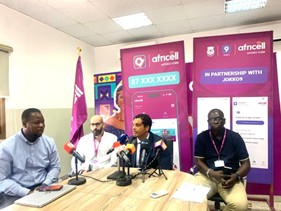
The numbering migration is being implemented with the support of the Public Utilities Regulatory Authority (PURA), the Ministry of Communication and Digital Economy and the Government of The Gambia.
Diab said the country currently has about 10 million numbers available, a figure he described as increasingly inadequate given the country’s growing population and the fact that many people use multiple mobile phones.
“With a population of 2.8 million people, we have 10 million numbers,” Diab said, noting that if an estimated three million people each used three numbers, the country would already be approaching nine million numbers.
Under the new numbering arrangement, Africell customers will have 87 added to their existing numbers.
However, Diab said customers would not immediately lose access to their existing numbers, as the first phase of the migration will operate under a parallel-run system, allowing both the old and new numbers to work.
“What’s going to happen at midnight tonight is stage one. And it’s called the parallel run,” he explained.
“It means that both your old numbers and your new numbers are going to work.”
The CEO said the parallel system would remain in place until further notice, stressing that the company would not rush customers into the next phase of the migration until the public had gained sufficient understanding of the changes.
The wider national numbering capacity is expected to increase from 10 million to one billion numbers, representing a 100-fold expansion.
CEO Diab said the increase was necessary because telecommunications had grown significantly over the past decade, with mobile phones now playing a central role in communication and digital financial services.
He said the rapid growth had also made the recycling of inactive numbers necessary.
“When you don’t use it, it goes back into the system and someone else can use it,” he said, explaining that number recycling had been necessary because the available pool was becoming exhausted.
While the initial migration is expected to have limited immediate impact on customers, he said users could encounter changes when setting up WhatsApp or other applications on a new device.
He explained that verification codes, commonly sent through SMS, would eventually be directed to the new number format.
Existing WhatsApp accounts, however, would continue to function during the parallel-run period as long as customers did not migrate their accounts to a new device.
International calls could also experience temporary disruptions as telecommunications partners outside The Gambia adjust their systems to recognise the new numbering format.
Diab said Africell had already communicated with its international roaming partners about the change.
To help customers manage the transition, Africell is introducing a Contact Updater feature on its MyAfricell application.
The feature will automatically update affected local contacts by adding the new 87 prefix, saving customers from having to manually change potentially thousands of numbers in their phonebooks.
Africell is also supporting JOKO9, an application developed by young Gambians from the University of The Gambia, which provides another option for updating contacts.
The developers said the JOKO9 application operates locally on users’ phones and does not require an internet connection to update contacts.
Diab said Africell tested the application before supporting it, describing the initiative as an example of young Gambians developing technological solutions to address national challenges.
CEO Diab revealed that the numbering migration had been in preparation for the past two to three years, requiring significant investment to upgrade Africell’s network infrastructure.
He said the company had also embarked on nationwide sensitisation, visiting communities and explaining the changes in local languages.
Africell, he added, would continue supporting customers through its call centre throughout the migration.
The CEO acknowledged that the transition could come with challenges but expressed confidence that Gambians would adapt to the new system.
“It’s come to a point that we don’t have a choice anymore. If we don’t do it, we’re going to be left behind,” Diab said.