The policy provides a national framework to strengthen early warning systems, enhance coordinated responses, and safeguard peace and human security.
It provides clear guidelines for monitoring risks across health, security, crime, governance and environmental sectors, and establishes mechanisms for timely response. It also aligns with ECOWAS regional frameworks and international best practices.
The NEWAR Policy document is now the official reference document guiding all national and partner interventions in early warning and response. Stakeholders across government, civil society and international organisations are encouraged to align their strategies and programming with the policy to ensure coherence and sustainability.
NCCRM said it will provide technical guidance to institutions and partners on integrating the policy into their operations.
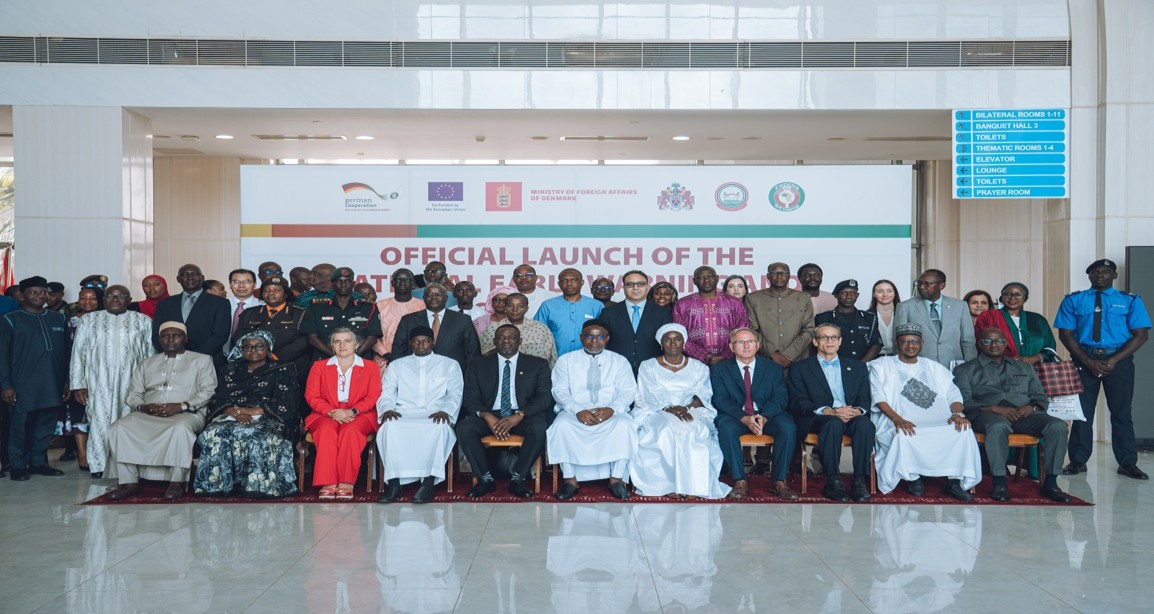
The launch event was attended by the Vice President of The Gambia, the European Union Ambassador, senior government officials, ECOWAS representatives and development partners.
Vice President Mohammed B.S. Jallow said risks facing societies today are increasingly complex and interconnected.
"This makes early warning and, more importantly, early response, essential to our national peace and security. This Policy provides us with a framework to move decisively from a culture of reaction to a culture of anticipation, prevention and preparedness," he said.
EU Ambassador to The Gambia, Imma Roca i Cortés, said crisis preparedness contributes to stability and sustainable peace.
"By anticipating risks and acting early, crisis preparedness and response actively contribute to stability and sustainable peace. As a close partner and friend of The Gambia, it is important for the European Union to accompany this National Early Warning and Response Mechanism Policy which will be instrumental to strengthen The Gambia's early warning systems," she said.
Director General of NCCRM, Binta Singhateh, said early warning and response is not the responsibility of one institution alone.
"It requires strong collaboration across government, local authorities, communities, civil society, traditional and faith leaders, individuals and institutions who share a common conviction that the best crisis is the prevented crisis and that the best warning is the one that leads to timely action," she said.
NCCRM was established by Executive Order No. 88 in 2019 and launched as a public institution under the Office of the Vice President in 2022. The Centre now operates under the National Early Warning and Response Mechanism Act, 2025, with a mandate to coordinate early warning and response systems and advise government on human security threats.
The development of the policy was supported through the EU Support to ECOWAS in Peace, Security and Governance Project, commissioned by Germany and co-financed by the EU and Denmark.