
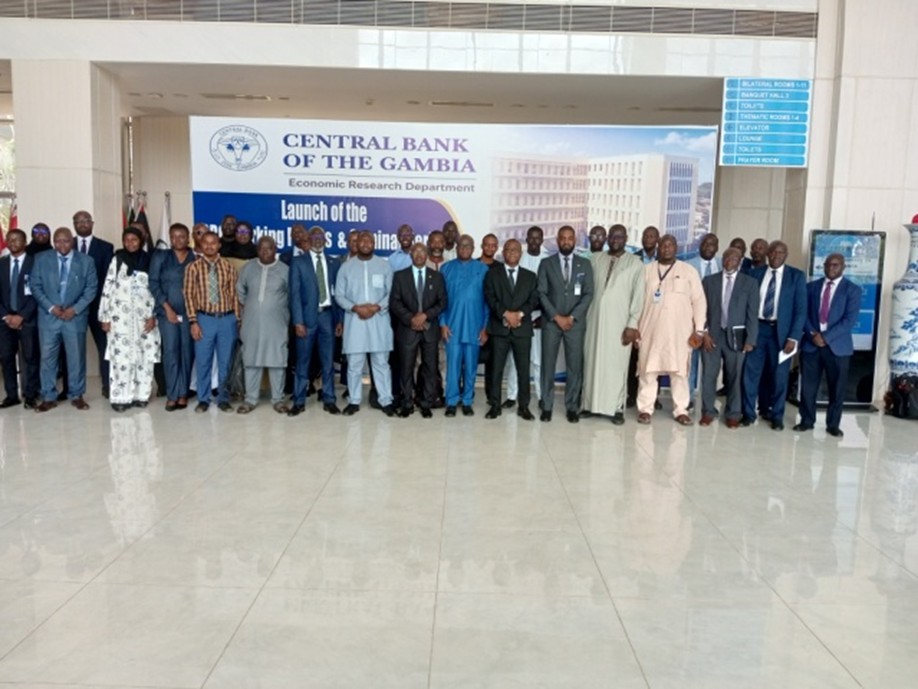
The ceremony was held at the Sir Dawda Kairaba Jawara International Conference Centre on Wednesday on 15July this year.
Speaking at the launch, senior officials emphasised that the program goes beyond a publication series. It is envisioned as a durable platform for rigorous research, intellectual exchange, and policy dialogue to enrich national economic discourse.
First Deputy Governor Dr Abdoulie Sireh Jallow noted that the initiative comes at a critical time, as the global economy grapples with the lingering effects of the COVID-19 pandemic, geopolitical tensions, climate shocks, commodity price volatility, and rapid technological change. Small open economies like The Gambia remain particularly vulnerable, making sound policies backed by credible data more vital than ever.
“Credible policy begins with a clear framework, institutional agility, and applied research,” the Bank stated, underscoring ongoing reforms to modernize monetary policy and strengthen transparency and accountability.
Guided by the Central Bank Research Agenda, the initiative will focus on issues relevant to the Gambian economy. A bi-annual seminar series will provide a forum for presenting new research and engaging policymakers, academics, financial sector professionals, development partners, and students.
Officials highlighted the importance of partnerships with universities, government agencies, international institutions, and other African central banks to build research capacity and promote knowledge sharing.
The Bank also reaffirmed its commitment to nurturing young professionals, noting the recruitment of 17 graduates in 2024 most of them women. Many of these recruits have already contributed to high-level policy discussions, reflecting the institution’s dedication to cultivating the next generation of Gambian economists.
As advances in data science, artificial intelligence, and digital technology reshape the global financial landscape, the Central Bank pledged to embrace innovation while upholding professionalism, transparency, and scientific rigour.
The event concluded with a call to all stakeholders, academia, civil servants, private sector experts, and international partners to reaffirm their commitment to advancing knowledge through credible research in support of macroeconomic management and national development.
Dr Lamin Bojang, representative of the Ministry of Finance and Economic Affairs, underscored the importance of rigorous analysis in navigating today’s complex global economic landscape. “Research is not merely an academic exercise; it is one of the most valuable tools available to policymakers,” he emphasised.
He said that across the globe, governments face mounting challenges: persistent inflationary pressures, heightened uncertainty, climate-related shocks, rising debt vulnerabilities, and rapid technological transformation. "In such an environment, decisions must be grounded in empirical analysis and credible data rather than institutional experience alone," he emphasised.
He mentioned that high-level research enables governments and central banks to understand the drivers of economic developments, anticipate risks, assess policy trade-offs, and evaluate the effectiveness of interventions. "For the Ministry of Finance, research plays a central role throughout the policy cycle from policy design and implementation to monitoring and evaluation," he stated.
He explained whether preparing the national budget, developing medium-term fiscal frameworks, assessing sustainability, or evaluating public investment programs, robust analysis remains indispensable. Reliable data and sound frameworks provide clarity on growth, inflation, and other key indicators, ensuring policies are both effective and sustainable.
He also highlighted the importance of collaboration with the Central Bank of The Gambia. Harmonized fiscal and monetary policies serve as complementary instruments to achieve sustainable growth, price stability, and external resilience, he noted, saying this collaboration is strengthened when institutions rely on shared evidence and common analytical foundations.