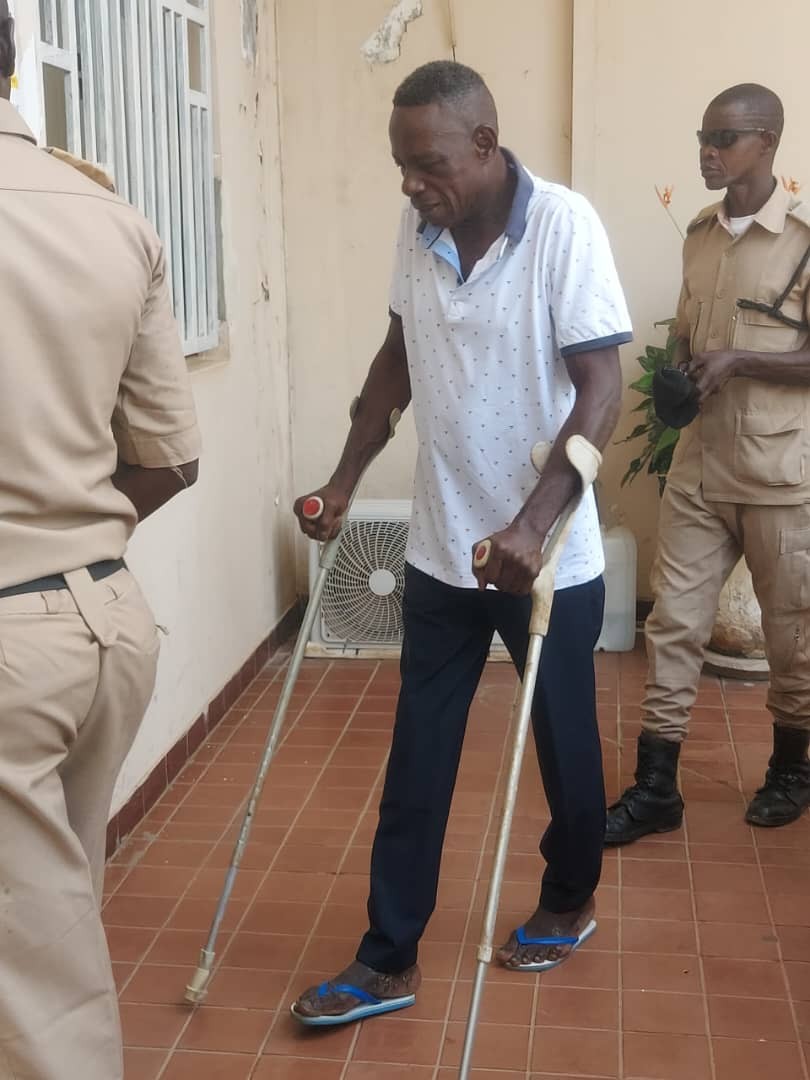
Delivering judgment on Tuesday, 10 February 2026, Justice Ebrima Jaiteh ruled that the prosecution failed to prove its case beyond reasonable doubt on both counts of arson and interference with judicial proceedings, stressing that suspicion or public disapproval could not substitute proof in criminal trials.
“In criminal proceedings, suspicion, conjecture, or public disapproval, no matter how strong, cannot take the place of proof,” Justice Jaiteh held.
Before Justice Jaiteh, Counsels S. L. Jobarteh and B. J. Konjira appeared for the State whilst K. Jallow and F. Bondi appeared for the Accused.
Sanyang had been charged with arson under section 305(a) of the Criminal Code, accused of financing and facilitating the burning of the APRC Bureau in August 2016. He also faced a second charge under section 99(1)(d)(i) of the Criminal Offences Act, 2025, for allegedly interfering with judicial proceedings through remarks made during a live broadcast of Coffee Time with Peter Gomez on West Coast Radio.
The prosecution called seven witnesses and tendered nine exhibits, including a cautionary statement, an investigation report, and video and audio recordings of the radio interview. Sanyang testified as the sole defence witness.
The State submitted that the sole issue for determination was whether it had proved its case beyond a reasonable doubt. It argued that, having survived a no-case-to-answer submission, the evidential burden had been fully discharged through the quality and consistency of its evidence, relying on section 144 of the Evidence Act, 1994.
On the arson charge, the prosecution maintained that the burning of the APRC Bureau was proved through the testimony of an eyewitness, PW6, who was on duty at the premises on the night of the incident. It further contended that Sanyang’s admissions contained in his cautionary statement and the recorded radio interview demonstrated that he financially contributed to and facilitated the burning, even though he was not physically present at the scene.
Relying on sections 23 and 24 of the Criminal Code, the State argued that physical absence did not absolve Sanyang of liability, as the law equally punishes those who aid, abet, counsel, or procure the commission of an offence. The prosecution insisted that the alleged admissions were consistent, mutually corroborative, and sufficient to ground a conviction.
On the second count, the prosecution argued that Sanyang’s description of the courts as “clandestine” and “controlled”, his accusations of wasted public resources, and insinuations of executive influence during an ongoing case were of prejudicing proceedings particularly The State v. Ousainou Bojang and undermining public confidence in the judiciary.
The defence countered that the burden of proof rested entirely on the prosecution and never shifted, relying on sections 141 and 144 of the Evidence Act and the authority of Woolmington v DPP. It argued that the prosecution failed to adduce credible and compelling evidence to establish guilt beyond a reasonable doubt.
On arson, the defence submitted that the prosecution failed to prove essential ingredients of the offence, noting the absence of proof of ownership of the alleged building, lack of forensic or expert evidence on the cause of the fire, and the complete absence of eyewitness testimony linking Sanyang to the act.
Counsel further attacked the reliability of PW6’s testimony, pointing out that the witness could not identify the perpetrators, admitting the incident occurred in darkness, and described masked individuals. The defence argued that no independent evidence such as financial records, transaction trails, or testimony from alleged co-conspirators was produced to support claims of aiding or abetting.
It was further submitted that the alleged admissions did not amount to a valid confession under section 31 of the Evidence Act and, at best, constituted extra-judicial admissions requiring independent corroboration, which was lacking.
The defence stressed that Sanyang had retracted the alleged admissions, thereby heightening the prosecution’s burden.
On the interference charge, the defence maintained that the comments amounted to fair criticism protected by freedom of expression and the prosecution failed to demonstrate any real or realistic risk of prejudice particularly in a non-jury system.
Justice Jaiteh identified a single overarching issue for determination: whether the prosecution proved its case beyond a reasonable doubt.
“In criminal proceedings, the legal and evidential burden of proof rests squarely and throughout on the prosecution and never shifts,” the judge stated.
On the arson charge, the court accepted that the APRC Bureau was willfully set on fire but held that the prosecution failed to establish Sanyang’s criminal responsibility by providing substantial evidences.
“The sole eyewitness to the arson could not identify the perpetrators,” Justice Jaiteh noted, adding that the court found “a complete absence of independent corroborative evidence” linking Sanyang to the alleged financing or facilitation of the attack.
Regarding interference with judicial proceedings, Justice Jaiteh acknowledged that judicial proceedings were pending at the time of the radio interview and that Sanyang did comment on them. However, he held that the offence requires intentional conduct calculated to obstruct or prejudice the administration of justice, not merely criticism or provocative speech.
“Robust or even ill-advised criticism of the courts does not, without more, amount to criminal interference,” the judge held.
The court found that no evidence was led to show that the remarks influenced judicial officers, interfered with proceedings, or posed a real risk to the fair administration of justice.
Citing the landmark case Ambard v Attorney-General for Trinidad and Tobago, Justice Jaiteh reiterated that justice “is not a cloistered virtue” and must tolerate public scrutiny and criticism, particularly in a non-jury system where the threshold for establishing prejudice is necessarily high.
“The court is not prepared to equate controversial public commentary with criminal interference, as to do so would unduly curtail constitutionally protected expression,” he ruled.
In concluding, Justice Jaiteh ruled that the prosecution failed to discharge its burden of proof on both counts.
“Where the prosecution fails to establish the essential ingredients of an offence beyond a reasonable doubt, the court has no discretion but to acquit,” he said.
Abdoulie Sanyang was therefore acquitted and discharged of the charges of arson and interference with judicial proceedings.