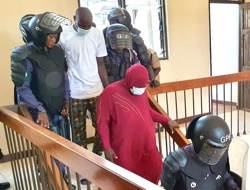
The defence submission follows the prosecution’s earlier final address in which the state led by the Director of prosecutions (DDP) A.M. Yusuf urged the court to convict Bojang on five counts, including murder, acts of terrorism and attempted murder. His sister, Amie Bojang, is also charged with being an accessory after the fact to murder for allegedly helping him flee to Senegal after the incident.
The case arises from the September 12, 2023 shooting at the Sukuta–Jabang traffic lights in which Police Constables Sang J. Gomez and Pateh Jallow were fatally shot and killed while on duty. A third police officer was also seriously wounded during the attack.
Defense Disputes Alleged Confession
In his reply, Darboe argued that the prosecution had misconceived the legal definition of a confession under Section 31 of the Evidence Act
According to the defense, the law provides that a confession made while a suspect is under arrest, detention or restriction by state agents is only admissible if it is made in writing and signed or thumbprinted by the accused in the presence of an independent witness who is not a member of the police, armed forces or other security services.
The defense maintained that statements allegedly attributed to Bojang by prosecution witnesses do not meet these legal requirements and therefore cannot properly be characterised as confessions.
Counsel Darboe also argued that even where a confession is admitted in evidence, courts are required to look for independent corroborating evidence before relying on it to establish guilt.
“There is no evidence before this court corroborating the alleged confessional statements,” the defence submitted, adding that the accused was never placed at the scene of the incident by credible evidence.
Defense Points to Contradictions in Eyewitness Accounts
The defense further challenged the reliability of eyewitness testimony presented by the prosecution.
According to counsel Darboe, witnesses who claimed to have been present at the scene provided conflicting descriptions of what the shooter was wearing on the night of the incident.
One witness told the court the attacker wore a yellowish shirt and three-quarter trousers, while another described a yellow or cream kaftan.
The defense argued that those inconsistencies are not minor discrepancies but significant contradictions that undermine the credibility of the identification evidence.
Counsel also disputed the prosecution’s reliance on identification by witnesses who did not previously know the accused.
According to the defense, the witnesses observed the attacker from a distance at night while he was armed, circumstances that limited their ability to clearly identify the perpetrator.
“The description that the assailant was taller than the witness and wore a yellow shirt could describe a large portion of the population,” Darboe argued.
Recorded Conversation and Evidence Concerns
The defense also referred to a recorded conversation tendered before the court as an exhibit, arguing that it contradicts the prosecution’s suggestion that the accused made an admission related to the shooting.
According to the defence, the recording reveals the accused discussing a dispute with a woman rather than the Sukuta–Jabang shooting incident.
Counsel urged the court to carefully examine how the alleged confessional statements were obtained and to consider whether they were made voluntarily.
Challenge to Terrorism Charge
Darboe also argued that the charge of terrorism against Bojang should not stand because investigators allegedly failed to comply with procedural requirements under the Anti-Terrorism Act.
According to the defence, the law requires investigators to keep custody records and video recordings of persons detained in connection with terrorism investigations.
The defence told the court that no such records or recordings were presented during the trial, arguing that the prosecution had therefore failed to establish the terrorism charge.
Defence Maintains Alibi
The defence further insisted that Bojang had raised an alibi during the investigation, maintaining that he was in Brufut at the time of the shooting.
Several defence witnesses testified that they saw him there that evening. Another witness also told the court that she was in continuous communication with the accused through WhatsApp during the period and knew he was in Brufut because he was using a guesthouse Wi-Fi network.
According to the defence, the accused provided investigators with his phone during questioning so that his communications could be verified, but counsel argued that investigators failed to properly examine the information.
Prosecution Earlier Urged for Conviction
In its earlier final address, the prosecution argued that the evidence against the accused was “overwhelming” and had remained “unshaken” throughout the trial.
Prosecutors relied on eyewitness testimony, medical findings and statements allegedly made by the accused to various witnesses.
Two soldiers who testified in the case told the court they witnessed the shooting while returning from the beach and later chased the gunman before he turned and fired several shots at them.
Medical evidence presented by a pathologist also concluded that the two police officers died from gunshot wounds that caused massive hemorrhage.
Prosecutors further told the court that the accused allegedly revealed details about the incident after his arrest near the Senegalese border, including shooting the windscreen of a vehicle at the scene because he believed the driver was recording him.
The state also relied on testimony from a Senegal-based marabout who told the court that the accused confessed the killings while seeking spiritual protection and financial assistance.
Regarding the second accused, Amie Bojang, prosecutors argued that she knowingly helped her brother escape after the shooting by accompanying him to the Darsilami–Giboro border crossing into Senegal.
With both the prosecution and defence having filed their final submissions, the High Court is expected to deliver the judgment on the 30th March 2026.