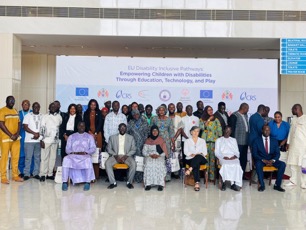
The €1,117,595 initiative, an equivalent of D95.7 million, aims to empower children with disabilities through improved access to education, technology, rehabilitation services, and inclusive play environments.
The 33-month project is implemented by CRS with €950,000 allocated specifically to Lot 2, which focuses on children with disabilities up to lower secondary education. The initiative places children with disabilities both boys and girls at the centre of national development efforts, promoting safe, inclusive and supportive learning spaces.
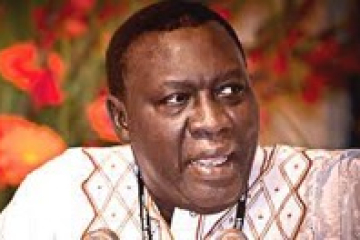
Speaking at the launch, CRS Country Manager Dr. Amulai Touray described the project as both a celebration of progress and a renewed commitment to inclusion. He acknowledged the European Union as the principal funder and disclosed that CRS has provided an additional 15 percent cost share to complement EU support. He emphasised that the project reflects CRS’s belief that every child, regardless of ability, deserves quality education and opportunities to thrive.
Dr. Touray explained that the project was developed through extensive consultations with key government institutions, including the Ministry of Basic and Secondary Education and the Ministry of Gender, Children and Social Welfare, ensuring alignment with national priorities. He also revealed that a nationwide awareness caravan reached 33 communities, leading to increased registration of children with disabilities, with 117 children identified in a single community in the Upper River Region.
The European Union Ambassador to The Gambia, Her Excellency Immaculada Roca Cortés, described the initiative as a direct response to the deep-rooted inequalities children with disabilities face. She highlighted systemic barriers such as inaccessible schools, lack of assistive devices, weak early identification services, and limited family support. She warned that girls with disabilities face compounded risks due to harmful gender norms and stressed that inclusion without protection is incomplete.
Ambassador Cortés praised the project’s holistic approach, noting that it strengthens inclusive education systems, improves school infrastructure, expands access to assistive devices, and enhances early intervention services. She reaffirmed the EU’s long-term commitment to disability inclusion, explaining that the project complements other EU-supported initiatives targeting amputee communities, students with disabilities, and vulnerable families.
Minister for Basic and Secondary Education Dr. Abibatou Drammeh welcomed the project as timely and transformative, emphasising its role in strengthening inclusive education and child protection.
The Permanent Secretary at the Ministry of Gender, Children and Social Welfare, Mr. Illo Jallow, stressed that disability is not inability, noting that societal barriers are the true limitations facing children with disabilities.
Chairman of the Gambia Federation of the Disabled, Magistrate Muhammed Krubally, described the project as a historic milestone aligned with national laws and international conventions, including the UN Convention on the Rights of Persons with Disabilities.
The project will directly support 12 mainstream schools, train teachers and administrators, strengthen the Gambia National Rehabilitation Centre, provide assistive devices to at least 100 children, guide parents and caregivers, and roll out media campaigns and school clubs to combat stigma. It will be implemented in Kanifing Municipality, West Coast and North Bank Regions.