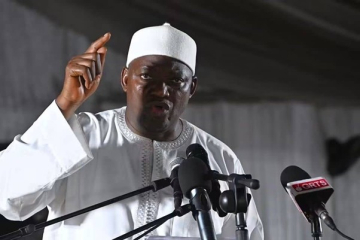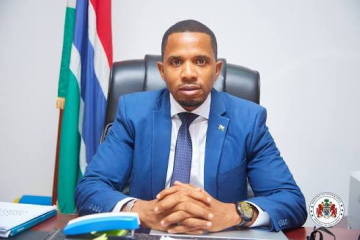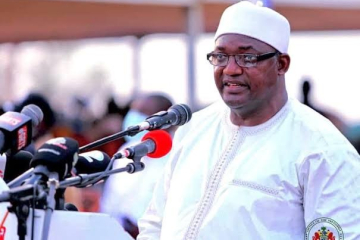
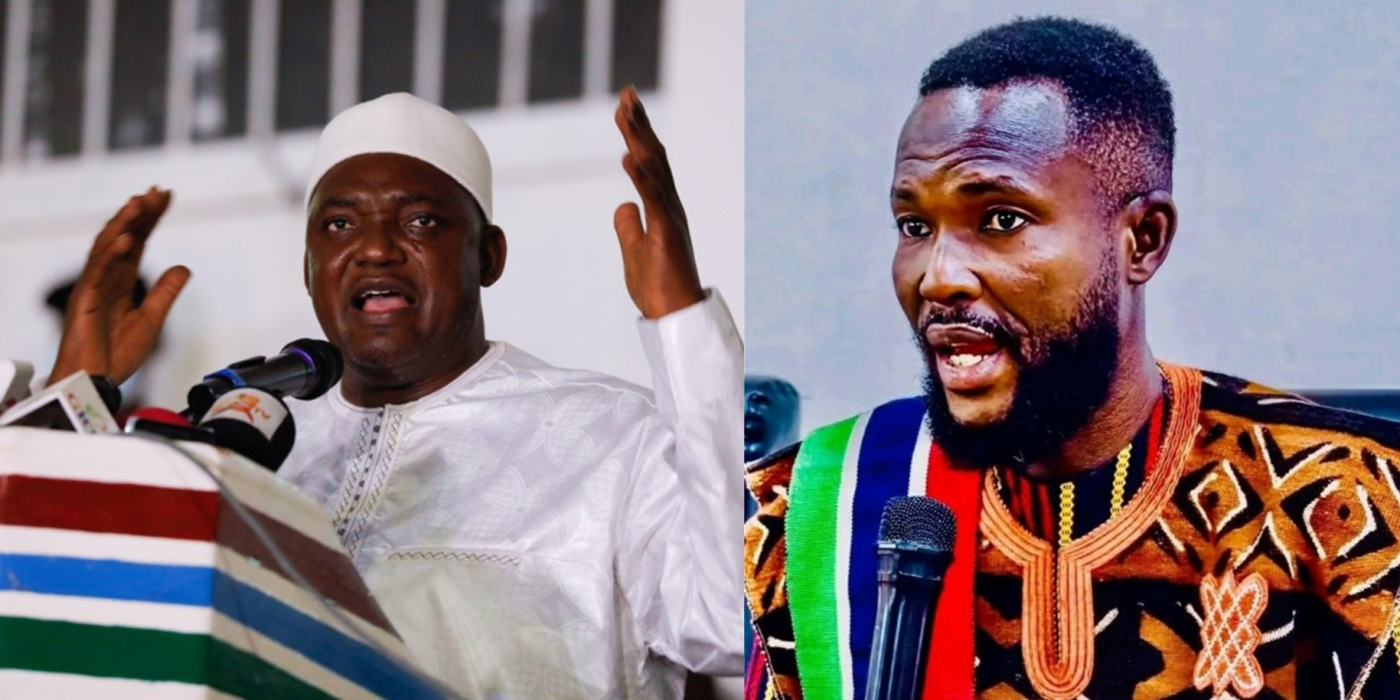
President Adama Barrow has issued a strong warning to Banjul North National Assembly Member (NAM), Hon. Momodou Lamin Bah, over a recent candlelight protest that attempted to march towards the State House, describing the action as a serious offence and cautioning that any repeat would attract severe consequences.
Speaking in Banjul on 19 October 2026 during the final stop of his Meet the People Tour, President Barrow condemned the protest organised by youths following a 48-hour electricity outage in the capital, arguing that targeting the State House crossed a red line.
The President described the action as a treasonable offence and remarked that the protesters would have faced a much harsher response under former President Yahya Jammeh.
"There is an issue that we must discuss. One month ago, your National Assembly Member for Banjul North mobilised children. They lit candles and attempted to go to the State House to protest because they said Banjul had been without electricity for 24 or 48 hours," Barrow said.
Recalling earlier periods of prolonged power shortages in Banjul, the President questioned the rationale behind the protest.
"They committed a very serious crime. It is a treasonable offence because you should not target the State House. If it had been President Jammeh at the State House, he would have shot all of them," he stated.
Barrow further warned the lawmaker against organising a similar demonstration in future, insisting that his tolerance should not be mistaken for weakness.
"But we are warning him: this is the last time. If he goes there again, by God, I swear he will not do it again. We will do something to him that he will never forget until he dies. Being tolerant does not mean that you are afraid. If I were afraid, I would not have faced former President Yahya Jammeh. This is the final warning. If he tries it again, I swear to God, he will not do it again," the President warned.
The President also took aim at Hon. Bah's performance as Banjul North's representative, arguing that development projects undertaken in Tobacco Road were delivered by his government rather than the NAM.
He urged constituents to consider electing a different representative, claiming the lawmaker had neither assisted the people of Banjul North nor supported government development efforts.
Bah hits back
In a swift response Hon. Bah rejected the President's claims, insisting that he would not be intimidated for standing up for his constituents.
The Banjul North lawmaker described the candlelight protest as peaceful, lawful and dignified, arguing that it was organised to demand accountability and improved service delivery.
"My only offence is better representing my people and leading the first-ever peaceful candlelight protest in the City of Banjul. It was a peaceful, lawful and dignified gathering of ordinary Gambians demanding honesty, dignity and respect in governance. We held candles, not weapons," Bah said.
According to Bah, the protest was conducted after the required notification had been submitted to the authorities and was fully protected under Section 25 of the 1997 Constitution, which guarantees freedom of assembly and expression.
"To be threatened by the Head of State for such an act is profoundly disappointing and dangerously out of touch with the democracy we all fought for," he added.
Bah further expressed concerns for his safety, saying he had reason to believe that his life and political work had been placed at risk because of his representation of the people of Banjul North.
He said he would hold the President personally responsible should any harm befall him or members of his family.
The lawmaker has since called on the Inspector General of Police to guarantee the security of his family, while urging the Speaker and leadership of the National Assembly to defend parliamentary immunity.
He also appealed to the National Human Rights Commission (NHRC), the Gambia Bar Association, civil society organisations, religious leaders, the media, ECOWAS, the African Union, the United Nations, the European Union and diplomatic missions to closely monitor what he described as a shrinking space for dissent in the country.
The exchange marks the latest political confrontation between the Presidency and the opposition-aligned lawmaker, and is likely to reignite debate over citizens' rights to protest, freedom of expression and the limits of political dissent in The Gambia.