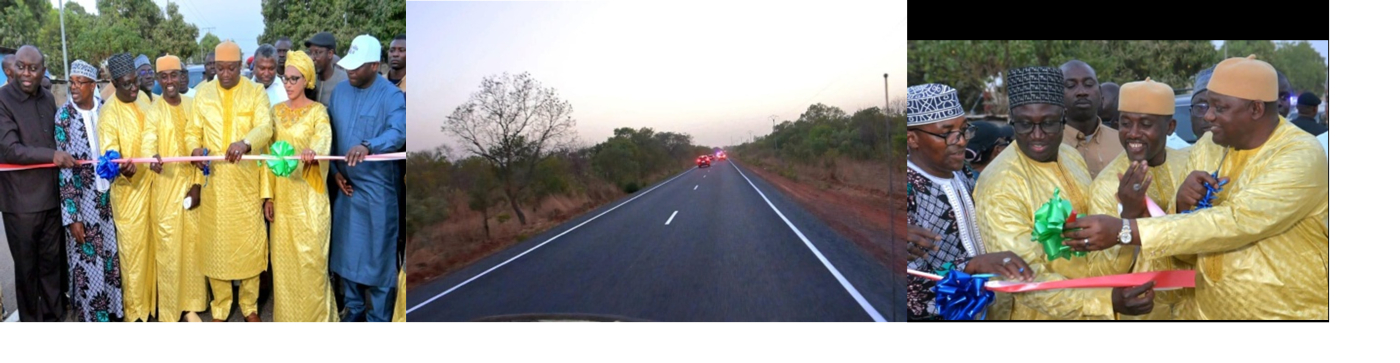
The inauguration ceremony in Jiffarong was charged with emotion. Hundreds lined the route, waving as the presidential convoy passed, echoing the collective relief of a community finally brought into the fold of national progress.
Officials from the National Roads Authority described the project as built to “standard,” assuring that the highway is expected to last decades. Beyond its asphalt and gravel, the road promises transformation: easier access to healthcare, stronger agriculture and trade.
Speaking at the inauguration ceremony, President Barrow underscored the significance of the road, saying: “Mindful that inadequate infrastructure contributes to rural-urban migration and constrains economic growth, my government’s policy is to decentralise development and create opportunities for all Gambian citizens, regardless of where they live. We continue to pursue this goal through sustained investments in roads, electricity, health services, and other critical infrastructure.”
For ages, he said, Kiang remained isolated, particularly during the rainy season. “Movement was difficult, economic activity constrained, and access to essential services limited. This has changed permanently.”
“The Kiang West Roads Project has opened the region to the rest of the country and, importantly, to the world for business. Farmers can now transport their produce efficiently to markets, and traders can expand their operations with reduced costs and improved reliability.”
“Furthermore, investors can access opportunities that were previously hindered by poor connectivity. This is what development means. It is about initiating real change in people’s lives and should be measured, ultimately, not only by the structures we build, but by the lives we improve.”
“Since 2017, my government has relied on domestic resources to finance major road development projects. This is unprecedented. Through domestic revenue, we have invested over GMD 18.5 billion and delivered more than 1,200 Km of all-weather roads.”
“We have significantly transformed connectivity and strengthened national ownership of development. This reflects our vision of using infrastructure as a driver of economic transformation, national integration, and inclusive growth.”
“By the end of 2026, my government will have added 375 Km of paved roads to the national network. This huge expansion is the result of strategic policy choices anchored in domestic resource mobilisation and innovative financing mechanisms.”
For his part, the managing director of the National Roads Authority (NRA), Sulayman Sumareh Janneh, said: “These roads are not merely strips of engineered pavement. They are pathways of possibility. They shorten distances that once separated farmers from markets, mothers from healthcare, children from schools, and communities from opportunity. Where journeys were once delayed by sand and seasonal floods, mobility now flows with purpose and dignity.”
From a technical perspective, he said, the project was executed with precision, foresight, and compliance with established engineering standards. Key features include a bituminous surface dressing, providing a durable, all weather riding surface capable of withstanding seasonal climatic variations, a carriageway width of 10 meters, inclusive of shoulders, designed to accommodate vehicular traffic and enhance pedestrian safety.
“The construction of hydraulic structures, including reinforced concrete culverts, side drains, and erosion control measure essential for effective stormwater management and long term pavement protection, Comprehensive earthworks, sub base, and base layers, executed with proper compaction to ensure structural strength, stability, and longevity, and integrated environmental protection measures, aimed at minimizing ecological disruption and promoting sustainable road infrastructure.”
Babanding Kinteh, speaking on behalf of the alkalo of Jifarong, emphasised the importance of the road, recalling the hardships villagers faced due to poor infrastructure.
Imam Ceesay of Kiaf echoed this sentiment, noting that although Kiang West had produced senior officials during the First Republic, the area had never witnessed such rapid development. He contrasted the current government’s approach with that of former regimes, stressing that President Adama Barrow chose reconciliation and progress over division.
Fabou Sanneh, a youth leader, highlighted the community’s long-standing frustrations, pointing out that despite paying taxes and voting, development had been slow. He urged the government to extend infrastructure deeper into the interior, provide electricity to underserved villages, and invest in skills centers and eco-tourism lodges. He praised the addition of bus services, hospitals, and a mini-stadium, describing Barrow’s decade in office as unprecedented for Kiang West.
Women’s representative Jalika Janneh recounted the difficulties of traveling to Kombo, where villagers often arrived covered in dust. She welcomed the new road and electricity, urging further investment in gardens, markets, and feeder roads to strengthen local livelihoods.
National Assembly member Maimuna Ceesay Darboe commended the president for addressing long-standing infrastructural gaps, dismissing claims that the project was merely taxpayer-funded by questioning why Kiang West had been neglected under previous governments.
Regional NPP Chairman Omar Drammeh called for a bridge to connect Kiang and Badibou, while Chief Lamin Drammeh praised the road’s potential to attract investors, boost tourism, and reduce rural-urban migration. He urged expansion of tertiary institutions, upgrading of schools, and provision of milling machines and fishing boats.
Paramount Chief Yahya Jarjusey recalled the days when traveling between interior communities took two days, describing the new road as a turning point. Regional Governor Seedy Lamin Bah emphasised the area’s tourism potential, noting that journeys that once took hours now take minutes.