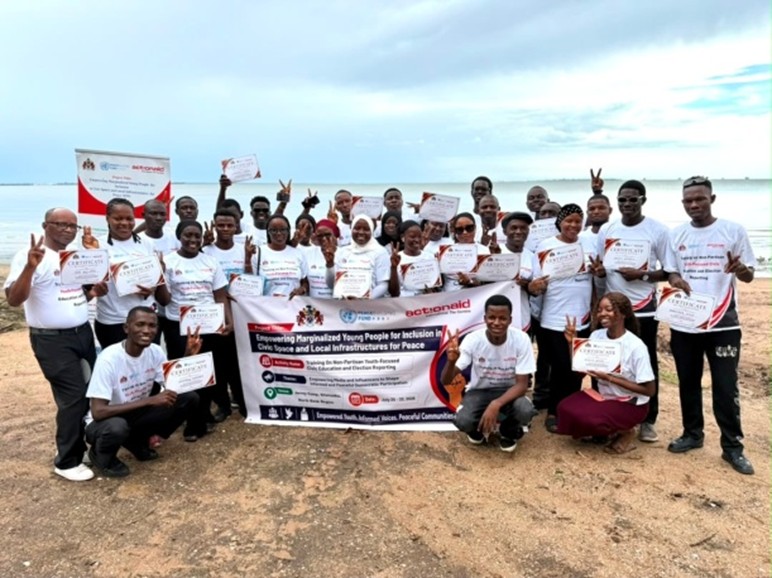
Participants will be equipped with practical skills to identify and counter misinformation, disinformation, and fake news, which tend to proliferate during election periods.
“In the Gambia, we have a lot of negative sentiments going around. Hate speech is all over the place. What we intend to do is to train you people to be our mouthpiece. Where we cannot reach, you reach there. Moreover, we want you people to report correctly. You report what you see and not be partisan. You should not be partisan because we want the Gambia to be the Gambia we want,” Bridget Tabou Corea, Youth Promotion Initiative Project Manager at ActionAid said.
Corea said the project aims at empowering marginalised young people to be included in the civic space. She said most times, the youth groups are sidelined and this project was supposed to come and empower them.
Corea said they have trained dozens of youth on Human Rights-Based Approach, conflict resolution and mediation. She said they have also trained youths and journalists, bloggers, to show them that they have rights as citizens of the Gambia.
“And they can do whatever they want. They can take up responsibilities in the civic space. This is the reason why we joined the journalists, bloggers and influencers so that they will come up with information to spread out, especially this one. It has to do with elections,” she said.
Alieu Jallow, a senior reporter with the Fatu Network considered the training both timely and highly relevant, especially with only a few months remaining before the country's December 2026 presidential election. He said the training’s importance cannot be overstated.
“Beyond informing the public, journalists have a duty to educate voters, promote issue-based discourse, and contribute to preserving the country’s social cohesion. We have seen on many occasions how politics can divide communities and even tear families apart. We have also witnessed the increasing use of inflammatory rhetoric, tribal sentiments, and hate speech by some political actors, all of which have the potential to undermine peace and national unity,” he said.
Jallow said the training reinforces the ethical and professional standards required of journalists during elections. He said it serves as an important reminder of the need for impartiality, accuracy, fairness, conflict-sensitive reporting, and responsible coverage of political events.
Jallow believes that elections are the cornerstone of any democracy as they provide citizens with the opportunity to freely choose their leaders and shape the future of their country. However, he said elections can also be periods of heightened political tension, misinformation, hate speech, and social division.
“In such moments, the media has a critical responsibility to provide accurate, balanced, and verified information while promoting peaceful coexistence and helping citizens make informed decisions,” he said.
Meanwhile, Eunice Akano, a student journalist from the University of The Gambia described the training as eye-opening, empowering and necessary. She said the training equipped her as a student journalist with tools to understand civic processes, promote voter education, and report on elections in a way that is accurate, balanced, and non-partisan.
Akano said the training’s focus on youth makes it especially relevant as the young people make up a large part of the electorate.
“As a journalism student, my role is not just to report events, but to inform the public responsibly. Understanding non-partisan reporting and civic education helps me avoid bias, misinformation, and sensationalism, especially on sensitive topics like elections,” she said.
She said the training also reminds her that as a journalist, her duty is to the truth and to the public, not to any party. This is the value she wants to carry into her journalistic career.
“It will help me cover the elections with clarity, fairness, and responsibility. I'll be better prepared to explain civic processes to my peers, fact-check claims, and report in a way that encourages youth participation instead of apathy or division. In short, it prepares me to be part of the solution,” she said.