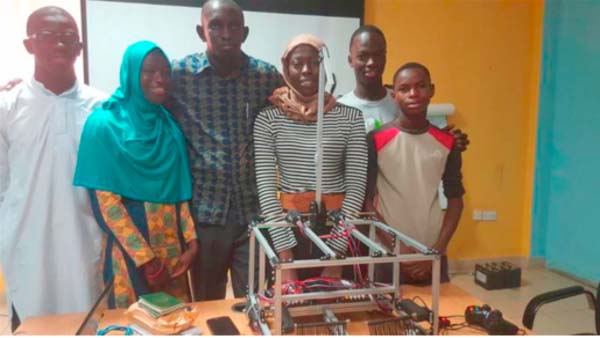
Five
teenage pupils from The Gambia who built a robot for a prestigious
international competition in the United States will not be able to accompany
their invention to the event after being denied a visa.
The
Gambian pupils become the second team of students refused entry to the US to
attend the FIRST Global robotics event in Washington, DC, on July 16-18. On
Saturday, it was reported that an all-girls team from Afghanistan were also
denied a visa to travel to the US to showcase their creation at the same
competition.
Moktar
Darboe, director of The Gambia’s ministry of higher education, research,
science and technology, told Al Jazeera that the team, made up of high school
pupils aged 17-18, were “very disappointed”.
“They
put in so much effort into building this, and now, after all the sacrifice and
energy they put in, they have been left disheartened,” Darboe, who is also the
team’s mentor, said on Monday.
The
robot, a ball sorting machine, will be shipped off in the next day or two, he
added.
The
Gambian American Association will represent the team at the event and the
students in The Gambia’s capital, Banjul, will watch it over Skype.
The
FIRST Global Challenge is open to students aged 15 to 18 from across the globe.
According to FIRST, around 158 countries will be represented, including 40
African countries. Only the teams from Afghanistan and The Gambia have had
their visas rejected so far.
Darboe
said that the visa was denied shortly after their interview at the US embassy
in Banjul in April. They were not given any explanation.
“We
were only told that we did not qualify and that we could try again.”
According
to Darboe, the students had to pay $170 each for the visa application. “Their
parents had to sacrifice a lot to pay this fee.”
The
students continued building the robot despite being denied the visa, hoping the
decision would ultimately change.
They
were further buoyed by a visit of US Ambassador C Patricia Alsup to their
project site last month.
“She
gave us hope not to give up, and she said they would give us all their support
to help us go further,” 17-year-old Khadijatou Gassam, a science student and
spokesperson for the team, said.
The
US embassy in Banjul told Al Jazeera that it did not comment on consular
affairs. Kevin Brosnahan, a spokesperson for the state department’s Bureau of
Consular Affairs, said he was unable to discuss individual visa cases.
‘Not
giving up’
Last
week, the US Supreme Court allowed the partial enforcement of President Donald
Trump’s travel ban on residents, citizens and refugees from six Muslim-majority
countries - but both The Gambia and Afghanistan are not on the list.
In
March, at least 60 African citizens were denied visas for African Global
Economic and Development Summit in the US state of California. Organiserssaid
at the time they were not sure if the rejection was linked to Trump’s
anti-immigrant policies or if talk of the travel ban was being used to “to
blatantly reject everyone”.
Darboe
said building the robot was difficult. When parts arrived, customs officials
took their time in releasing them. “They asked us if were building RoboCop,” he
said.
Fatoumata
Ceesay, the team’s programmer, told Al Jazeera that she had come to terms with
the fact their creation will be run by other students in the US.
The
17-year-old said they had worked under trying conditions, day and night, and
with little guidance over the entire Muslim holy fasting month of Ramadan.
“And
we started building it after the [visa] rejection. We built it despite knowing
we weren’t going,” she said.
Gassam
says that she was disappointed that she wouldn’t be able to represent The
Gambia and “show the world [that] ‘yes, we can do it’”.
“But
we’re not giving up, despite the challenges we face, we still continue to work
hard,” she said. “Next year it will be somewhere else, so I think next year we
have hope to get there.”