
Reviewed
by Michael
Bellesiles
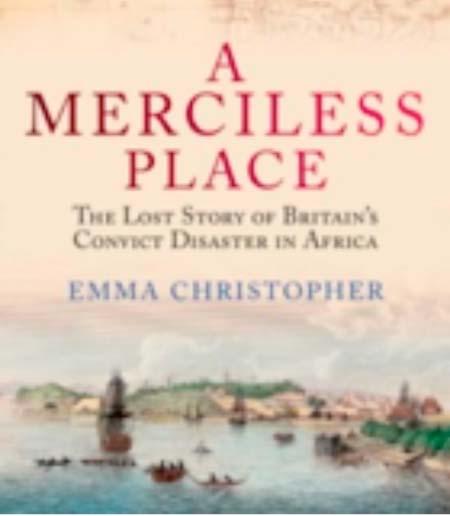
By Emma Christopher
It
is a rare pleasure to review a book that will appeal not only to the specialist
in the field, but also to the general reader. A Merciless Place is such a book,
a work of original scholarship that clearly indicates years of hard labour in
the archives, and also a beautifully crafted literary endeavour, one that
should attract anyone who appreciates excellent writing.
For
more than a century, England used its North American colonies as a dumping
ground for its unwanted criminals. Societies without prisons generally rely on
physical punishment and exile as punishment for all levels of crime. England
had used branding, beating, mutilation, and the death penalty for centuries. On
paper, British law relied heavily on the latter penalty for all sorts of
crimes, from petty theft to the most heinous acts of violence. By the latter
half of the eighteenth century, England had some 225 capital offenses on the
books. However, as many historians have pointed out, juries hesitated to
convict if they believed that a minor crime against property would result in
the death penalty. The legal system relieved that stress through the ingenious
mechanism of the king’s pardon commuting the death penalty into transportation
to the colonies. Few people objected to shipping common criminals off to North
America, with more than fifty thousand having been transported to the American
colonies by 1775. Transportation not only relieved the English of thousands of
criminals, but it also allowed them to treat their American cousins with
contempt, as when Samuel Johnson declared the Americans “a race of convicts,
and ought to be thankful for anything we allow them short of hanging.”
The
Americans were not consulted on this creative legal structure, but they gave
their opinion on many occasions, and it was decidedly negative. In 1759
Benjamin Franklin publicly complained that the policy was “an insult and
contempt, the cruellest perhaps that ever one people offered another”. He
suggested that it would only be fair for the colonies to ship rattlesnakes to
Britain in exchange. The American Revolution created a crisis for the British
legal system, which had a serious backlog of criminals sentenced to
transportation with nowhere to send them. Emma Christopher of the University of
Sydney gets to the obvious but previously unstudied question: what did Britain
do with its criminals when the United States came into existence? It is well
known that eventually the British government decided to use Australia as a home
for its undesirables, but I hate to admit that it never occurred to me to
wonder what happened to its criminals between 1776 and 1788. Christopher
provides the answer in fascinating detail.
After
the American Revolution London’s jails were bulging with men and women
sentenced to death. Lacking America as an alternative punishment, the courts
proceeded with executions in “an orgy of public slaughter,” the number of
hangings in Middlesex doubling between 1780 and 1785. Hundreds of sleight-of-hand artists and
petty criminals became caught up in a wild scheme of the government to dispose
of its convicts in the unlikeliest of places. Trying anything to avoid the
overuse of the death penalty yet faced with overcrowded prisons, the government
decided to try transporting their prisoners to some other remote location,
though in a rather nonchalant fashion. It decided to ship the lot of them off
somewhere--an attitude that would probably find many adherents in modern
America.
Captains
Kenneth Mackenzie and George Katenkamp sought to attain glory and position
fighting His Majesty’s war against the American rebels. They gained permission
from the War Office to raise two Independent Companies, reluctantly accepting
the enlistment of more than one hundred convicted criminals. There were a few
true scoundrels in the mix, most notoriously William Murray, a professional con
artist and thief who had escaped the gallows on several occasions. But most of
these “recruits” had been incarcerated and often sentenced to death for minor
offenses. For instance, John Plunkett, who had stolen three mirrors, thought
serving in the army could not be worse than His Majesty’s prison ships,
especially if he would be doing that service in North America. But on the day
they set sail, the members of the Independent Companies discovered that they
had been tricked by their government and were bound for Africa.
With
the collapse of Britain’s North American empire, Africa had become the new
focus of British greed and imperial schemes. But the British “died in droves,”
and the War Office quickly found it difficult to man their African
outposts--thus the logic of sending convicts rather than regulars who would be
better employed in safer climes.
Slaves
remained the major source of British wealth in Africa, the slave trade under
the control of the Royal African Company but they absolutely did not want the
convict soldiers. Racial attitudes complicated the effort to place criminals in
positions of both authority and servility in major slave-trading centers; the
Royal African Company warned that they would undermine the proclaimed racial
superiority of Englishmen. Governor Richard Miles wrote from his headquarters
at Cape Coast Castle that these convicts were a “Disgrace to the very Colour”.
He knew full well that the African merchants and monarchs were not the
powerless figures portrayed in imperial propaganda, but capable of crushing the
English slave trade if they ceased fearing British troops. Reinforcing Miles’s
concern, the convicts arrived at Cape Coast Castle on the Brookes, the slave
ship made notorious by William Elford’s much-reproduced diagram of the ship’s
hold crammed with slaves. It was not an auspicious beginning to this latest experiment
in criminal justice.
Much
of Christopher’s book is devoted to telling the bizarre story of the fate of
these convicts--men and women--who travelled unwillingly to the coast of
Africa. The reader shares the researcher’s sense of wonder as she explores yet
another outrageous aspect of Britain’s transportation policy.
It
is worth noting Christopher’s larger point, that the British government acted
to solve a domestic problem by sending convicts overseas without any planning,
lacking even a “specific destination”. No step of this operation seems to have
been thought through, as the convicts were dropped off without food or supplies
at remote imperial outposts. The result, as many contemporaries predicted, was
a catastrophe for those involved, making Africa synonymous with death. The Lord
Mayor of Plymouth, John Nicol, challenged the Home Office over its use of “so
severe a Sentence as that of Transportation [to] the Coast of Africa,” which
was tantamount to a death sentence.
Christopher takes a number of informative
detours into other dark corners of the empire, such as the corrupt rule of
Governor Joseph Wall on the island of Gorée--another convict dumping ground on
the coast of Africa that ended in a “reign of terror”. After the failure of the
Africa plan, the government tried America again, which led to two mutinies, an
inability to find buyers of the criminals’ indentures, and outrage from the new
U.S. government. Returning to Africa in 1785, the transportation of criminals
there again proved a debacle, as did the disastrous settlement of black
Loyalists in Sierra Leone. A proposal to develop South Africa with convicts in
order to make up for the loss of the American colonies also went pear shape.
Christopher
writes beautifully and with wit, personalizing this tragic history with
outstanding character sketches. There are also a number of evocative set
pieces, such as her description of public executions, the hell of British
prison ships, and the environment of west Africa. She concludes her book with Australia,
the settlement of which takes on new meaning in the context of these previous
efforts to deal with a deeply flawed legal system. After all, Australia was
first suggested as an appropriate dumping ground before the Lemane Commission,
which was looking into a harebrained scheme for convicts to grow wheat on an
island in the Gambia River.
Christopher
moves beyond traditional legal studies to give us a vision of the law’s impact
on the individual lives of the powerless and marginalized. She asks us to
imagine the consequences for a young man or woman who steals a handkerchief or
loaf of bread and is sentenced to transportation to the coast of Africa.
Thoroughly researched, brilliantly written, deeply humane, A Merciless Place is
a model of modern legal scholarship.
Available
at Timbooktoo, tel 4494345