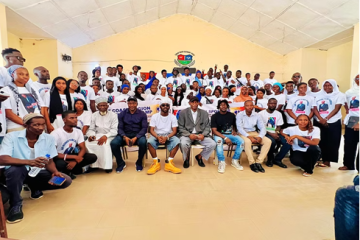

Gambian youth are striving to better their living standards through entrepreneurship, skills development (vocational/digital), agriculture, and leveraging digital platforms, despite facing high poverty and unemployment challenges.
Government and UN initiatives focused on training, job creation (tourism, ICT, agric), and policy support (National Youth Policy) to empower them away from risky migration ("back way") and towards national contribution.
Young Gambians are developing skills in trades, ICT, and business to create their own opportunities, often through vocational training programs.
Some youth are returning to agriculture, seeing it as a path to self-sufficiency, though they seek better support for storage and sales.
ICT skills are seen as crucial, with youth using online platforms for showcasing talent, mentorship, and accessing opportunities, notes UNFPA The Gambia.
Programmes such as the National Youth Service Scheme (NYSS) offer training, aiming to build skills for national development.
A significant portion of the population lives below the poverty line, and youth unemployment remains high across sectors, The Point and Afrobarometer report.
Farmers and entrepreneurs often lack adequate resources for storage, pricing, and investment, notes Sahel Films.
Primary completion is high, challenges persist in upper basic education and the prevalence of ICT skills.
The National Youth Policy (2019-2028) aims to empower youth for employability and enterprise.
The UN's Youth Empowerment Project (YEP) provides vocational training, while the ILO supports employment-intensive works in key sectors like agriculture and tourism, according to UN Gambia and International Labour Organisation.
In 2026, youth in The Gambia—who make up over 60% of the population—continue to strive for improved living standards through a combination of entrepreneurship, vocational training, and civic engagement.
Despite facing systemic challenges such as high unemployment (37.2% for those aged 13-30) and limited resources, young Gambians are increasingly shifting from seeking "white-collar" jobs towards self-employment in key economic sectors.
Many youths are launching micro, small, and medium-sized enterprises (MSMEs).
Initiatives like the Youth Empowerment Project (YEP) and "Kankiling" provide professional guidance, business advisory support, and access to finance for thousands of young entrepreneurs.
To bridge the skill gap, youth are enrolling in Technical and Vocational Education and Training (TVET) programmes focusing on modern manufacturing, services, and construction.
There is a growing movement to move away from low-productivity subsistence work towards modern, tech-driven farming, fisheries, and value-added agribusiness.
Young Gambians are leveraging digital platforms and STEM (Science, Technology, Engineering, and Mathematics) to drive innovation in energy, transportation and health sectors.
Economic desperation has historically driven youth towards irregular migration (the "backway").
In 2026, there is a renewed emphasis on "re-investing" in the local economy to provide a "future worth staying for".
High interest rates from local commercial banks remain a significant hurdle for youth-led startups.
There is a growing recognition of the need for mental health support and counseling to help youth navigate the emotional burdens of economic instability and social pressures.
This framework remains the primary guide for government and donor investment in youth development, focusing on employability and enterprise.
Organisations like the UNDP, UNICEF, and the International Labour Organization (ILO) support employment-intensive works in road infrastructure and tourism to create immediate income opportunities.
Youth are also engaging in governance, recently unveiling a Youth-Led Peace and Security Blueprint to ensure their voices are heard in national decision-making.