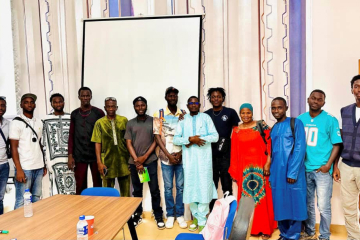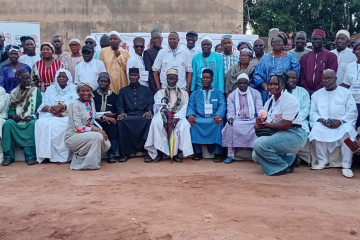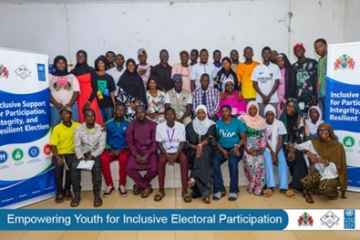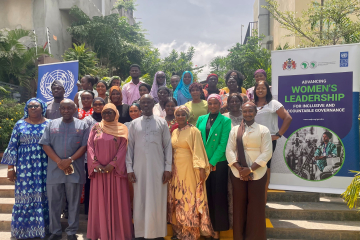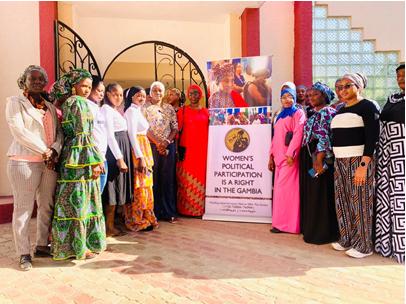
The initiative, supported by the Canada Fund for Local Initiatives, forms part of FLAG’s project Access to Justice and Enhancing Women’s Political Participation. While the first phase focused on community engagement, this latest stage aims to promote women’s involvement in politics at both grassroots and national levels.
In her opening remarks, FLAG Vice President Yassin Senghor described the session as “crucial and timely,” noting that the country faces presidential elections later this year, followed by legislative and local government polls in 2027.
Senghor reminded participants that women are the backbone of Gambian society: “We grow the food, build the businesses, and hold families together. We mobilise voters and sustain peace, yet when it comes to decision-making in our communities, economy, land, bodies, education, and future, women are absent from the table or severely underrepresented.”
According to the Independent Electoral Commission, women make up 56.68% of registered voters—545,318 out of 962,157. Yet in the 2022 elections, only three female candidates were elected, two of them independents. Senghor argued this reflects political parties’ reluctance to field women in winnable constituencies.
At the local level, female representation is equally bleak: just one woman heads one of the country’s eight administrative areas, and only three ministers in Cabinet are women. Senghor stressed that these figures are not due to a lack of capacity or ambition, but rather structural, cultural, financial, and political barriers “sustained by systems not designed with women in mind.”
She cited the failed 2021 attempt by MP Touma Njie to introduce a constitutional amendment increasing female representation in the National Assembly, which collapsed due to lack of quorum. “This shows a lack of commitment to ensuring sufficient female representation,” Senghor said. “Today is not just another workshop—it is a space for truth-telling, confronting uncomfortable realities, and addressing the intimidation women face in politics.”
Touma Njie, National Assembly Member for Banjul South, echoed these concerns. “When women are excluded from power, democracy loses its voice. And when women with disabilities are excluded, democracy loses not only its voice, but its conscience,” she said.
Njie highlighted that women occupy only 8% of seats in the National Assembly—five out of 58—and just three of those are elected. In the 2022 parliamentary elections, only 19 women contested, with three winning. At local government level, women represent just 15% of elected councillors.
“These numbers are not accidental,” Njie argued. “They reflect structural barriers rooted in culture, economics, political party systems, and limited access to resources and networks. For women with disabilities, exclusion is even deeper. Despite making up at least 10% of the population, persons with disabilities have no representation in the National Assembly, Cabinet, or local councils. For them, it is a double burden.”
Njie also shared her personal journey: “In 2017, I entered Parliament under a political party. Later, when I was expelled, my career seemed uncertain. Many would have stepped aside. Many would have accepted that politics was no longer their space. But I chose to remain.”
Both Senghor and Njie emphasised that democracy cannot be strong, legitimate, or sustainable when women who make up more than half the population, are excluded from shaping it.
“Women’s political participation is not a favour to be granted,” Senghor declared. “It is a right to be claimed. The Gambia stands at an important moment in its democratic journey.”