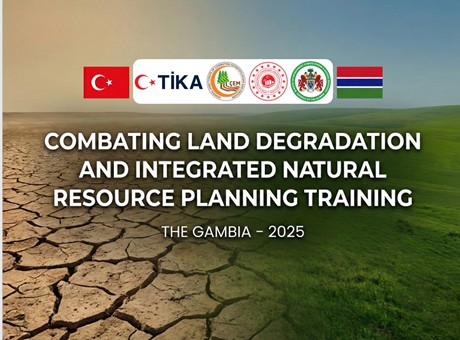
The training, held at the Senegambia Beach Hotel, brought together Gambian environmental professionals and technical experts to build knowledge and practical skills in land degradation management, erosion and flood control, water and soil conservation, carbon sink development, and integrated natural resource planning.
The programme drew on Türkiye’s experience in tackling desertification and land degradation, while adapting lessons to The Gambia’s local environmental and climatic conditions. It also sought to strengthen institutional capacity among African countries facing similar challenges linked to climate change, unsustainable land use, and environmental pressure.
The initiative falls under the TIKA Climate Action Program, which focuses on supporting partner countries to reduce the effects of climate change and improve ecosystem resilience through knowledge sharing, technical support, and capacity development.
Throughout the training, participants engaged in theoretical presentations, practical field applications, and interactive sessions that encouraged inter-institutional learning and experience sharing.
Speaking at the closing ceremony, Ali Kerim, Program Coordinator of the Turkish Cooperation and Coordination Agency (TIKA) in Banjul, praised the trainers for their commitment and expertise, while commending MECCNAR for its effective coordination and support.
He described the programme as a clear reflection of TIKA’s development cooperation approach, which prioritises knowledge transfer and long-term capacity building over short-term interventions.
“Our aim is to strengthen institutional capacity in The Gambia in key areas such as land degradation control, natural resource planning, and climate resilience,” Mr. Kerim said.
He explained that the training was deliberately designed to combine theory with hands-on practical experience, ensuring that participants could apply the lessons learned directly to local conditions. He added that the programme also highlights the strong and growing cooperation between Turkey and The Gambia in the areas of environmental protection and climate policy.
“We are encouraged by the level of cooperation and commitment shown by all stakeholders throughout this programme,” he said.
Representing the Ministry of Environment, Climate Change and Natural Resources, Momodou Kanyi, Principal Assistant Secretary, described the training as timely and impactful, noting that land degradation and desertification remain serious challenges facing the country.
Mr. Kanyi expressed appreciation to TIKA and the Turkish experts for the opportunity, saying the training had enhanced participants’ understanding of integrated land and climate management.
He noted that the programme adopted a two-way learning approach, allowing Gambian participants to share local experiences while benefiting from international best practices.
“I encourage all participants to make full use of the knowledge and skills acquired during this training in their work and policy deliberations,” he said.
Also addressing the gathering, F. Türker Oba, Turkish Ambassador to The Gambia, reaffirmed Turkey’s commitment to supporting The Gambia in addressing environmental challenges that threaten livelihoods and sustainable development.
“Our objective is always to support The Gambia in areas where support is needed,” Ambassador Oba said. “I am pleased to see that our team of four technical experts, together with TIKA specialists from Turkey, have successfully trained 47 Gambian professionals to a high level.”
He commended the participants for their professionalism and eagerness to improve their technical knowledge, noting that such commitment is essential for effective environmental management.
Ambassador Oba stressed that institutional capacity building is a critical step toward ensuring that The Gambia is able to design and implement sustainable solutions to its environmental challenges.
He reminded participants that the training should not be viewed as a one-off event, but as part of a wider effort to identify long-term solutions to land degradation and climate-related problems, while assuring them of his embassy’s continued support for similar capacity-building initiatives.