The event, held from January 21st to 23rd, 2026, at the Ocean Bay Hotel in Bakau, also seeks to create a platform for networking, knowledge sharing, and exchange to amplify and complement the efforts of project beneficiaries in promoting economic growth.
At the event, Ebrima Jawara, Permanent Secretary, MECCNAR, commended stakeholders and partners for their leadership, expertise, and commitment to building a locally driven, commercially viable, and sustainable economy.
Equally, he extended appreciation to the United Nations for its technical partnership, which he said, combines international expertise with national institutional strengths to deliver tailored solutions.
Aji Oulaye Njie, RICAR Project Coordinator, revealed that the project demonstrates that sustainable resilience is built through economic and knowledge empowerment of communities.
“Women and youth change agents were identified, trained, and supported to deliver essential climate and agricultural services in their communities. Their voluntary efforts were transitioned into viable rural enterprises through targeted financing, business development support, and the Rural Resilience and Entrepreneurship Award,” she said.
She added that with oversight from a multi-stakeholder committee led by the Ministry of Environment and Climate Change, selected enterprises were vetted for commercial, technical, and environmental viability.
The supported businesses, spanning livestock production, agroforestry, and forestry services, received specialised training and are now being integrated into national value chains through business linkages, financial inclusion, and digital integration, showcasing climate adaptation as a sustainable business opportunity.
Njundu Fatty, president of The Gambia Chamber of Commerce & Industry (GCCI), said the forum highlights a policy shift that connects climate resilience, rural development, and youth entrepreneurship as pillars of national development.
He stressed that sustainable growth requires active private sector engagement to mobilise investment, strengthen value chains, and scale climate-resilient enterprises, saying rural youth are key drivers of innovation in agriculture, renewable energy, and agribusiness.
The forum, he added, aims to turn policy commitments into practical partnerships by addressing finance, regulation, and investment barriers.
Baboucarr Kebbeh, Chief Executive Officer of the Gambia Start-up Chamber of Commerce (GSCC), highlighted the importance of regular stakeholder engagements with partners and members to strengthen collaboration and knowledge sharing.
He outlined that the GSCC roadmap, which focuses on empowering its members and regional coordinators, is also strengthening private sector participation in climate-resilient entrepreneurship, while creating sustainable linkages between rural enterprises and national value chains.
RICAR Project, GSCC engage stakeholders
I
Isatou Ceesay-Bah
The Point
Jan 27, 2026, 12:19 PM
3 min read
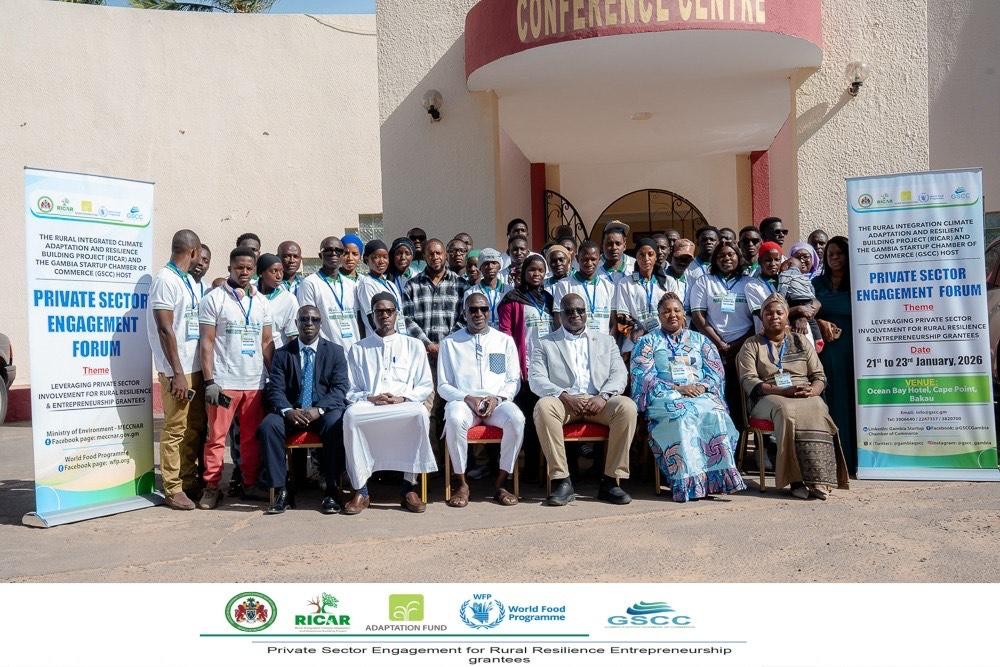
RICAR project 1
The Ministry of Environment, Climate Change and Natural Resources (MECCNAR) through the Rural Integrated Climate Adaptation and Resilience Building Project (RICAR), recently played host to a three-day private sector engagement forum on the theme “Leveraging Private Sector Involvement for Resilient Rural Entrepreneurship Grantees.”
Read Other Articles

UTG selects representatives for SDKJ International Moot Court Competition
Sep 28, 2026
Youth in NBR urged to move from rally crowds to real political power
Oct 13, 2026
GPPA trains procurement cadre on new act, regulations & standard documents
Oct 9, 2026
UNDP boosts NCCE with equipment to power civic education
Oct 21, 2026
Communities join forces to clean Kotu stream on Int’l Coastal Clean-up Day
Oct 2, 2026