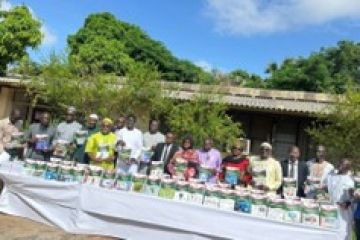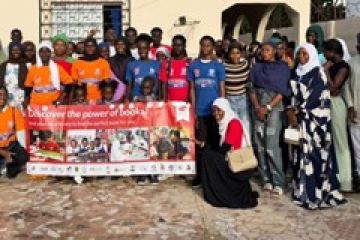
With businesses already operational in various rural communities, beneficiaries say they are now focused on scaling up their ventures to improve accessibility, increase profitability and further contribute to climate change adaptation—an outcome project officials describe as central to RICAR’s long-term goals.
RICAR is a five-year project funded by the World Food Programme (WFP) through the Adaptation Fund (AF), executed by the Ministry of Environment, Climate Change and Natural Resources (MECCNAR), and implemented in the Upper River Region (URR), Central River Region (CRR) North and South.
The project is designed to enhance the adaptive capacity of rural populations by supporting climate-resilient and diversified livelihoods, while reducing vulnerability to climate shocks.
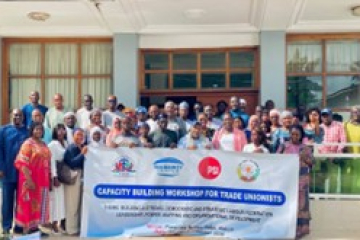
As part of its implementation strategy, RICAR partners with the National Nutrition Agency (NaNA) to deliver Social and Behaviour Change Communication (SBCC) activities through Multidisciplinary Facilitation Teams (MDFTs) and trained Community Change Agents.
The Change Agents are equipped to promote climate change mitigation and adaptation practices within their communities, while also receiving grants to venture into climate-smart businesses and agricultural activities that generate income and strengthen household resilience.
NaNA is also responsible for collecting and documenting human-interest stories under the project, highlighting the most significant changes resulting from the intervention.
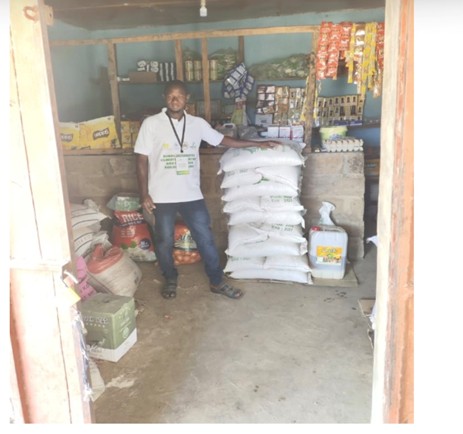
One such beneficiary is Bakary Kamaso, a RICAR Change Agent from Ali Makka village in Sadu District, Upper River Region, who invested his D250,000 grant into establishing a consumer shop—now officially registered with the support of the project.
“After a year or so, I would like to expand this business to other locations by opening more consumer shops, so that people can easily access food commodities within their communities,” Mr Kamaso said.
He explained that Change Agents were selected from three communities under Diabugu Ward to work closely with RICAR and local residents, ensuring community ownership and sustainability.
“I can never forget RICAR because of how it has positively changed my life and that of my family. If I were to write my history, I would definitely include RICAR in my life story,” he added.
Mr Kamaso noted that beneficiaries were required to submit business plans that posed no harm to the environment and this influenced his decision to open a consumer shop in an area where access to basic food items was previously limited.
“Now residents can buy foodstuffs nearby without hardship,” he said.
Another beneficiary, Saikou Dampha, a RICAR Change Agent from Jaga Jari village in Sandu District, also received a D250,000 grant, which he invested in sheep rearing as a climate-resilient livelihood activity.
Similarly, Ismaila Sanyang of Gada Faro in Kantora District, Upper River Region, ventured into animal husbandry, reinforcing efforts to combat climate change through diversified and sustainable income sources.
Collectively, the Change Agents have urged fellow beneficiaries to make prudent and productive use of project grants, while expressing gratitude to RICAR for what they described as a life-changing initiative for Gambian youths.
As climate challenges continue to affect rural livelihoods, the success of RICAR Change Agents underscores the growing impact of climate-smart investments in empowering communities, strengthening food security and advancing sustainable development in The Gambia.