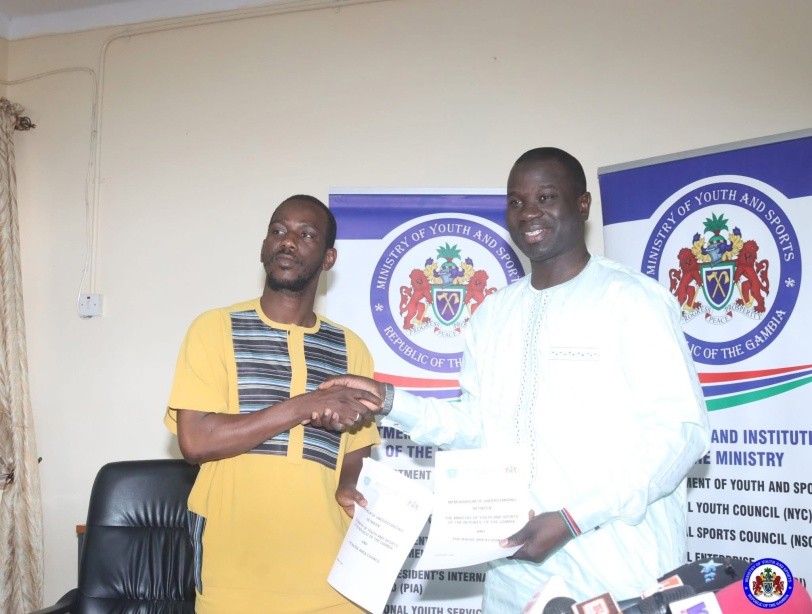
The agreement, signed in Banjul, forms part of the government’s broader decentralisation agenda, designed to empower local authorities to take ownership of sports facilities while ensuring alignment with national development goals.
Speaking at the ceremony, the Minister for Youth and Sports, Bakary Y. Badjie, reaffirmed government’s commitment to advancing sports nationwide. He described the partnership as a strategic step towards placing responsibility in the hands of local councils, while maintaining national standards through policy guidance and oversight.
The minister emphasised that strengthening grassroots sports remains central to the government’s vision. He noted that effective management structures at the local level will guarantee sustainability, improved standards, and greater community participation. He assured stakeholders that the Ministry would continue to provide direction to ensure the stadium operates in line with national expectations.
Chairman of the Basse Area Council, Honourable Mahamadou Ceesay, hailed the signing as a landmark achievement for the region. He acknowledged past criticism over the absence of a standard football competition in the Upper River Region, admitting the concerns were justified.
Between 2023 and 2025, he explained, the Council deliberately prioritised institutional strengthening over rapid infrastructure expansion. With limited financial resources and a modest annual budget, the leadership focused on building sound governance systems, accountability mechanisms, and financial discipline before embarking on major projects.
“We began with what we had, recognising that restoring confidence and strengthening internal structures were necessary steps towards sustainable progress,” he said.
Hon. Ceesay added that the Council studied best practices from other countries and adapted lessons suited to local realities to ensure long-term impact. He reaffirmed the Council’s readiness to support sporting competitions and collaborate with stakeholders to provide players with proper conditions, including improved lighting and essential logistics.
Permanent Secretary Mr Bulli Dibba and the Acting Executive Director of The Gambia National Sports Council also underscored the importance of structured management and community ownership in safeguarding the stadium’s future.
The ceremony concluded with the signing of documents and a symbolic handshake between representatives of both institutions, sealing a partnership many believe could redefine sports development in the region.