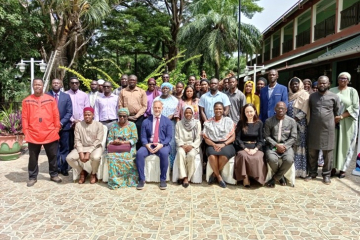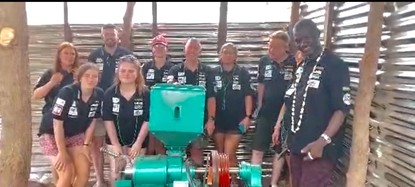
The new facility, handed over in a colourful ceremony attended by villagers and residents from neighbouring settlements, is expected to significantly transform agricultural productivity, reduce drudgery, and strengthen food security in the rural community.
For decades, women in Kankuntu have relied on manual pounding or travelled long distances to nearby communities to mill their rice - a process that consumed valuable time and energy. With the installation of the milling machine, rice can now be processed locally, allowing women to focus on other productive ventures while increasing household income.
The Alkalo of Kankuntu Landing, Saro Badjie, described the intervention as timely and impactful. He expressed profound gratitude to WYCE and its Irish partners, noting that the machine would free women from the exhausting labour of pounding cereals manually.
“This is a big relief for our women,” he said. “They have suffered for years, travelling far and spending hours pounding rice. Today marks a new chapter for our community.”
Speaking at the ceremony, WYCE Director Lamin Kijera emphasised that the project is designed to reduce hardship, save time, and promote agricultural value addition at the village level.
“This milling machine is not just equipment; it is a tool for empowerment,” he said. “It will reduce drudgery, improve efficiency, and create opportunities for women to enhance their incomes.”
Representatives of JOAL explained that the project forms part of their broader rural development initiatives implemented in collaboration with WYCE. They highlighted previous interventions, including educational projects and a laboratory in Medina Salaam, a borehole in Tenuna, and other small-scale water projects aimed at improving living standards in underserved communities.
WYCE Project Coordinator Malang Camara urged the community to take ownership of the facility and manage it responsibly to ensure sustainability.
“Before this machine arrived, beneficiaries had to travel to Brikama to process their cereals. Now the service is within reach. It is important that the community protects and maintains it for future generations,” he stated.
Beneficiary Musukebba Sanyang said the machine will drastically improve their lives. According to her, rice milling is a critical requirement in transforming raw paddy into edible rice by removing husks and bran layers, a process that previously required intense manual labour.
“This machine will enhance food security, increase productivity, and reduce labour costs,” she stated. “It means we can process our rice here in the village without travelling long distances.”
She also appealed to donors to support fencing of the community vegetable garden, which she said is often damaged by roaming animals, leading to losses before harvest.
Members of the JOAL delegation including President Stephen Roche, Vice President Matthew Hodgkiss, and Communication Manager Paul Dowling commended their partners and supporters back home for contributing to grassroots development efforts that directly improve rural livelihoods.
In his closing remarks, Village Development Committee Chairman Sambujang Dahaba said the project aligns with the community’s development agenda: focused on empowerment and sustainability.
“As a Village Development Committee, this is part of our broader plan to improve the livelihoods of our people, especially women, by reducing the burden of travelling long distances to process grains,” he said.
He added that although JOAL members come from different parts of Ireland, England, and Spain, they are united by a shared commitment to making a meaningful difference in The Gambia, which they consider their second home.
“As we hand over this milling project, we have one simple hope that it will make the day-to-day lives of the women of this village easier,” he said, while expressing gratitude to WYCE for facilitating the initiative.
For Kankuntu, the hum of the new milling machine now signals more than convenience; it represents dignity, empowerment, and a step forward in rural transformation.