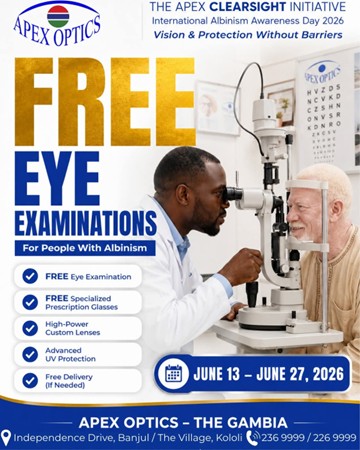
The initiative, which is part of their broader public outreach health interventions, seeks to address the complex visual vulnerabilities associated with oculocutaneous albinism.
Over a synchronised two-week period, Apex Optics clinical facilities and ophthalmic laboratories will provide completely free comprehensive eye examinations and custom, high-power, UV protective eyewear to the albinism community across the countries of operation.
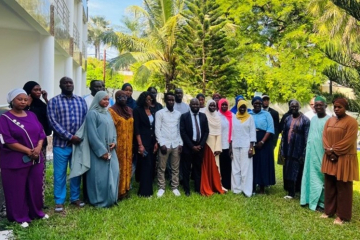
At the launch held on Saturday at its office at the Village, Senegambia, Mary Louis Gomez, Branch Manager Senegambia, recalled that Apex Optics began in Banjul in 1985 and from that beginning, the company has grown into original eye care and optical business servicing communities across The Gambia, Senegal, Sierra Leone, Liberia and Guinea.
“For nearly four decades, Apex has worked to provide professional eye care, quality, optical products, ethical service and respectful patient care. Today's launch is part of that same history. Albinism is often discussed mainly in terms of skin color or social stigma.”
However, she pointed out that albinism can also significantly affect vision, revealing that many people with the condition experience reduced vision, light sensitivity, involuntary eye movements, refractive errors and low vision challenges.
These issues, she added, can affect education, employment, mobility, confidence and daily life.
“The Apex Clear Sight Initiative is our professional response to these needs. Through this initiative, Apex Optics will provide eye assessment, optical correction where possible, advice on light sensitivity and glare, low vision guidance where needed and referral support where further care is required. This initiative is not about pity, it is about dignity, access, inclusion ad proper care.”
To this end, she paid glowing tribute to the Ministries of Health and Social Welfare and Social Security for their support, while also saluting the efforts of the Albinism Association of The Gambia.
Awa Bouye, a representative from the Albinism Association The Gambia, reminded the public about the plight faced by the albinism community in The Gambia, adding; ‘imagine a child sitting in a classroom, eager to learn, but unable because he or she cannot see what is written on the board’.
Those, among others, she said, are just some of the challenges many persons with Albinism face especially in the Gambia, where awareness raising lacks on the challenges of visual impairment in Albinism in schools.
“And this may result of many people with Albinism in schools performed poorly in exams, in assessment.”
In his keynote address on behalf of the Health Ministry, Dr. Abubacar Bojang, described the initiative as important as it addresses real life public health and social inclusion needs.
“People with albinism may face visual challenges that affect their education, employment, mobility, independence and quality of life. These challenges require awareness, early assessment, proper correction and appropriate support.” He added.
Dr Beatrice Omoregba, a representative from Social Welfare, reminded that the launch of the initiative marks an important moment in view of the fact that people with albinism are both health-related and social.
Social inclusion, she added, is not achieved by words alone, adding that it requires practical support, access to services, public understanding and institutional cooperation.
Dr. Benjamin Rimamnde, revealed that albinism is not only a skin pigmentation condition, but that it can also affect both visual and eye development.
However, he noted that not every person with Albinism has the same level of visual difficulty, saying some have mild visual challenges, while others may have significant visual impairment.
International Albinism Day is a set aside by the United Nations General Assembly, after adopting the resolution on Albinism that 13 June be celebrated as International Albinism Awareness Day to raise awareness, confront challenges and concerns affecting the Albinism community.