The foundation came about following series of consultations and meetings and is now legally registered under the Companies Act 2013 in the Republic of The Gambia.
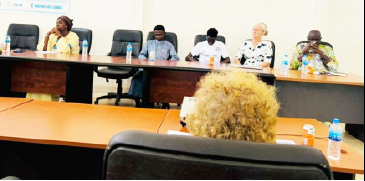
Speaking at the launch, Lamin K. Ceesay, chairman Hope for Health Foundation, described the day as another major milestone in that shared journey.
“Today's gathering serves us two important purposes. First, to officially launch Hope for Health Foundation and to introduce it to the Gambian community. Second, to demonstrate our commitment in preventive health care through free health screening which will be conducted after the launching program, which is mainly focused on hypertension and diabetes screening.”
The initiative, he added, reflects their dual approach, supporting underprivileged sick individuals in hospitals, while also promoting prevention, early detection within local communities.
He pointed out that HHF was conceived from a simple but painful reality they all witness in Gambian hospitals, adding that a person suffers or loses their lives, not because treatment is unavailable, but because they cannot afford the cost of care.
“This reality moved a group of committed professionals from diverse backgrounds to come together and ask, what can we do to make a difference? Hope for Health Foundation was born not in offices, but in hospital wards, emergency rooms and also communities where we have witnessed time and again, patients suffered not because treatment does not exist, but because they cannot afford the treatment.”
In her presentation on strategic guidance and ethical leadership in advancing accessible health care for all, Prof. Jainaba Sey-Sawo, Advisory Committee Member, HHF, described the foundation as a beacon of commitment to advancing accessible health care for vulnerable populations. Health is not a privilege but a fundamental right.
“Yet too often families face barriers that prevent them from seeking and receiving care that they need. Today the Hope for Health Foundation has taken a bold step towards breaking these barriers. Despite significant progress made in the health system, health inequalities remain a daily reality in our country.”
She observed that communities often travel long distances to reach health facilities, noting that shortages of both skilled health workers and essential medicine persist.
“Mothers and new-born face preventable risks. Families delay seeking health care because of health care costs and distance of travel.”
These inequalities, she added, are not inevitable but are the result of structural and systematic challenges and so demand strategic and ethical responses.
“This brings me to the national priority. A healthy population is the foundation of national development. When health care is accessible, children attend school and learn better.”
She observed that adults remain productive and families are shielded from catastrophic health expenses, acknowledging that conversely, when access is limited, illness deepens poverty, weakens the workforce and strains public resources.
Therefore, she added, investing in accessible health care is not only a social responsibility.
Also presenting on the role of NGOs in supporting health initiatives, Saihou Omar Fofana, a representative from Vision Development Foundation, recalled that he has worked with the organisation for the past 26 years, and he is very happy to be associated with this very important foundation.
Commenting on the topic, he recalled that he had heard numerous, but most significantly, NGOs that are purposely operating in the areas of health and health service delivery.
Fofana reminded some NGO interventions dating back to 1968, when the Gambia Family Planning Association was established, adding that this is an NGO that specialises in the areas of health and health service delivery.
“And this NGO has built up a track record in the health sector, and it has complemented the effort of the government and played a great role in uplifting the service of humanity. Now, NGOs are non-governmental organizations, and they are set up to complement the effort of the government in ensuring access to services and giving the necessary support and care in a very timely manner.”
He observed that today, numerous NGOs have been established in the Gambia, and they are all yearning towards complementing the government in the program.
Erica Van Dijk of Take Care Foundation and Modou Sarjo, both spoke at the ceremony.