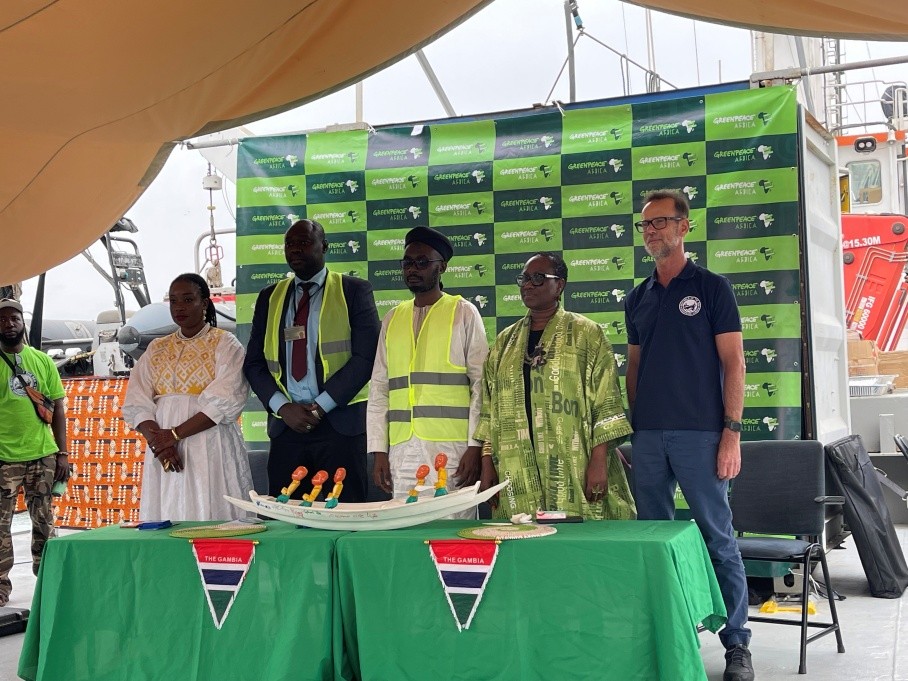
Welcoming guests on board, Greenpeace Africa Communications Director, Madam Fatima Ceesay, deputising for the Executive Director, underscored the deep connection between the ocean and everyday life in The Gambia and across West Africa.
“The sea feeds families, creates jobs and carries history and culture,” she said. “For coastal communities, the ocean is not an abstract idea but a source of food, dignity and survival.”
Ceesay explained that Greenpeace Africa chose The Gambia – the “smiling coast of Africa” – to launch its Sentinels of the Sea mission, an ambitious initiative linking local coastal realities to global decisions on ocean protection. She described the Arctic Sunrise as “not just a symbol but a space for evidence, for voices and for action.”
She highlighted shared concerns across West African communities: dwindling fish stocks, rising living costs and livelihoods under threat. Industrial and illegal fishing, she warned, are depleting waters faster than they can recover. “What happens beyond the horizon directly affects whether a fisher’s net is full or empty,” she said.
However, she stressed that communities are not powerless. For generations, small-scale fishers have protected the sea by respecting limits and maintaining balance. Greenpeace Africa plans to work with them by training community monitors, supporting those who report illegal fishing and strengthening local guardians of the ocean. She emphasised that Greenpeace’s presence is about collaboration with government, not replacement, and about putting communities at the centre of ocean protection.
The visit coincides with the enforcement of the High Seas Treaty, which for the first time provides a global legal framework to protect oceans beyond national borders. Ceesay called for a fully protected marine area in the Canary Current, describing it as one of the richest ecosystems on earth and a lifeline for millions in the region.
Representing The Gambia Maritime Administration, Abass Saidykhan outlined the institution’s mandate, including regulating and monitoring maritime activities, registering ships, ensuring port safety and safeguarding the marine environment. “We welcome the ship and hope it serves its purpose for the long term. Protecting the ocean is not a luxury, but a matter of food security, livelihoods, justice and the future of children yet to come,” he stated.
Captain Mike, the ship’s commander, described the Arctic Sunrise as Greenpeace’s longest-serving vessel, sailing with the organisation for over 30 years. Originally built for another purpose, it was transformed into a champion for life at sea, travelling the world with an international crew and message. He expressed pride in bringing the ship to The Gambia, calling the visit “a historic moment and a beacon of hope for sustainable oceans and future generations.”