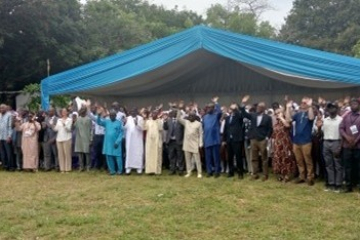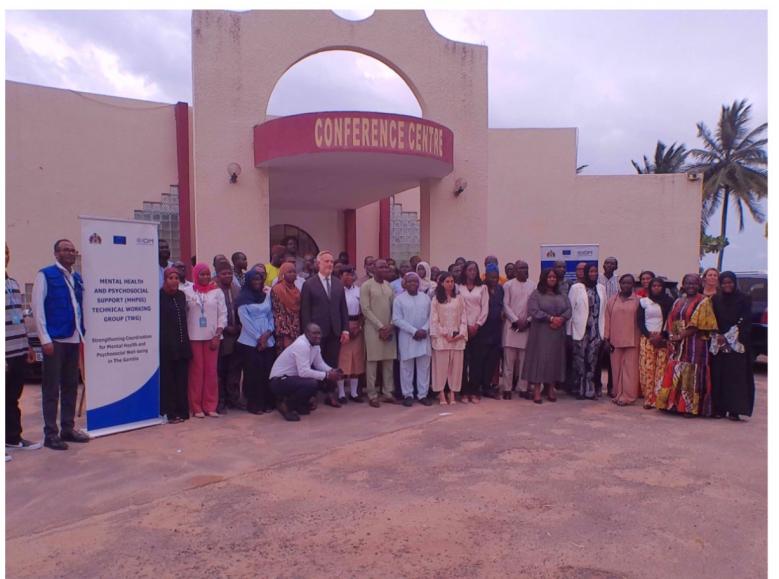
The Ministry of Health, through the National Mental Health Programme, on Thursday convened the inaugural meeting of the Working Group, bringing together government institutions, United Nations agencies, civil society organisations, professional bodies and academia to strengthen coordination and shape national priorities for mental health services.
Funded by the European Union through the International Organization for Migration (IOM), the initiative is expected to provide a common platform for stakeholders to share evidence, coordinate interventions, strengthen referral systems and identify critical gaps in mental health and psychosocial support services across the country.
Speaking at the meeting, Mam Jarra Marega, Programme Manager of the National Mental Health Programme and Chair of the Technical Working Group, described mental health as a responsibility that extends beyond the health sector.
“Mental health belongs to all of us in health, education, social welfare, protection, justice, and in every home where a family is quietly caring for someone they love,” she said.
She said the creation of the Working Group represents an effort to connect the work already being done by different institutions and ensure that people and families seeking support do not have to navigate the system alone.
“This Technical Working Group is our answer. Not just another meeting, but a shared platform to connect what each of us is already doing, so that no family has to search alone,” Ms Marega stated.
She challenged members to measure the success of the initiative not by the number of meetings held, but by tangible improvements in people’s lives, particularly whether young people can access support before reaching crisis point, whether families know where to seek assistance and whether services are available closer to communities without stigma or fear.
Raphael Brigandi, Deputy Head of Mission at the European Union Delegation to The Gambia, described the launch as timely, stressing that mental health challenges require a coordinated national response.
“Today’s event is more than the start of a coordination platform. It is government, supported by partners, taking a firm stance to strengthen mental health and psychosocial support services in The Gambia,” he said.
Citing World Health Organization data, Mr Brigandi noted that more than 1.2 billion people globally live with a mental health condition, while a significant proportion of the world’s population will experience a mental health condition during their lifetime.
He said The Gambia is not exempt from the challenge, noting that mental health concerns affect individuals, families and communities, including people who have experienced difficult migration journeys and those undergoing return and reintegration.
According to him, no single institution can address the country’s mental health needs alone.
He stressed that meaningful progress would depend on building trust, strengthening referral pathways and ensuring sustained coordination between health facilities, public institutions, social actors, communities and development partners.
Sibgha Ajaz, Officer-in-Charge of IOM The Gambia, said the establishment of the Working Group marked an important milestone in placing mental health at the centre of health, protection and social development.
“Mental health and psychosocial wellbeing are fundamental to resilience, social cohesion and sustainable development,” she said.
Ms Ajaz said the platform would provide government, development partners and other stakeholders with an opportunity to work collectively to improve coordination, strengthen referral pathways and address gaps in services.
She highlighted IOM’s experience supporting vulnerable populations across The Gambia, particularly migrants and returnees who may face complex challenges arising from their migration experiences.
She noted that prolonged uncertainty, family separation, exploitation and difficult migration journeys can have lasting psychosocial consequences.
Ms Ajaz further identified children, survivors of violence, persons with disabilities, migrant returnees and communities experiencing hardship among groups that continue to face significant barriers to accessing mental health and psychosocial support.
The National Technical Working Group is now expected to translate the commitments made at the inaugural meeting into coordinated action, including strengthening referral mechanisms, addressing service gaps and advancing the country’s national MHPSS agenda.
The initiative comes at a time when stakeholders are increasingly calling for mental health to be treated not as an isolated health concern, but as a cross-cutting national development issue requiring coordinated action from government, communities, families and partners.