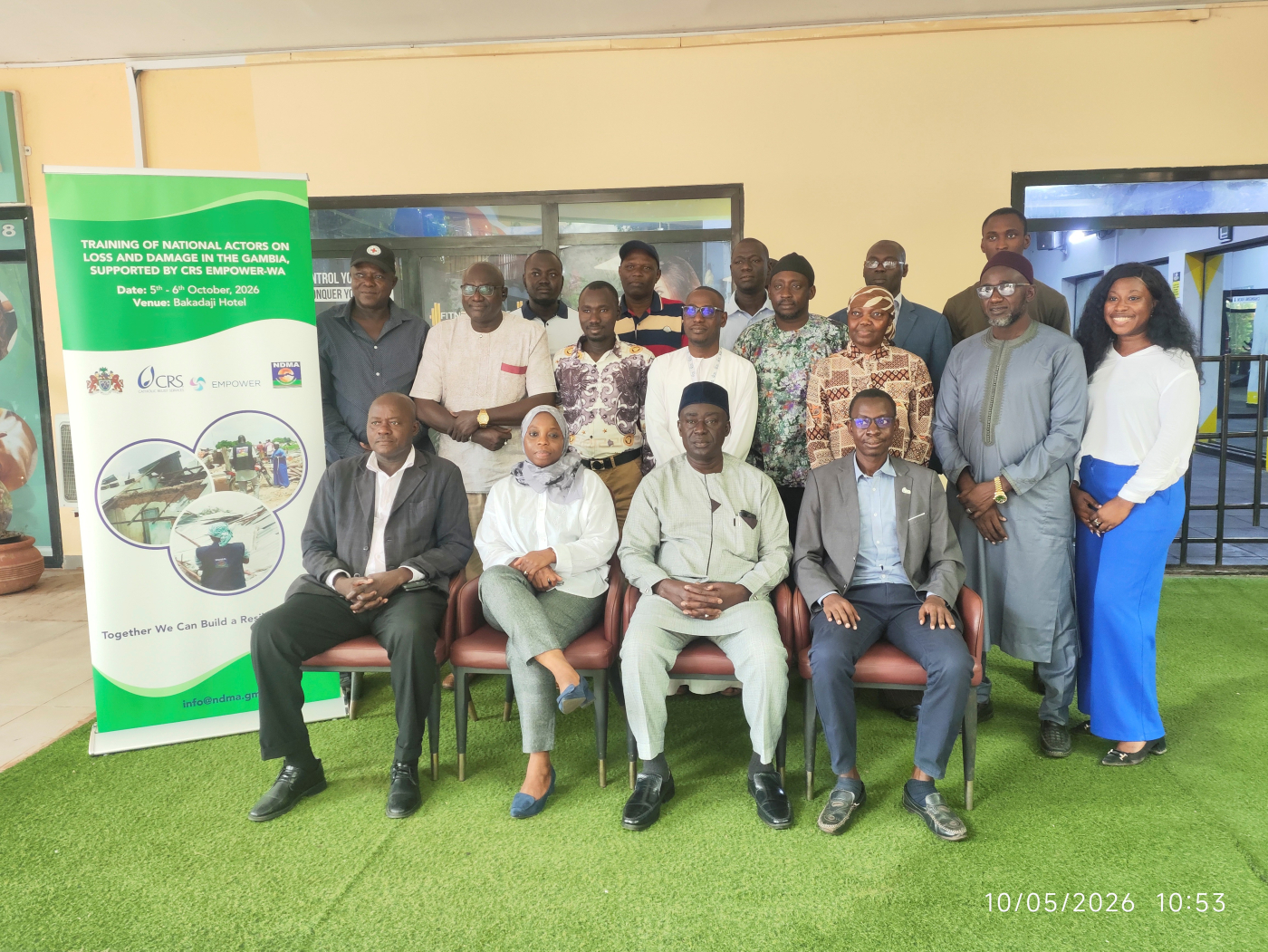
The Gambia has stepped up its response to climate-induced loss and damage as key national stakeholders undergo a two-day intensive training aimed at strengthening the country's climate resilience.
The training is being implemented by the National Disaster Management Agency (NDMA) with funding from Catholic Relief Services (CRS) through the EMPOWER Project.
Held at Bakadaji Hotel, the forum seeks to address climate risks and transform national actors into strategic drivers of loss and damage action by building robust mechanisms to identify, quantify and report climate impacts.
At the opening, Lamin Jadama, Deputy Executive Director of NDMA, commended CRS and the Climate Finance Directorate of the Ministry of Finance and Economic Affairs for co-leading the initiative, noting that technically equipping national institutions is the first step toward unlocking critical international climate finance.
He stressed that climate change does not respect sectoral boundaries and challenged participants to look beyond individual ministries to build integrated, nationwide frameworks.
Jadama noted that despite contributing a negligible fraction of global greenhouse gas emissions, The Gambia remains on the frontline of climate devastation.
“From severe coastal erosion in urban areas to devastating flash floods and unpredictable droughts in farming communities, climate change is no longer a future threat but an active development crisis,” he said.
“When adaptation limits are breached, we face residual consequences — economic losses to livelihoods and infrastructure, alongside irreversible non-economic losses to cultural heritage, health and ecosystems.”
Country Manager of Catholic Relief Services - The Gambia, Dr. Amulai Touray, said strengthening understanding of loss and damage is critical for low-emitting countries like The Gambia that suffer disproportionately from climate change.
He noted that communities are already grappling with droughts, floods, coastal erosion and other hazards that threaten livelihoods and reverse development gains.
“The training provides an important platform for stakeholders to enhance their knowledge, share experiences and strengthen evidence-based approaches to addressing climate-induced losses and damages,” Dr. Touray said.
“It also reinforces the principle that those most affected by climate change, particularly vulnerable countries and communities, should not bear a disproportionate burden for a crisis they did little to create.”
He reaffirmed CRS’s commitment to supporting initiatives that strengthen local capacity, promote resilience and contribute to sustainable and inclusive development.
For her part, Ms. Isatou F. Camara of the Directorate of Climate Finance at the Ministry of Finance and Economic Affairs described the training as timely.
“While we continue to strengthen mitigation and adaptation efforts, we recognize that some climate impacts cannot be fully avoided or addressed through adaptation alone. The resulting economic and non-economic losses are at the heart of the Loss and Damage agenda,” she said.
Camara stressed that for a highly climate-vulnerable country like The Gambia, loss and damage is not just an international policy debate but a daily reality, with floods, droughts, saltwater intrusion and other climate events damaging homes, disrupting livelihoods, threatening food security and mounting pressure on public finances.
She said the training marks another important step in strengthening collective capacity to advance the Loss and Damage agenda at the national level.