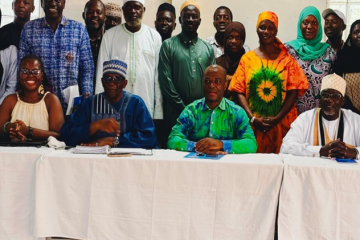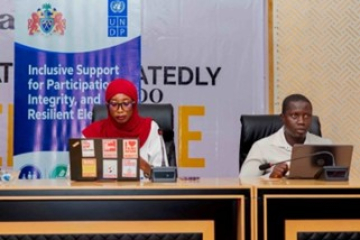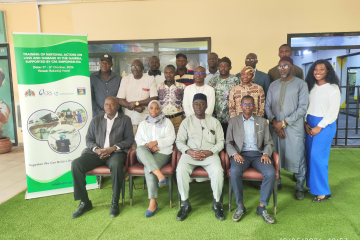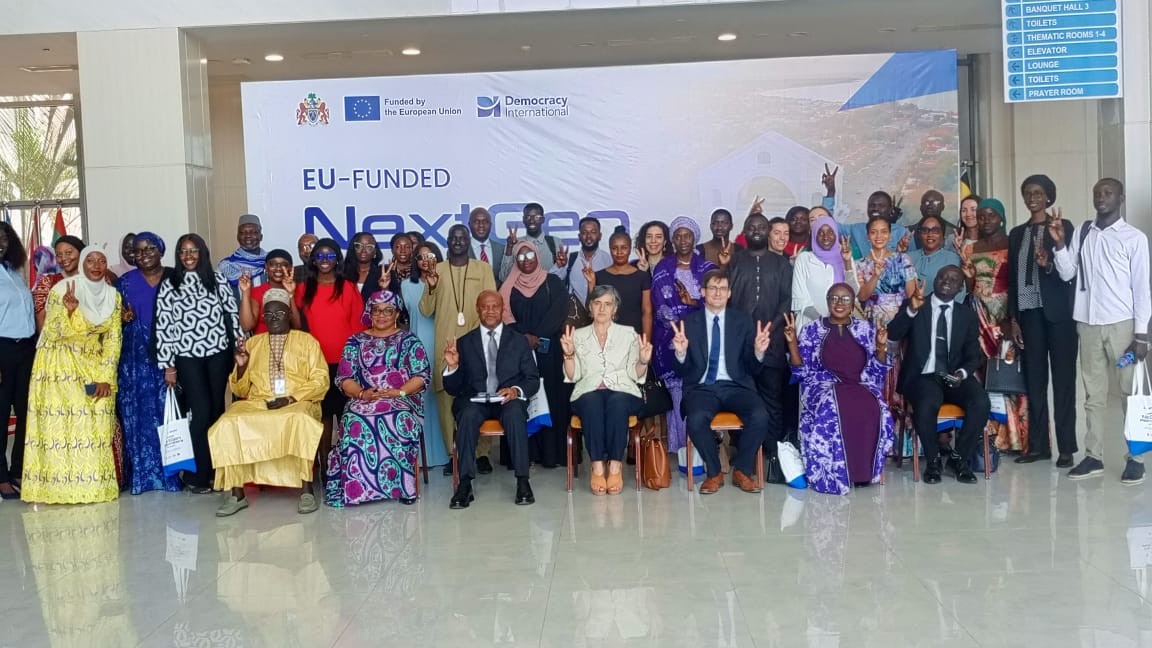
The project launch, held at the Sir Dawda Kairaba Jawara International Conference Centre, also seeks to empower survivors and marginalised communities in The Gambia to enable them contribute to meaningful to transitional justice and peacebuilding initiatives.
The event was held under the theme – ‘Empower youth to create a successful foundation for conflict prevention and peace building’.
Welcoming the gathering, Aaron Myers, Director of Global Programs, Democracy International said what excites him most about this partnership is that it gets at the heart of many.
He indicated that expanding the skills and assets of youth in civil society is a top focus of the program, adding that the opportunities to apply these skills and assets meaningfully are often the true barrier to inclusion.
‘‘Fortunately, we have committed government partners who have chosen to commit precious resources to expand seats at the table on issues pivotal to the Gambia's future.’’
Myers revealed that Democracy International is a global organisation that has spent more than 20 years supporting citizens and governments in over 80 countries to realise their own visions of democratic change.
‘‘We are not strangers to The Gambia. Since 2023, DI has been a proud partner to Gambian institutions.’’
Also speaking, Immaculada Roca I Cortes, ambassador of the European Union Delegation to The Gambia, revealed that transitional justice is not looking backwards, but rather it is actually building a peaceful future.
‘‘Accountability and reparation for Reconciliation and guarantees of non-recurrence are not abstract concepts. There are practical tools. They help to restore trust between citizens and institutions.’’
Ambassador Cortes revealed that these virtues all fully aligned with the European Union's global commitment to peace, stability and conflict prevention, further reflecting their policy framework and transitional justice which she said, must be inclusive.
Also speaking, Ida Persson, head of the Post-TRRC Unit at the Ministry of Justice, disclosed that the Post-TRRC Unit at the Ministry of Justice has been coordinating the post-TRRC process.
‘‘We have 263 recommendations that are being implemented at various degrees. The Human Rights Commission has every year told us about the status of implementation. And what is apparent now, really, is that implementation in some areas is going to take a long time.’’ she stated.
‘‘In fact, some areas will never stop. And so, of course, when you set out on a journey that you know yourself, you will not see the conclusion of.’’
Ebrima A. Ndow, Monitoring and Evaluation Officer at the National Youth Council, shared some brief reflection on the activities of the NYC, adding that the project is offered on the National Action Plan on Peace, Youth and Security, which provides a framework to promote meaningful participation of young people in peace building, conflict prevention, governance, and post-conflict recovery.
Alaji Jarju, executive Director of National Youth Council representing the Ministry of Youth and Sports, expressed delight to represent the Ministry at this important project launch, further thanking EU and Democracy International for putting together this important project that they are about to launch.
Jarjue also alluded that youth forms the biggest strength of the country alongside women. To sustain the gains made in terms of peace in the country, Jarju underscored the need to involve the youth and women in the process.
In his launch statement on behalf of the Attorney General and Minister for Justice, Hussein J. Thomasi, solicitor general and legal secretary at the Ministry, lauded the initiative, which he said, is aimed at reinforcing government’s commitment to youth engagement in peace and security in The Gambia.
To that end, he thanked the EU and other partners for their support towards the project, acknowledging that it is in recognition of the reality that The Gambia is one of the first countries globally to adopt a National Action Plan on Youth, peace and security in line with United Nations Security Council.
‘‘As a very young nation with approximately 77% of the population under the age of 35, youth are not a marginal constituent, but forms majority and this is the trajectory of the entire African continent.’’
To this end, he reminded that their aspiration, creativity and resilience are shaping political, economic and social trajectory of the world.
The Solicitor General also spoke about the country’s ambitious youth action plan, which he said, will continue to invest in human capital development, strengthening institutional capacity and building an enabling environment for youth participation in decision making process among a host of others.
He spoke highly of the project, which he said, would provide grants to civil organisations, empower survivors and marginalised communities in The Gambia to enable them contribute meaningfully to transitional justice and peacebuilding initiatives, while turning policies into actions.
Kebba Jome, representative of Members of the Alliance of Victim led-Organization, Sait Matty Jaw from the Centre for Research and Policy Development and Oumie Jagne from Think Young Women all shared insights into the work of their respective NGOs.