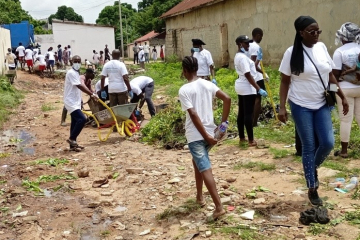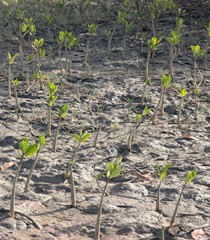
Between 4th and 10th March 2026, project personnel conducted monitoring missions across 11 sites in the West Coast, Lower River, and North Bank regions, assessing survival rates of mangroves planted last year.
Mangroves are vital for coastal resilience, acting as natural barriers against erosion and storm surges, while also serving as breeding grounds for fish and shellfish. Their restoration is central to strengthening The Gambia’s fisheries sector and improving rural livelihoods.
During the six-day tour, the PROREFISH team, alongside local residents, visited Kayobor, Jiffony, Bantanjang, Jomo Kunda, and Bajiran in the West Coast Region; Manduar, Karantaba, Barrow Kunda, Toroba, Kasewa, and Sittanunku in the North Bank Region.
Saikou Bojang, a native of Jiffony, described the transformation: “Few years ago, it was very difficult for us to catch fish from our riverside, but today, thanks to the mangrove plantations, fishes have now returned.”
In Bantanjang, where survival rates reach 90 per cent, mangrove restoration has boosted economic opportunities, particularly for women. Resident Malang Jarjue explained: “We now have a lot of oysters in my community. Women have started harvesting and selling them, generating income from it.”
For others, the benefits extend beyond fisheries. Meta Badjie, a gardener from Bantanjang, highlighted the cooling effect of denser forest cover, which has improved local microclimates.
At Kasewa, community members expressed pride in their participation. Moses Mendy, son of the village Alkalo, said: “We want to hail FAO through PROREFISH Gambia for this wonderful initiative. We believe that taking part in this exercise will change our livelihood and improve our lives.”
According to PROREFISH Natural Resources Management Specialist, Malang Jatta, a total of 4,000 mangrove bags were planted. The overall survival rate across all 11 sites is estimated at 75 per cent, resulting in the restoration of approximately 831.7 hectares.
The initiative, funded by the Green Climate Fund (GCF) and implemented in collaboration with the Government of The Gambia, is a multi-year project designed to build climate resilience. Mangrove restoration aligns with FAO’s “Four Betters” – Better Production, Better Nutrition, Better Environment, and a Better Life – while advancing progress towards Sustainable Development Goals 13 (Climate Action), 14 (Life Below Water), and 15 (Life on Land).
Mangroves are more than trees; they are lifelines for coastal communities. By protecting shorelines, storing carbon, and supporting fisheries, they underpin both ecological balance and economic opportunity. The PROREFISH Gambia project demonstrates how community-led restoration can deliver tangible benefits, from improved fish stocks to women’s empowerment, while safeguarding The Gambia’s coastal heritage for generations to come.