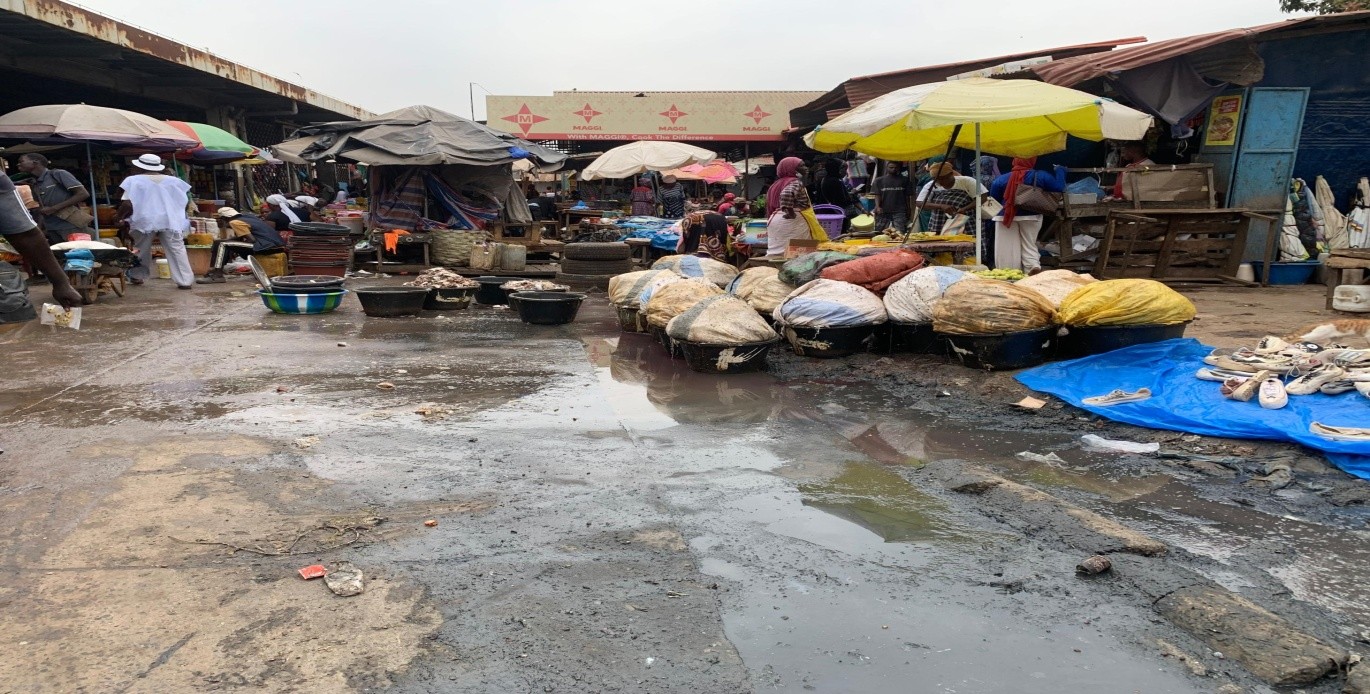
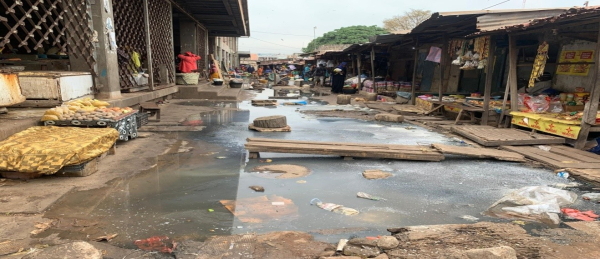
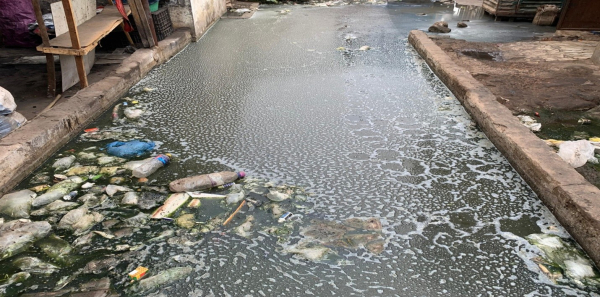
In Brikama, one of The Gambia’s busiest markets, a silent crisis is poisoning daily life. Beneath the noise of bargaining and the rush of trade, vendors and customers are forced to wade through foul‑smelling stagnant water. What should be a centre of livelihood has instead become a breeding ground for disease.
For more than ten years, Brikama Market has been crippled by a drainage problem that no authority has managed to fix. The worst of it lies at the fish market, where overflowing septic tanks and blocked gutters spill dirty water across the trading grounds.
The stench of rot, swarms of mosquitoes, and food falling into contaminated puddles have left vendors desperate and customers staying away. Even after the market was rebuilt following the 2022 fire, the same problem persists, thus turning a place of hope into a symbol of neglect and a threat to public health.
The Brikama Fish Market, constructed with Japanese government support and inaugurated in 2010, was meant to modernise fish trading in the region. However, in 2022, a devastating fire reduced it to ashes. A year later, President Adama Barrow inaugurated a newly rebuilt market, fully funded by the Gambian government.
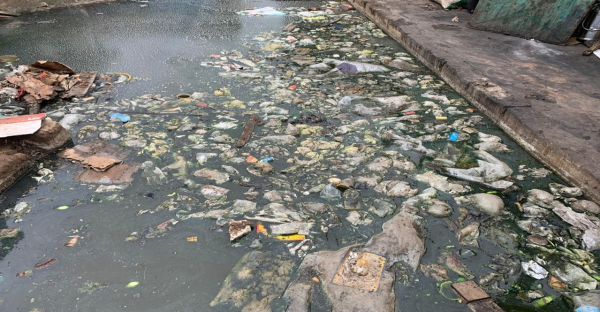
Despite this fresh start, the same old problem remains. The fish market produces hundreds of ice blocks daily to preserve fish. When these melt, the water flows into a septic tank. Once full, the tank overflows, flooding the market with stagnant, bacteria-laden water that reeks of decomposing organic matter.
Vendors and Customers Cry Out
The situation has become unbearable for vendors and customers alike. In 2022, before the fire, the Food Safety and Quality Authority (FSQA) shut down the fish market due to unhygienic conditions. Four years later, the same nightmare continues.
“Every day, we pay money to the council, but still they cannot solve this water problem. We are tired of the bad smells around us,” lamented a vegetable vendor to The Point Newspaper.
Sheikh Nyass, a tailor who has worked in the market for over a decade, praised the council for regularly draining the septic tank but criticised the fish market’s management. “Just yesterday, the council removed the water completely, but look at it now—water lodged everywhere. The council is helping us, but the fish market is not helping the council,” he said.
Nyass explained that the stagnant water not only disrupts business but also poses health risks to apprentices learning tailoring skills. “The bad smell is not good for these children. Sometimes we even use insecticide just to sit in our shops because of the mosquitoes and flies,” he added.
He accused some vendors of unhygienic practices, such as retrieving goods that fall into the dirty water and reselling them. “This is a gutter that runs up to the highway, but the council says the water cannot flow out. If that is the case, then they must find a long-term solution,” Nyass stressed.
A Market in Decline
The tailor painted a grim picture of daily life in Brikama Market. “Right now, no tailor here can pull out D200 from his pocket because there is no work. Clients don’t want to wade through dirty water to reach us. This is not healthy at all,” he said.
He recalled sending an apprentice home after the young man developed an allergic reaction to the filth. “The gutters have never been cleaned. They are full of sand, blocking water flow. Even a little rain makes things worse,” Nyass explained.
Fatoumatta Gaye, a vegetable vendor, echoed his frustration. “We are tired of talking to the media. I have been here since morning and could not even sell D200 because clients refuse to come near this water. They are right—it is not healthy,” she said.
A Call for Action
The vendors’ voices are united in their plea: the council and the Ministry of Fisheries must act. Daily septic tank draining is not a sustainable solution. Without proper drainage and sanitation, Brikama Market risks becoming not just a place of commerce, but a public health hazard.
As Nyass put it bluntly: “There is a solution to everything except death. This situation cannot continue forever.”
Ensa Saidy‑Faye, also a tailor in the market, said even breathing properly has become a challenge for everyone working there. He explained that the water flowing from the fish market has nowhere to go, and despite attempts to remedy the situation, it worsens daily.
“We reported the matter to the Council and other relevant authorities, but the problem is only getting worse. Sometimes the Chairman of the Council, Yankuba Darboe, comes here to see things for himself, but we realise he does not have a solution to our problem, even though he is trying his best,” Mr Saidy‑Faye said.
He noted that while the Council frequently cleans most of the gutters, the one carrying water from the fish market has been left untouched. “It has been more than three years since they banned that gutter because of the dirty water coming from the fish market. The condition has remained the same in both the dry and rainy seasons,” he explained.
According to Mr Saidy‑Faye, the rainy season makes matters worse. “When the rain adds to the water from the fish market, both vendors and customers struggle to find a place to walk unless they have rain boots,” he said.
He added that the unhygienic environment has crippled their livelihoods. “Sometimes we arrive in the morning and stay until evening without a single job to do. This is not healthy for anyone, which is why our clients are avoiding the market. Some come up to the entrance and then turn back because they are afraid to enter the dirty water. Some shop owners have even resorted to pouring detergent into the water to disinfect it, which is why the colour has changed. This is how we have been living for the past three to four years,” he said.
Mr Saidy‑Faye suggested that the Council should plan to dig new sewage channels to redirect the water and prevent stagnation. “That is the long‑term solution I am proposing. If not for the harsh economy, we would not still be here hustling. By right, we should not even be here given the state of the water, but we have no choice,” he told our reporter.
Foday Manjang, Chairman of the Fish Market Committee, confirmed that the fish market is indeed responsible for the unhygienic conditions. However, he also blamed women vendors for blocking the drainage system, an allegation they strongly denied.
“The women vendors who sell vegetables are sitting exactly where the water is supposed to pass. I personally complained about this to the Council and even to central government officials, but nothing has been done. These women are blocking the waterway by putting sand and gravel so they can have a place to sit and sell,” Mr Manjang alleged.
He argued that relocating the women would solve the problem, but claimed the Council has not acted because of the duties they pay. “We are again calling on the authorities, including the Central Government and Area Council, to come and help us. We are suffering here—the smell is terrible and it is not healthy,” he pleaded.
Brikama Area Council’s Response
As the administrative body of West Coast Region, the Brikama Area Council (BAC) oversees the daily affairs of all public markets in the region, including Brikama Market. However, the fish market, though located within Brikama Market, falls under the Ministry of Fisheries and Water Resources.
When contacted about the unhygienic conditions, Lamin Singhateh, Public Relations Officer of BAC, said the Council’s only intervention is to drain stagnant water, citing its lack of authority to carry out infrastructural development in the fish market.
“There is only one step the Council can take to mitigate the challenge, and that is to deploy our septic tank to drain the sewage waste daily. That is the only thing we can do. Any other measure requires infrastructural development, and that facility is not under the Council, it is under the Ministry of Fisheries,” Mr Singhateh explained.
Asked about the women vendors affected by the stagnant water, Mr Singhateh acknowledged they fall under the Council’s jurisdiction but insisted that the Council cannot provide a long‑term solution for a facility it does not own. “Even if we propose a long‑term solution, the owners could reject it. What is the essence of planning for someone else’s property?” he asked.
On allegations that women vendors were blocking the drainage, Mr Singhateh dismissed the claim as untrue. He confirmed that the Council had authorised them to sell at the entrance of the market. He explained that the real problem lies in the collapsed sewage system of the fish market.
“The system was designed to recycle waste, but it no longer operates. They produce ice blocks and process fish, which generates large volumes of liquid waste. The daily sewage output exceeds the facility’s storage capacity, so it leaks,” he said.
Mr Singhateh added that allowing the sewage water to flow into public canals would be catastrophic. “No one in their right mind would permit that. It would cause a serious public health crisis,” he warned.
He confirmed that the Council is willing to collaborate with the Ministry of Fisheries. “If we were not ready to collaborate, we would not have sent septic tanks there to drain the sewage. We take this as an obligation because of the women vendors working there,” he said.
Mr Singhateh recalled that in 2019, the former Governor of West Coast Region, now the Ombudsman, initiated discussions for the Ministry to hand over the fish market to the Council. The Ministry refused, insisting it was better managed under their authority.
“Administration is continuity. Just because it failed under Chairman Sheriffo Sonko does not mean Chairman Yankuba Darboe must repeat it. But Yankuba said no, we cannot simply abandon the women vendors suffering there. That is why we purchased a septic tank to drain the fish market every two days. We are doing our part,” Singhateh said.
He concluded by stressing that while the Council is ready to collaborate, the ultimate responsibility lies with the Ministry of Fisheries. “The facility belongs to them. The approach must come from the owners,” he said.
Minister of Fisheries and Water Resource’s Response
When contacted for comments on the crisis at Brikama Market, Hon. Musa Drammeh, Minister of Fisheries and Water Resources, acknowledged the situation and outlined his ministry’s plans to address it.
Hon. Drammeh explained that the fish market was sponsored by the Japanese government and was originally intended to be connected to a sewage system in Brikama, a plan that never materialised. He said septic tanks were installed to accommodate water from melting ice blocks, but misuse has worsened the problem.
“I think the people doing business in the market throw waste into those systems, which causes blockages. I was involved myself. I went there and even provided facilities to empty them,” he said.
The Minister revealed that a Japanese team visited the market in September and October to assess the situation. “We engaged them, and they now know the problem. They are working on engineering solutions to alleviate it,” Hon. Drammeh said.
On claims that the Brikama Area Council (BAC) had requested the fish market be handed over to them, Hon. Drammeh denied such a request ever reached his office. He said that while the Bakoteh fish market was handed to Kanifing Municipal Council (KMC), he would not have approved such a move. “What is happening there is not for a fish market. There are other commercial activities,” he alleged.
He added that the Brikama fish market was developed with international partners, and any handover would only be considered once the facility was fully completed. “Sometimes the council just likes to play politics. They cannot even clean the market environment, yet they are asking for the fish market to be handed over,” he said.
FSQA Threatens Closure
AlhasannaJatta, the Food Safety and Quality Authority (FSQA) officer attached to the market, highlighted his efforts to push for improvements. “When I came in, I inspected the entire market and met with management. I wrote a report and recommended a proper sewage system with a septic tank within the premises, and regular cleaning every three months,” he said.
He explained that while the council occasionally drains stagnant water, this is insufficient. Initially believing the fish market was under the governor’s office, MrJatta wrote to the governor, only to learn it fell under the Ministry of Fisheries. He then redirected his recommendations to the ministry.
Another FSQA staff member, MrEbrima Sonko, confirmed that inspections are scheduled for 23rd to 27th February 2026. “If we visit and find the same problems persisting, we will recommend shutting down the fish market,” he said.
Public Health Risks
Karim Darboe, Regional Principal Public Health Officer for Western 2 Health Region, warned that stagnant water poses serious health risks. He explained that unhygienic pools of water provide ideal conditions for disease‑causing microorganisms.
“When water collects and remains unclean, especially in crowded places like markets, it becomes contaminated with organic waste, fish residues, garbage, and human activity. This supports harmful bacteria such as E. coli, Shigella, Salmonella, and Vibrio cholerae, which cause water‑borne diseases,” he said.
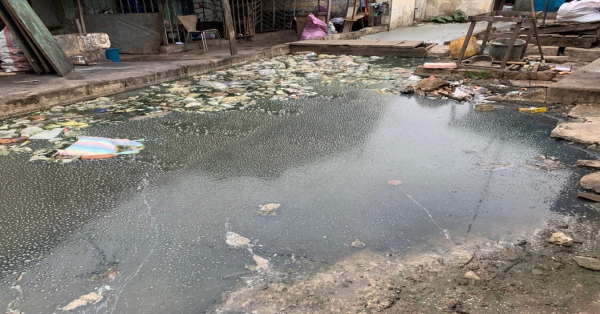
Mr Darboe added that contaminated water easily spreads pathogens through food, hands, utensils, and surfaces, leading to diarrhoea, gastroenteritis, cholera, and typhoid fever. He also warned of skin infections, including dermatitis and bacterial complications, when cuts or abrasions come into contact with polluted water.
He added: Stagnant water also attracts mosquitoes, increasing risks of malaria, dengue, yellow fever, and lymphatic filariasis. Rodents drawn to the waste add further dangers. “Unhygienic stagnant water is not just an environmental nuisance—it is a significant public health hazard,” Mr Darboe stressed.
He explained that foul odours arise from decomposing organic matter and blocked drainage, releasing gases such as hydrogen sulphide, ammonia, and methane. Continuous exposure to these gases in crowded environments like markets deteriorates air quality, causing respiratory irritation, coughing, throat discomfort, and difficulty breathing.
“These effects are especially severe for people with asthma or other respiratory conditions. Exposure can also cause headaches, dizziness, nausea, and vomiting. In the long term, it aggravates chronic conditions such as asthma and COPD,” he said.
Brikama Market, he went on, is both an environmental and public health emergency. “Addressing the underlying sanitation issues is crucial to preventing outbreaks and protecting the health of the population,” he warned.
He maintained that although the smell alone may not directly cause severe illness, it signals underlying environmental contamination and harmful bacterial activity. He explained that this combination not only poses direct health risks but also undermines the working environment and quality of life for those who depend on the market for their livelihood.
He stressed that the presence of unhygienic stagnant water in a busy market setting is a serious public health threat, particularly when food items are sold nearby. “Vegetables and essential commodities such as rice, onions, potatoes, salt, and sugar are often displayed openly, making them highly vulnerable to contamination from the polluted environment. Stagnant water containing organic waste, fish residue, and bacteria creates a breeding ground for flies and other insects,” he said.
“Flies move between the dirty water and food items, carrying harmful microorganisms that can easily be transferred through direct contact. Airborne contamination further increases the risk, as microorganisms from decomposing matter can enter the air and settle on exposed food, while dust and wind blow contaminants onto vegetables and grains.”
He added that cross‑contamination occurs when vendors walk through stagnant water and then handle food with unwashed or contaminated hands, creating a direct route for bacteria to reach products consumed by households across the West Coast Region and beyond.
“Such contamination is often invisible, making it even more dangerous, as consumers may unknowingly ingest contaminated produce. Environmental factors also play a major role. When bags of rice, potatoes, onions, or other commodities are stored directly on the ground, they absorb moisture and contaminants from the wet, dirty surface,” he said.
He warned that this promotes bacterial and mould growth, both of which compromise food safety. Mould contamination, he explained, can lead to the production of harmful toxins that pose long‑term health risks if consumed. Vegetables that come into contact with contaminated splashes or surfaces are also at high risk of carrying diarrhoeal pathogens into homes.
“Therefore, the stagnant water situation in Brikama Market is not just an environmental concern; it is a direct public health hazard that threatens the safety of food consumed by thousands of families. Addressing this issue is critical to preventing disease outbreaks and safeguarding the well‑being of the population,” he said.
Mr Darboe emphasised that consuming food contaminated by stagnant, unhygienic water can lead to a range of serious medical complications. One of the most common consequences is food‑borne illness, including diarrhoea, typhoid fever, cholera, dysentery, and salmonella infections. These conditions occur when individuals eat food exposed to harmful bacteria, particularly when vegetables are eaten raw or food items are poorly washed.
He explained that such infections can cause severe dehydration, abdominal pain, fever, and in some cases require urgent medical treatment. Stagnant water often contains fish waste, blood, decomposed organic material, and even industrial contaminants such as oil or detergents. When these substances come into contact with food, they introduce harmful toxins and pathogens that pose both immediate and long‑term health risks.
“The health impact is especially severe for vulnerable groups, including children, pregnant women, the elderly, and individuals with weakened immune systems,” he said. These populations are more likely to suffer complications such as severe dehydration, prolonged illness, malnutrition, and in extreme cases, life‑threatening conditions.
He stressed that contamination of food within the market represents a major public health concern requiring urgent intervention. “The presence of unhygienic stagnant water in Brikama Market represents a serious public health threat with the potential to cause bacterial, parasitic, and vector‑borne diseases. This situation compromises not only the health and safety of vendors who operate daily in the market, but also the wider community that relies on the market for fresh food and essential commodities,” he said.
Darboe argued that addressing the issue requires urgent and coordinated public health action. Priority interventions, he said, include emptying and repairing the soakaway or septic tank to prevent overflow, restoring drainage channels to allow proper water flow, and carrying out regular environmental sanitation exercises.
He added that vendors must be supported through continuous public health education on safe food handling and hygiene practices to minimise contamination risks. Strengthening these preventive measures, he said, will protect both vendors and consumers from avoidable illnesses.
“Sustained monitoring is equally important. Regular inspection of the market by public health officers, coupled with enforcement of hygiene standards, will ensure that sanitation conditions are maintained and health risks are kept under control. By implementing these steps promptly, the community can restore a safe, healthy, and functional market environment that protects public health and supports livelihoods,” he said.