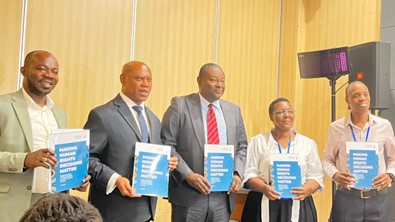
The report, titled “Making Human Rights Decisions Matter: Regional Insights and Best Practices on Implementation in Africa,” was launched Wednesday at the OIC Conference Centre during the 87th Ordinary Session of the African Commission on Human and Peoples’ Rights.
The study is based on findings from seven national dialogues held between 2023 and 2025 in Cameroon, Guinea, Malawi, Mali, Niger, Nigeria and Sierra Leone, as well as a regional consultation in Dakar.
According to the report, African human rights bodies continue to issue important rulings on torture, slavery, discrimination, violence against women and children, and denial of fair trial rights, yet implementation remains weak across the continent.
“The gap between judgment and justice continues to undermine the credibility of the African human rights system,” said Dr Musa Kika, noting that the report offers practical recommendations to ensure decisions lead to real change.
The launch was officially conducted by Hussein Thomasi. A high-level panel discussion featured Michael Gyan Nyarko, who highlighted the need for stronger mechanisms to support victims whose rights have been violated.
Other panelists included Emmanuel D. Joof, Mme Joseph Felistas, and Dr Japhet Biegon.
The report identified weak political will, poor enforcement systems, institutional fragmentation, and limited public awareness as major barriers to implementation. It also found that monetary reparations ordered by courts are often the least implemented component of rulings.
Among its recommendations, the report urges African states to domesticate regional human rights decisions, empower national courts to enforce judgments, and adopt clear implementation policies to bridge the gap between regional rulings and domestic enforcement.