She said nearly three-quarters of global merchandise trade — around 72 per cent — still moves under the most-favoured-nation terms that their 166 members negotiated and are legally committed to uphold.
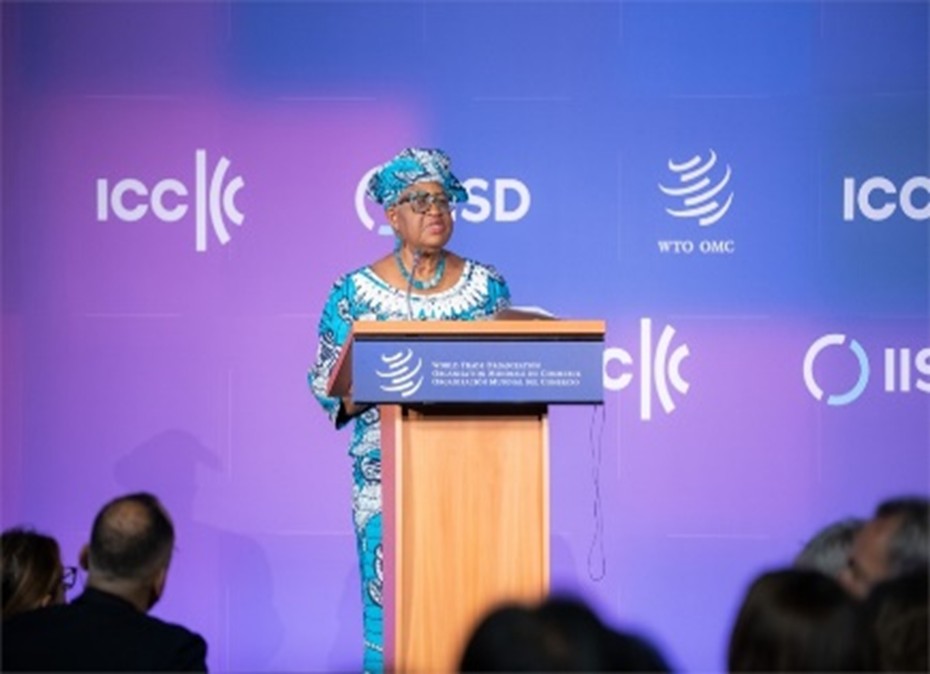
She made these remarks at the 2026 edition of the World Trade Organization (WTO), World Trade Report, issued on Tuesday, 15 September, convened at the WTO’s Headquarters, Geneva, Switzerland.
She underscored that global trade is at record levels. “We have weathered multiple economic crises without a repeat of the protectionism of the 1930s. Shocks have exposed supply bottlenecks, yet the bigger revelation has been supply resilience,” she said.
Speaking at the WTO public forum 2026, and World Trade Report launch of the annual flagship research product, Director General Ngozi Okonjo-Iweala outlined that the report doesn't shy away from where they have fallen short, stating that the WTO has not adequately adapted to the world economy it helped create.
She added that members have been unable to strike new agreements to seize the opportunities created by shifts in economic power over the past thirty years except of course the wonderful multilateral agreement on fisheries subsidies at MC12 and several other multilateral decisions at that time.
In the meantime, she said the bargains reached in the 1990s have come under strain. In addition, while the GATT/WTO system has long dealt with so-called 'interface' problems for members with different economic systems, she said the scale and scope of those problems have exploded, leading to increasing tensions around level playing field issues.
Meanwhile, she noted that most years, these reports hone in on a single theme and how it translates to trade and the WTO, that recent editions have focused on AI, macroeconomic inclusion, climate change, resilience, and services, among others.
With the world trading system facing challenges on a scale unseen since it was created in the wake of the Great Depression and the Second World War, she said it asks more fundamental questions on how has the GATT/WTO system worked, where has it faltered, what is still working well and what seems out of date.
As members move forward with WTO reform, she noted that this difficult moment for the trading system has the potential to become a turning point for renewal and revitalization and that the new World Trade Report explains, with factual rigour and historical depth, what the system has delivered, and where the mechanisms are now under strain.
“The stresses around global trade today are not primarily a function of trade rules and policies,” she said. “Macroeconomic imbalances, technological innovations and geopolitical rivalries have played a bigger role.”
She added that gaps in domestic social protection have mattered too, emphasizing that an important factor in today's disruptions is the widespread sense that WTO rules have not kept pace with a rapidly changing global economy.
She said that the report persuasively argues that many of the pressures the WTO faces today are, to a very real extent, a consequence of the system's successes.
That the GATT/WTO system helped build a more open, more integrated, more rules-based world economy, emphasising that in today's world economy, economic power is far more widely distributed than in 1947, or even in 1995.
She advanced that the trading system was vital for building this more prosperous, and in many respects more equitable, world economy, that since 1995, WTO membership has helped expand trade between members by roughly 140 per cent.
Low and middle-income economies’ share of global merchandise trade has nearly doubled, to 45 per cent. Faster growth, accelerated by trade, made it possible for poor countries to narrow the income gap with rich for the first time since the Industrial Revolution two centuries ago.
She said that many of the WTO's successes have quietly endured, delivering substantial “benefits to businesses and households around the world every day.
“Nearly three-quarters of global merchandise trade — around 72 per cent — still moves under the most-favoured-nation terms that our 166 members negotiated and are legally committed to uphold,” she said.