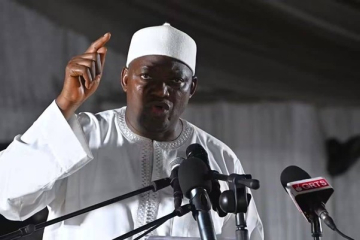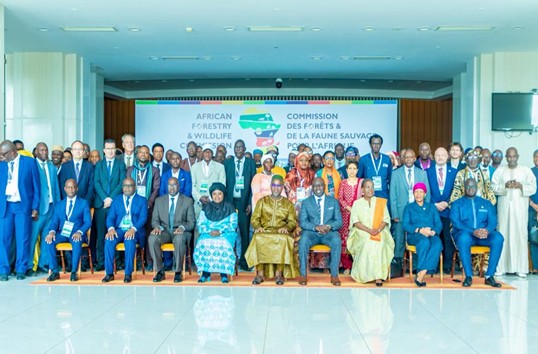
Speaking at the 25th Session of African Forestry and Wildlife Commission (AFWC25) and the 9th African Forestry and Wildlife week currently underway at Sir Dawda Kairaba Conference, VP Jallow said The Gambia is a nation with a big heart, a country deeply committed to the defense of Africa’s environment and the preservation of its shared natural heritage.
He indicated that The Gambia positions itself firmly among the nations of Africa that have chosen to “protect, not exploit; to restore, not destroy; and to act, not just talk our environment.”
“This forum places Africa at the centre of global forest and wildlife conservation and the attainment of the 2030 Agenda,” he declared.
“We share solutions for climate action, biodiversity, and sustainable development. And I believe our collective work here will shape policies and practices beyond the continent.”
He described AFWC25 as a platform for African countries to exchange knowledge and coordinate policies on forestry and wildlife and promote inclusive governance, youth and community engagement, and emerging technologies.
“Through this commission we have opportunity to strengthen regional collaboration and safeguard Africa’s natural heritage for future generations.”
“My government took a bold and irreversible step to ban all timber exports, revoke all illegal felling permits, and disrupt the cross-border trafficking of rosewood that was devastating our environment.
We took these actions because they were necessary, as leadership is tested in moments when political convenience must give way to moral duty, and on our part, we chose duty.”
“Our success would not have been possible without strong partnerships. I therefore want to express our profound appreciation to the Food and Agriculture Organization of the United Nations (FAO), our trusted ally in conservation and resilience-building.
I take this moment to express our appreciation to His Excellency, Dr Qu Dongyu, the Director General of the Food and Agriculture Organization of the United Nations (FAO) and its Member States for their support to the Government of the Republic of the Gambia.”
FAO’s support has been consistent in community forestry programmes, mangrove restoration, biodiversity protection, forest management and capacity strengthening across the sector.”
For her part, the FAO country rep. Ms. Moshibudi Rampedi, said The Gambia’s decision to host this session shows leadership in conservation, sustainable land use, and environmental governance.
According to her, FAO stands firm in supporting Member States to advance national priorities, mobilise resources, and ensure that forestry, wildlife protection, and climate action remain central to sustainable development and the 2030 Agenda.
She also cited that FAO has over the years supported the Gambia’s National Forest Programme through a National Forest Inventory as well as Community-Based Biodiversity Conservation, Parks and Wildlife Management and the development of forest policies, contributing to the National Action Plan for the Great Green Wall.
“The Global Environment Facility (GEF), Forest and Farm Facility, and the Green Climate Fund have collectively provided grants to enhance forest tenure, innovative energy supply, restoration of degraded mangrove ecosystems and supporting the recovery of riverine forests, climate-smart enterprise development, large scale greening for climate adaptation.”
“Gambia is committed to forest conservation; this year, communities in Gunjur, Kartong, and Sanyang planted 20,000 trees as part of the shared commitment to greener, healthier landscapes for a better environment and a better life,” she affirmed.