The ISS, established several years ago, is Africa’s leading multidisciplinary human security organisation, combining research, policy analysis, technical assistance, and training.
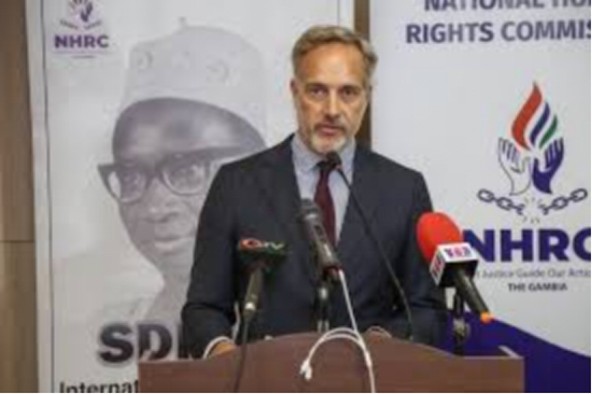
Brigandi stressed that TOC generates both direct and indirect impacts that violate human rights, citing violence, forced labour, sexual exploitation, and corruption, all of which weaken the rule of law.
“Ultimately, the consequences of this criminality undermine the human rights of the most vulnerable – particularly women, children, and migrants, those who too often go unheard,” he said.
He emphasised that the EU believes responses to TOC must go beyond law enforcement, adopting a holistic approach grounded in human rights, the rule of law, transparency, and accountability.
“That is why we are proud to support the ENACT initiative not only as a security response, but as a catalyst for institutional reform and rights-based policymaking. Today’s dialogue marks a transition – from reflection to action, from identifying gaps to closing them, from dialogue to concrete policy direction. The recommendations emerging from Banjul must not end in reports; they must travel, as planned, to Arusha and Addis Ababa, to inform African Union legal and institutional responses.”
Brigandi further underscored the importance of gender considerations, noting that women and girls are disproportionately affected by human trafficking, sexual exploitation, and the breakdown of protection perpetuated by TOC.
Salan Gibbs, Programme Manager at the African Centre for Democracy and Human Rights Studies (ACDHRS), described the event as “apt and timely,” adding that Banjul was a fitting venue given the African Commission’s role as guardian of human and people’s rights.
She highlighted the role of civil society throughout the ENACT programme: “The NGO Forum has stood as a vital bridge between the lived realities of African communities and the formal mechanisms of the African Commission. Civil society voices, community experiences, and survivors’ perspectives have been channelled into continental human rights discussions, ensuring that policy debates remain grounded in reality.”
Eric Bizimana, Senior Legal Officer at the African Commission on Human and People’s Rights, noted that TOC is now widely recognised not only as a security or criminal justice issue, but as a persistent driver of human rights violations across Africa.
“While the African Charter was written in a different era, its principles are timeless. TOC is the new frontier of human rights violations. We have moved past the debate of whether TOC is a human rights issue – we have proven it is. Now our task is to ensure that the Commission’s oversight tools, from state reporting to urgent appeals, are sharpened to meet this threat.”
Dr Feyi Ogunade, Regional Organised Crime Observatory Coordinator for West Africa and convener of the event, recalled his years working within the African human rights system.
“Every single transnational organised crime in the world, without question, violates a key principle of the African human rights system and the African Charter,” he said.
He admitted it took years for institutions such as the African Union to recognise the link between TOC and human rights violations.
Ogunade pointed to trafficking in persons, migrant smuggling, and illicit financial flows as clear examples of this interconnection. He cited Libya as a “quintessential example” of the devastating consequences of migrant smuggling, where people have even been sold as slaves.