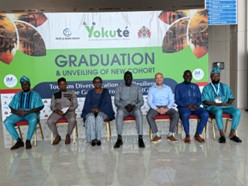
The Government of The Gambia, in partnership with the World Bank, yesterday awarded matching grants totalingUS$1,235,641 to beneficiaries of the third cohort of the Yokuté Accelerator Program, while officially launching its fourth cohort to strengthen local businesses and expand economic opportunities in the tourism sector.
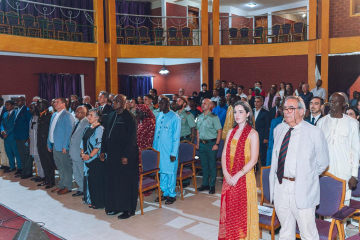
The ceremony, held under the Tourism Diversification and Resilience in The Gambia Project (TDRGP), celebrated the graduation of 60 micro, small and medium-sized enterprises (MSMEs) following six months of training, mentorship and business development support at the Sir Dawda Kairaba Jawara Conference Center (SDKJCC).
The Yokuté Accelerator is implemented under the TDRGP, funded by the World Bank through the International Development Association (IDA). The 3 - 5-year intervention aims to build the capacity of more than 200 tourism-related MSMEs.
The program provides training, coaching, mentorship, investment-readiness support and access to matching grants to help enterprises grow and establish stronger commercial partnerships within the tourism sector.
Tourism, Arts and Culture Minister Abdoulie Jobe said 40 per cent of the third cohort comprised women-owned or women-managed businesses, highlighting the program’s contribution to women’s economic empowerment and inclusive growth.
The fourth cohort comprises nearly 40 MSMEs and will benefit from similar capacity-building support aimed at improving business management, investment readiness and commercial relationships within the tourism value chain.
Speaking at the ceremony, Jobe commended the World Bank Group and the International Development Association (IDA) for financing the project, saying the initiative was equipping local entrepreneurs with the skills, management capacity and financing needed to become more competitive and resilient.
He urged graduating businesses to use the matching grants for their intended purposes and apply the knowledge acquired to expand their operations, create jobs and generate lasting economic benefits.
The minister also called on entrepreneurs and stakeholders to develop ideas for sustaining the program’s achievements beyond the project’s lifespan.
Momodou Ceesay, project manager of the TDRGP, said the Yokuté program had exceeded several of its performance targets and was helping businesses strengthen their operations and establish contractual relationships with major tourism operators, including hotels and tour operators.
He cited the growth of businesses supported under previous cohorts, including Kaba-girl, which has expanded its domestic market and exports to Europe and America, and Chef Bojang’s Spice Hub, which is developing into a restaurant chain.
Ceesay also highlighted other beneficiaries whose company developed and could help tourism businesses address electricity challenges.
He said the program had conducted business diagnostics on more than 500 tourism-related MSMEs, helping identify their challenges, growth opportunities and investment needs.
The initiative has also extended its reach beyond the traditional coastal tourism areas to businesses across the country’s regions.
Washington Koech, IBF project manager, said that more than 1,000 MSMEs had applied to participate in the program, while approximately 529 businesses had undergone diagnostic assessments.
He said the four cohorts included 62 businesses in the first, 64 in the second, 60 in the third and nearly 40 in the final cohort, reflecting strong demand for business development support among Gambian entrepreneurs.
Koech stressed that the program’s long-term success would depend on whether participating businesses could sustain their growth, improve competitiveness and create employment after the intervention ends.
World Bank representative Rafael Pardo said the programme was designed to ensure that more of the economic benefits generated by tourism reached Gambian businesses and communities.
He said stronger links between hotels, tourism operators, local producers and service providers would help increase local sourcing and strengthen the wider economy.