The Social Security and Housing Finance Corporation (SSHFC) has been quietly reinventing how it serves Gambians. My findings indicate that the Corporation is now on the verge of launching the pilot phase of its Informal Sector Social Security Scheme, known as Taye Sama ("today and tomorrow" in Wolof and Mandinka) — the first time in its more than four-decade history that SSHFC will extend social security protection beyond the formal workforce.
The idea took shape after SSHFC's Managing Director attended the International Social Security Association (ISSA) forum at the World Social Security Forum in Morocco in 2022. He returned with a concept for adapting international best practice to Gambian realities. Management endorsed it, the Board approved it, and in August 2023 a Technical Taskforce and a Governance Team were constituted to take it from concept to implementation. The Technical Taskforce was directly supervised by the Managing Director.
Three years on, the result is a fully developed, soon to be field-tested with Board-approved pilot programme — designed, built and to be deployed by SSHFC's own staff.
Why the informal sector pilot matters
For over four decades, SSHFC has concentrated its services on the formal employment sector. Yet that sector is only a small slice of the Gambian workforce. The Taye Sama pilot addresses three strategic priorities at once.
1. Inclusion of the vulnerable and marginalized
According to GBOS 2026 statistics, the informal sector accounts for 85.8%% of The Gambia's workforce. At most, 14.2% of workers are covered by formal social protection, leaving the vast majority — market vendors, farmers, artisans, transport workers — without a safety net in old age, illness or hardship.
UN Sustainable Development Goal target 1.3 calls for universal social protection coverage by 2030. The Government has committed to extending coverage to the informal sector through the National Social Protection Policy 2025–2035, but practical interventions on the ground have been limited. Taye Sama is designed to turn that policy commitment into real coverage, and it places SSHFC at the forefront of the national agenda.
2. Strengthening the Fund for future generations
SSHFC is planning well ahead to secure its pension fund for the long term. As with any well-established pension scheme, more members are now reaching retirement and drawing the benefits they have earned over a lifetime of work. Growing the contributor base today keeps the Fund strong for current workers and for the retirees of tomorrow.
Management is pursuing a forward-looking strategy to broaden and diversify the Fund's income:
• Extending coverage to the informal sector — bringing the majority of the workforce into the contributor base and lifting contribution revenue.
• Pursuing offshore investments — earning foreign-currency returns that hedge against Dalasi depreciation.
• Land banking — strategic land acquisition for long-term capital appreciation.
Of these, the informal sector scheme is the most transformative. By opening membership to the 85.8% of Gambians who work outside formal employment, it extends the Fund's reach to the majority of the workforce for the first time.
3. A cascading impact on the wider economy
The scheme cuts across the mandates of several ministries, including Agriculture, Gender and Social Welfare, Trade and Employment, Finance, and Transport and Works. Its potential reach goes well beyond pensions.
Consider women in market gardening, the pilot's priority group. A structured savings mechanism lets them reinvest in and scale up production. With improving roads, that produce can reach urban markets more efficiently, and surplus can be exported to Europe through the ACC3-certified cargo complex at Banjul International Airport.
The ripple effects are significant: less dependence on imported food, higher export earnings, and new demand for transport, storage, processing, packaging and retail. That means jobs for young people and women — and viable livelihoods at home that can help reduce irregular migration, the "backway". Over time, these effects could support a stronger Dalasi and lower inflation, while building a broader and more resilient contributor base for the Fund.
Above all, the scheme promotes gender balance and strengthens the financial security of women, many of whom carry the cost of their children's education. And it is built to scale nationwide.
Made in The Gambia: an in-house scheme and IT system
What sets Taye Sama apart is that it was built entirely in-house. No international consultancy designed it; SSHFC's own staff did, over three years of sustained work that often ran into weekends.
The team's output covers the full journey from idea to launch:
• A nationwide baseline survey, which found that 99% of informal sector respondents are willing to join a social security scheme.
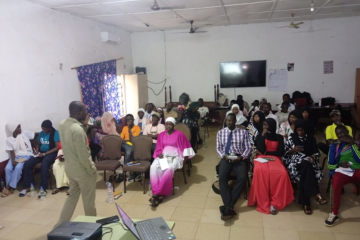
• Countrywide consultations, with the team crossing the country more than six times, including dedicated engagement with women horticultural gardeners.
• Benchmarking study tours to Ghana's NPRA Tier 3 voluntary scheme and Kenya's NSSF "Haba Haba" product, with lessons adapted to Gambian conditions.
• Backing from a broad coalition of partners — the World Bank, EU, UNDP, ILO, UNICEF, IMF, WFP, NSPS and NaNA — with the initiative strongly endorsed at an IMF-convened partner coordination meeting.
• The Informal Sector Framework was developed by SSHFC inhouse and validated by United Nations Development Programme(UNDP) andNational Social Protection Agency (NSPA) at the technical level.
A top-notch, home-grown IT system
The centerpiece is the Taye Sama IT system, formally the Informal Sector Management Information System (ISMIS). Under the strategic direction of Managing Director Saloum Malang, Management chose to develop it internally rather than procure it from an external vendor. The result is a digital-first platform on a modern, secure and scalable architecture, with its key features already in operation:
• Offline-first registration, so field staff can enrol members where there is no internet connection
• Wave Mobile Money integration for contribution payments
• Instant payment receipts via WhatsApp and Members Portal
• A member self-service portal showing balances, savings and benefits and full statements in real time
• Flexible contribution options for people with irregular incomes
• Automated contribution and arrears tracking
• Data analytics, dashboards and reports to support management decisions
A dedicated website for the scheme has also been built in-house.
The system was presented to Senior Management on 1 April 2026 and has since been tested in the field, covering registration, payment integrations and user adoption. Management assesses it as stable, well aligned with operational needs and ready to progress toward national rollout. Because it was built by people who sat through the consultations and mapped the business processes themselves, it reflects how informal sector workers actually live and earn.
Millions of Dalasis saved
Building in-house has delivered substantial savings. Procuring a system of this kind through a conventional external contract is benchmarked at over US$600,000, or more than GMD 40 million. The in-house system has cost a small fraction of that, an indicative saving in the tens of millions of Dalasis.
The same approach applied to designing the scheme itself. SSHFC estimates that outsourcing that work to external consultants would have cost at least US$700,000, roughly GMD 51.8 million. That estimate is based on a comparable consultancy in Ghana in 1997, so the figure at today's rates would likely be far higher.
Instead, those millions stay with the Fund, and the Corporation has gained something no consultant could leave behind: a pool of Gambian professionals with consultancy-level expertise in social protection design and systems development.
A model for the sub-region
With the pilot about to launch, SSHFC is positioned as a regional leader in extending social protection beyond the formal workforce. Taye Sama shows what a Gambian public institution can achieve when it trusts and invests in its own people: a scheme designed at home, a system built at home, and millions of Dalasis kept at home.
For the 85.8% of Gambians who work in the informal sector, the message is simple. Social security is no longer reserved for the few — it is coming to the market stalls, the farms, the workshops and the entire informal sector workforce. (Advertorial)
Lamin Sidibeh writes on public sector innovation and social security in West Africa.